by Brenda Roger
I am just back from the PennWriters conference in Lancaster, Pennsylvania. I won’t be giving a detailed report, as I have not finished processing some of the information. My reason for attending was two-fold; to get some specific information on craft and to find out more about the process of selling a manuscript.
The message from the industry is that they will only buy what they can sell gobs of in Target, Costco, Barnes & Noble and Borders. That is disappointing, but it explains why most of the books that I buy have to be special ordered, and why I like to go to Mystery Lover’s Bookshop and ask the staff there to help me select books. It also explains why I don’t watch much television, and I only go to the movies about twice a year. There are no new ideas and everything is driven my mass consumption.
My rant about boring consumer goods could go on, but I have to hurry and post this so I can bid on twenty-year-old skirts on e-bay in an effort to have something interesting to wear this summer.
If you are lucky enough to sell your work, you will get a very small payday and the marketing of the book is pretty much up to you. Hmmm. Tell me again why you need to use a large publishing house?
Perhaps the most exciting thing about the weekend was when my roommate taught me how to read a racing form. I’m not a gambler by nature, but I love to watch horse racing. I took up riding about eighteen months ago, and once you have experienced the power of the animal it is intoxicating to watch them run at top speeds. The language on a racing form is like poetry. There are phrases at the end of each entry that say things like, “stretch duel, driving,” or “wide, steady urging.”
Other than discovering that horsemen are poets, I don’t think I garnered much good news from the weekend. The information about the publishing industry being very narrow minded is useful, however, because both of my concepts could be re-packaged as something other than a commercial book. A new direction may be called for.
Who else went to the conference? How are you feeling about things?
Monday, May 19, 2008


Saturday, May 17, 2008
What If?
by Brian Mullen
I absolutely LOVE alternative histories. I have a pile of them I'm waiting to read and a few audiobooks I've managed to listen to in my vehicular travelling.
If you're not familiar with the genre, here's the premise in a nutshell. Select a fundamental event in history (say the American Colonies winning the Revolutionary War) and imagine what would have happened had the event occurred in some other way (i.e. we lost). How would the world be different? Write a story set in that reality.
One of the greats of alternative histories has got to be Harry Turtledove. I have, though have not yet read, "The Guns of the South" in which time travellers, hoping to alter history to their benefit, travel back to the American Civil War and supply the Confederates with automatic weapons. It's first on my "To Read" list.
The next one I have is titled "Pavane" by Keith Roberts and is based in a world where the Spanish Armada defeated the British Navy.
But the one that had initially captured my imagination is called "For Want of a Nail" by Robert Sobel and is the example I began the blog with. The British win the Revolutionary War and those unwilling to continue to live under British rule move...and create the United States of Mexico. The book itself is not really a novel but rather a fictitious history text book detailing the tumultuous history of these two countries including charts and appendices, quotes and speech excerpts, even footnote/references from where the information had supposedly been gathered.
It's fun to wonder "What If?" and imagine that the course of history could be significantly different over a single detail. I have long, long, long term plans to write such a story though I must admit my alternate histories will rely much more on imagination than on any real understanding of history. But, then again, that's what makes it fun in my opinion.
Friday, May 16, 2008
The World Is Too Much With Me
by Cathy Anderson Corn
My first writer’s group was spawned from a Community College course in creative writing led by teacher Linda Blahut. We took Linda’s class several times, and then some of us gracefully retired to first Linda’s, and then classmate Eleanor’s home for our sessions.
Class continued with tremendous benefits. We weren’t a high-powered, let’s-get-published group. We each read some work in progress and critiqued it, but mostly admired each person’s literary contributions. We supported each other through divorce, sickness, and death, so I guess you might say we were a social group; yet our group helped me keep writing, keep questing for a career then beyond my grasp.
Linda, the teacher, was married with teenage children. Eleanor, a fiercely independent lady who walked with a cane, had survived two marriages and lived with Charley, an energetic, loving spaniel. Ginny, widowed, treated me to dinner and an evening in her hot tub. Roy, a Vietnam vet, had divorced and shared custody of a young daughter. And my friend Vesta confessed to childhood scars, filled dressers with her unpublished novels to handle her angst. She didn’t know how to end her stories, so the protagonist ultimately got run over by a bus.
But the words of Angie, the psychologist of our group, still ring in my memory. Many times we of the circle would read and Angie’s turn would come. She’d look over her dark brown-framed glasses, throw up her empty hands, and apologetically announce, “The world has been too much with me.”
Lately, I’ve been thinking of Angie as I struggle to produce pages, to forge ahead with my novel. Some years I pumped out pages like water from a well, but this hasn’t been one of those years. The well hasn’t run dry, it just trickles at times.
I remember Angie’s words as I plug along and try to keep my project flowing. I would have liked to attend the Pennwriters Conference, but again, the world stepped in and I’m going to a Craniosacral Workshop instead (to expand on my non-writing job which pays the bills).
So, fellow bloggers and readers, has the world been too much with you lately? How do you cope with the rigors of every day living and still produce your works? What distractions in your life cause you to veer off your path to the Pulitzer Prize?
But most of all, anybody out there, or are you all at the Pennwriters Conference? Hope you’re having a great time.
Thursday, May 15, 2008
The Secret Life of a Writing Mama
by Kristine Coblitz
Five months ago, I took on the most difficult and rewarding job of my entire life. In this job, I was given no training. No hands-on workshops or seminars to prepare me for my duties. In this job, success is measured by whether or not I can make it to the following day without having an emotional breakdown. In this job, my boss is someone with even less experience than I have, who expects me to get the job done without excuses. She expects long hours, even on the weekends, and doesn’t tolerate sick days. On the day I started, I had to agree to a lifelong contract.
I became a mom.
In addition to being a mom, however, I am also a writer. I like to refer to myself as a “Writing Mama” because for me, the two jobs are not mutually exclusive. In my life, one goes with the other.
But not everyone will agree.
I read a blog recently that discussed the movie industry’s portrayal of mothers who are writers as being narcissistic and emotionally distant. It’s even written that Daphne du Maurier, the acclaimed author of Rebecca, “could be aloof and distant to her children” when immersed in her writing. The media has painted a generalized picture of writing moms as troubled women who are so wrapped up in the non-reality of their writing that they are unable to raise their children in a normal, functional way.
Hmph! Being normal is overrated, if you ask me.
When I was pregnant, I had more than one person tell me that with the birth of my child would come the death of my writing career. “It can’t be done,” they would tell me. “It’s either one or the other. You can’t have both.”
Once again…Hmpf!
Granted, my life transformed dramatically after my daughter was born, and I wasn’t exactly prepared for the changes. The first few months, my life was consumed with learning how to care for the little person who had invaded my life and my household. I didn’t write a word. I was too busy and too sleep deprived to even remember my name. I didn’t want to accept that the naysayers were right, but I started to doubt my ability to balance my parenting duties with my part-time technical editing job (which I need to pay for all those diapers and cans of formula), my marriage, and also my writing.
But then something happened. After about two months, I found myself getting irritable and moody, and it wasn’t just the surge of post-pregnancy hormones. Something was missing.
I had to write. But how?
I realized that I could squeeze in some writing time after my daughter and hubby went to bed. I was suddenly spending an hour every night at my computer when the house was quiet, and suddenly something amazing happened. My mood lifted. I felt like myself again.
Being a writer has helped me become a better mom, and being a mom has helped me become a better writer.
Five months into my new job as a writing mama, and I’m still going strong, averaging about three to five manuscript pages a night, even on those nights when I just want to climb into bed and pull the covers over my head. I’ve learned how to unplug the Internet and close my eyes to the dirty dishes in the sink, the last pile of laundry, and the dusty furniture, and just write. Even if the writing stinks (which it usually does).
For that one hour, I’m not just a mom. I’m a Writing Mama.
Happy Belated Mother's Day to all the Writing Mamas out there.
Wednesday, May 14, 2008
Citizens' Police Academy: Bomb Squad
By Annette Dashofy
Citizens’ Police Academy this week was a real hands-on experience. Maybe a little TOO hands on. But I’ll get back to that in a minute.
The topic was “Recognizing the Explosive Threat” and our instructors were Detectives Andre Henderson and Sheldon Williams of the Bomb Squad. Class began with a Power Point presentation and lecture.
The Pittsburgh Police Bomb Squad has four certified EOD (Explosive Ordinance Disposal) techs and a support system of eight. And one BULLDOG. Last year, they answered 51 class one calls. That’s a call that consists of some type of suspicious item or package. A class three call is a bomb threat. Eight of those 51 calls involved actual IEDs and four of them were simulated devices.
There are two common types of IED (Improvised Explosive Device): Non electric such as pipe bombs AND electric which are more complex and include explosives, a power source such as a cell phone or a batter, wires, and an initiator.
Another threat that you may not think of is the media. Specifically, live television feeds. Imagine this scenario: A suspicious package has been identified and the bomb squad called in. A live news truck sets up shop and reports broadcast that the area has been cleared and the bomb squad is going on. Meanwhile, down the street, the bomber is watching all this from the local K-Mart. He watches as the EOD tech approaches his package, places a call on his cell phone and…BOOM.
Okay, what should YOU do if you find a suspicious package that might be a bomb? RAIN.
Recognize the threat
Avoid it.
Isolate the hazard (clear the area)
Notify the appropriate resources and authorities
Do NOT use your cell phone to make the call. Phones and pagers might set the bomb off. Use a landline OR move AT LEAST a football field away before calling on your cell phone.
Then we watched a video on the Redstone Arsenal in Huntsville, Alabama, the only bomb squad school in the country that’s recognized by the FBI.
And, finally, back to that “hands-on” stuff.
Our class broke into two teams. One team headed to the “kill room” while my team were introduced to BULLDOG, the robot. Named after a former bomb squad member, the robot is an impressive-looking piece of equipment that takes a large portion of the risk away from his human teammates. BULLDOG (Bomb Urban Logistics Landmine Disposal Ordinance Guru) operates via fiber-optic wires and can be driven from a control board into a hazardous area to do certain tasks. Humans do ultimately need to go in and perform the hands-on work of handling the bomb, but BULLDOG can sometimes disable the threat or can at least help determine how much of a threat there really is.
BULLDOG has a very firm handshake. I can vouch for that fact as I somehow was “volunteered” to offer up my fist to be gripped by the robotic hand. However, his grasp only applies about 40 psi, so the operator must use extreme care in HOW a package is picked up, as it can (and has) slipped out. Dropping bombs is not good.
And my hand survived.
Next, the class teams swapped and we took our turn in the “kill room” where we were expected to locate and call out potential threats. Most were obvious. The hand grenade, the landmine, the sticks of dynamite. But the small motion detector with the blasting caps would have taken us all out.
One of the main points the detectives wanted us to “get” was that a bomb can be anything. Look around your own house. Hydrogen peroxide plus fingernail polish remover plus citrus fruit equals bomb components.
Back in the kill room we continued to look for suspicious packages, knowing that a bomb can look like anything. Another point that was stressed is to look for what does not belong. Like the homeland security book sitting on the table in the Hazelwood Presbyterian Church. THAT was the final bomb in our kill room. It was a hollowed out book that contained the IED.
To wrap up this week’s report, let me offer a couple of terms the insiders use. An explosion is called a “high order.” A fizzle is called a “low order.” The bomb squad aims to keep those high orders to a bare minimum.
Next week: Crime Scene Investigation
Tuesday, May 13, 2008
I Meant to do That
by Kathryn Miller Haines
 You know what an actor’s nightmare is, right? It’s when it's opening night and you’re in a play that you’ve never seen a script for. And sometimes you're not wearing pants. I always imagined that a writer’s nightmare would be that a book of mine would go to press with mistakes. Not a missed comma here or there, but an obvious error I made and didn’t catch.
Well it happened to me. And I feel like a complete moron.
I’m not going to tell you what the error is in hopes that you’re a part of the reading population it won’t matter to. I would love to blame this on my editor. Or my copy editor. Or my critique group. Or my husband (when in doubt, he’s a marvelous scapegoat). But it’s nobody’s fault but my own.
How did it happen? I’m a fast writer and sometimes, rather than verifying a detail, I plug something in thinking I’ll go back and change it later so that I don’t interrupt my flow. In this instance, I used a placeholder and then forgot about it because…well….because there were a thousand other details in my mind that I needed to attend to. And I’m an idiot. As I read draft after draft what should’ve stuck out like a sore thumb, insidiously wedged its way into the text and became a legitimate part of the story.
Someone else caught the error, the last person I’d want to have pointing out my mistakes, but by that point the book was on its way to the printer and it was too late, and too expensive, to do anything about it.
My editor assures me this happens with every book. In fact, there’s even a website devoted to it, where I find myself in the illustrious company of Dan Brown, J.K. Rowling, and Steven King. In truth it’s a small thing. A single detail. A poorly chosen word that would only rip certain people out of the story and temporarily at that. But I’m one of them and that sucks. This will always be The Book with the Mistake in It.
I’ve mourned the error the way you mourn a fresh scar you know won’t go away. I know it could be much worse. I could’ve been caught plagiarizing scholarly research on black-footed ferrets. I could’ve carefully created a murder scene that so closely mimicked a real life crime that the authorities realized that there was a very good chance I had actually murdered someone. I could’ve erroneously called my book a memoir. I could’ve accidentally inserted a block of text from personal correspondence that revealed my long-standing love of prostitutes and how for years I’ve been client number 9 at a well-known brothel. In the grand scheme of things this is tiny.
When I screw up on stage I try to make a bit out of it. Let the audience know I know I messed up and share -- rather than suffer-- the laughter. You’ll leave them wondering if you didn’t intend to do it all along. I made a decision to do something similar with this mistake. I've reclaimed it. It’s part of the story now and by golly I’m going to do something with it.
But you better believe I've gone over ever manuscript since with a fine toothed comb.
So hit me with your best mistake -- writing or otherwise. How'd you make lemonade of that lemon?Monday, May 12, 2008
MIND LIKE A STEEL SIEVE
by Gina Sestak
YIKES.
I seem to have forgotten that it's my turn to blog today.
I have nothing prepared, so I propose to open this up for questions. What would anyone like to know about:
me?
my published and (mostly) unpublished work?
the courses I'm taking through the City of Pittsburgh Dept. of Police, the University of Pittsburgh Osher Institute, and the Pennsylvania Bar Institute which include:
current:
Citizen's Police Academy
Irish Dancing
French
Acting
recent (this year):
Daniel Day Lewis films
Coming of Age on the Silver Screen (films)
Fused glass object making
Public Utility Law
Unlocking Creativity
Bird watching
I also spent part of Saturday at the Meadowcroft Rockshelter, which is the oldest known site of human habitation in North America. Oh, and I folk dance and participate in a dream study workshop (as well as being an active member of the International Association for the Study of Dreams).
Ask away.
Friday, May 09, 2008
Dinner with the Boys
by Lisa Curry
One hears how important the family dinner is to the wellbeing of children, especially during adolescence. We’re told that teens whose families make time to sit down and eat dinner together on a frequent, consistent basis are less likely to do drugs and get into trouble with the law.
Back in the days when I freelanced at home or worked part-time and spent lots of time with my kids (sometimes more than my mental health could bear), I didn’t think much about the importance of family dinners. But now that I work full-time and dinner is often the only occasion during the work/school week that my husband and I and our two boys, ages 8 and 10, are all together at once, I value that time to touch base, reconnect, and find out what’s going on in my kids’ lives.
At one recent dinner, I asked my younger son, Sean, about his day at school.
“Mrs. Cox hurt her back and had to leave, and guess who we got for our substitute,” he said. “Nurse Razzano. She’s mean!”
I’d never heard of a school nurse being called in to substitute for a teacher, but perhaps she’d been the best the school could do on little to no notice.
“She’s not that bad,” my older son, Griffin, said. “She loves my hair.”
Griffin has long, wild, curly locks, thanks to DNA inherited from yours truly and the fact that he’s refused to have it cut for the past year.
He added, “She tells me how much she loves my hair every time we have a head-lice check.”
Nice.
At another recent dinner, I asked Griffin about his day. “Did you go outside for recess, or was it raining?”
“The boys went out, but the girls weren’t allowed.”
“Did the girls do something bad?” I asked.
“No, they had to have a talk about menstruation.”
Probably another of Nurse Razzano's many duties, along with head-lice checks and occasional emergency substitute teaching, I thought.
“What’s menstruation?” Sean asked.
“I’ll tell you what it ISN’T —” my husband said, “— appropriate dinner table conversation!”
Sometimes he’s funnier than the kids. “We’ll talk about it later,” I said.
After we’d eaten and their squeamish father left the table, I explained the menstrual cycle to the boys and answered other questions they posed about the facts of life.
Sean, looking thoughtful, announced, “When I grow up, I want to have sex.”
What do you say to that? Myriad possible responses flitted through my mind.
So do most people…
I’m sure you’ll have plenty of it…
Good luck with that… ?
I settled for, “Well, good, that makes you normal.”
Since my boys aren’t adolescents yet, I can’t tell you if family dinners have kept them off drugs or out of trouble with the law. But in the meantime, family dinners can always be counted on for a laugh.
Thursday, May 08, 2008
Rest in Peace, Aulf
by Joyce Tremel
I’m so sick of hearing parents of criminals complain that their “baby” was unjustifiably “murdered” by police officers.
Yesterday in Pittsburgh, an officer shot and killed a 19 year old man who shot and killed his police dog. Two officers and a police dog in a marked police car responded to a report of shots fired. When they arrived at the scene, one of the officers spotted Justin Jackson, who had his hand under his shirt. When he was ordered to show his hand, Jackson pulled out a gun. The canine officer then deployed his dog and Jackson shot the dog in his chest and front legs, fatally wounding him. The officer then shot and killed Jackson. Police Chief Nate Harper stated the dog did what he was trained to do and called the shooting a justifiable action.
I agree.
The dead man’s parents do not. Here’s a quote from the dead man’s father from the Pittsburgh Tribune Review: “"This needs to stop. The police are using excessive force and killing young black men," said the victim's father, Donald Jackson of the West End. "It doesn't make sense, this is terrible, and I want answers."” And from the mother: “"We are not going to let them get away with this!" Anna Jackson screamed. "They will pay for killing my son. They are going to pay for shooting my son over a dog!"”
While I feel sympathetic to the fact that they lost their son, he killed what, by law, amounts to killing a police officer. If Jackson would have showed his hand or put the gun down, the whole incident would have ended differently. Jackson caused his own death by his actions.
Although his father stated his son did not own or carry a gun, according to court records, Justin Jackson did have an arrest record for firearms violations, assault, and criminal conspiracy.
The Pittsburgh Police Department is flying the flag outside headquarters at half-staff and some officers are wearing the symbol of mourning—a black band over their badges. They are mourning a fallen officer.
There will be a thorough investigation of the incident by the Allegheny County District Attorney’s office, but I’m sure they’ll come to the right conclusion. While certainly tragic, the shooting was justifiable.
Wednesday, May 07, 2008
Citizens' Police Academy: Terrorism and Gangs
Annette Dashofy is currently enjoying a long-overdue vacation with her husband, but sent in the following post on the Citizens’ Police Academy, which she attended before leaving. Gina will be stepping in to answer questions and respond to comments in Annette’s absence.
We had another two-parter this week, beginning with Detective Ashley Thompson’s presentation on CAT Eyes, or Community Anti-Terrorism. It’s a nationwide program developed to eliminate racism and terrorism through educating and empowering the average citizen to defend our homeland against terrorism.
One of the main points Detective Thompson wanted to make was that we should watch for a person’s actions. Not what they look like, but what they’re doing. He asked us to use our instincts. Listen to those gut feelings when you notice someone acting suspicious. And he recommended the book The Gift of Fear by Gavin DeBecker, if you’re interested in personal safety or crime prevention.
The general profile of a terrorist is someone who is intelligent, well educated, obsessed with initiating change. He (or she…not all terrorists are men) is 22 to 25 years old and middle class to affluent. However, remember these are generalizations.
There are two categories of terrorism: Domestic and International. Domestic is US citizen against US citizen and happens ALL THE TIME. Think neo-Nazis, the KKK, black supremacist groups, etc. All extremists are not terrorists…at least not until they commit an act of violence.
International terrorism happens less often here on US soil. And not all international terrorists are from the Middle East.
Terrorists often use a “safe house.” You may notice a few suspicious aspects of such a house. The occupant (the terrorist) will use an outside phone. They pay the rent in cash and won’t permit the landlord or maid inside. They have no furniture, but the space may be filled with lab equipment. There will be strange comings and goings, lots of different people and there will be unusual packages delivered. Occupants keep unusual hours.
If you’re thinking, this sounds like a drug house, you’re right.
Terrorists need to raise funds. Some of their methods to come up with cash are coupon fraud (clipping coupons and cashing them in illegally to a store owner); counterfeit baby formula (watered down formula—this happens more in other countries, not so much here); cigarette smuggling (this brings in BILLIONS of dollars each year in the US); illegal drugs (Afghanistan produces 70 to 90% of the world’s supply of opium); credit card theft/identity theft; and something as simple as fake non-profits. Those canisters in the 7-11 asking for your spare change…do you really know if those are legit charities???
We received so much information in this CATS Eyes Basic Program that I can’t begin to cover it all here. Basically, we need to all keep our eyes open, be alert to suspicious activities, listen to our instincts, and report those activities to the authorities. There may be an ongoing investigation that your input could assist.
If you ever get a chance to take this program, do it. We all need to do our part to protect our corner of the world.
Besides, we got a really cool certificate of completion for taking the program.
The second half of the evening was devoted to the Pittsburgh Police Intelligence Unit and gang awareness. The Intelligence Unit’s role is identification ONLY. Pittsburgh does not have a “gang unit.” And not all of their work is gang related. However, gangs were the topic covered this week.
Pennsylvania doesn’t currently have laws on the books concerning gangs, but they’re working on it.
Gangs started appearing in Pittsburgh in the 1980’s and 90’s in the East End. NOW there are gangs in every neighborhood in the city, with around 1000 identified gang members. In Pittsburgh, unlike the West Coast, gangs are less concerned with territory and more concerned with money and drugs. Here, Crips and Bloods often work together.
Gang identifiers include clothing. They wear their colors: Crips wear blue, Bloods wear red, but they adapt and aren’t stupid or obvious. The red may be a bandana or red shoe laces or belt loops or may be something worn under a shirt. The current trend is an oversized white shirt and baggy pants or t-shirts custom air-brushed with a gang identifier.
Other identifiers are hand signs: non verbal communications in which the fingers are placed in ways to “spell out” the gang’s initials.
There is also the use of slang, but it changes all the times. “Cuz” is currently a Crip greeting. “Geyer” said in a kind of growl refers to the Geyer Street gang in the North Side.
Tattoos are either used by all members of a gang or NO members of a gang.
Graffiti can be used as a warning, to challenge rivals, to put out a contract, or as a sign of respect for a fallen gang member.
Not all graffiti is gang related. A TAG is the most basic and prevalent type. A PIECE is a large, labor-intensive artsy works of graffiti, possibly with 3-D effects. These are almost masterpieces and are sometimes considered museum quality. Then there are THROW UPS, multi-colored and balloon-shaped.
None of these are gang related. Gang graffiti uses symbols, numbers, and characters and may identify a gangs ideology, territory, enemies, or allies.
Here are some of the things you may see and their translation.
OG: Original Gangster
LOC: Love of Crips
MOB: Money Over Bitches or Member Of Blood
CK: Crip Killer
BK: Blood Killer
Crips will mark x’s through their o’s because there are o’s in Blood.
Finally, as a citizen, remember the four R’s of Graffiti:
Read it
Report it
Record it (take a picture)
Remove it (quickly)
I know I won’t drive through the city and look at all that graffiti in the same way ever again.
Next week: Recognizing the Explosive Threat
Tuesday, May 06, 2008
Feeling Nifty at 50
By Martha Reed
Last Friday I celebrated my fiftieth birthday, the big 5-0, and I suppose I shouldn’t let the event go past without writing about it, since writing is what I do. It’s been a pretty funny experience, first off because I’m okay with it, I’ve never felt healthier and I’m very happy where I am in my life, but everyone else seems to be having a bigger reaction to it than I am. It’s making me feel, well, odd.
One of my neighbors, a very nice older woman, saw the black balloon floating outside my door and offered her condolence, asking me how I felt about it. I think I surprised her when I said I felt great. Somehow, I think I’m supposed to be feeling like the end is near and the grim reaper is about to tap me on my shoulder, but honestly I can’t say I feel that at all – I’ve got way too much work to do to think of giving up now.
But fifty is a great time to take a pause and assess your life and your direction. I guess I’m one of the lucky ones – I wrecked my life pretty effectively in my late thirties and I have been rebuilding it ever since, and building it in what I think is a good direction and on a solid foundation. One of the things I’ve committed to is my writing – I’ve written before on how easy it is to get distracted and to go off and spend great swaths of time doing foolish things. Now don’t get me wrong, foolish is fine, in the proper place and at the proper time. Maybe that’s what turning fifty did for me; it seems to have freed me up to say ‘no, thanks’ and to continue on doing what I think is important (to me): the writing.
Two weekends back I did get a little distracted and I drove to Arlington, Virginia, to help celebrate another anniversary: twenty years of traditional mystery at the Malice Domestic convention. Everyone who enjoys traditional mysteries should go to Malice at least once – it’s a three-day merry-go-round of author signings and informative entertaining panels and interviews plus an awards banquet where they hand out the Agathas. I’ve always had fun making sure I read the Agatha entries beforehand so I could pick out my favorite dark horse, and the true surprise of the convention is just how accessible everyone is: I’ve met some terrific new authors just by sitting next to them in The Mez restaurant for lunch or taking a pause in a cozy chair in the lobby. This year introduced me to Nan Higginson with her Agatha nominated short story “Casino Gamble” (http://homepage.mac.com/adept/CasinoGambleMNYS.pdf) and I fell right into a great new series by Beverle Graves Myers, “Interrupted Aria” featuring Tito Amato, a castrato soprano in 18th-century Venice.
 For purposes of disclosure I should mention that something big happened to me at Malice this year, and I have to laugh at it. With all the effort I put into my fiction, with the hours I spend exploring every possible plotline or trying to develop interesting new characters, the hours I spend polishing my prose to be the very best it can be, I finally won an award at Malice XX - for my hat. That’s right, yours truly won the Malice Domestic XX Most Beautiful Hat Contest for my entry “Black and White and Read All Over”. Actually, I don’t really think it was my hat that won, I think it was more likely the pun that won the judges over, and I’m sure there are some serious southern ladies with bigger hats who are a little steamed at me right now, but I’ve made it back north across the Mason/Dixon line and I’m hoping they’ll get over it in time for Malice XXI, because next year, as God is my witness, I’ll be judged for something I wrote!
Monday, May 05, 2008
Syphilis
by Brenda Roger
You’re welcome for that image first thing on Monday morning. I thought it would be an appropriate topic for Monday morning because I spent much of Sunday afternoon thinking about it, but doesn’t everybody?
Actually, I just finished Ross King’s The Judgment of Paris, much of which is devoted to the story of painter, Edouard Manet, who died of untreated syphilis. Naturally, I spent all afternoon planting sunflowers and thinking about syphilis. It’s no wonder that I think my neighbors are boring!
It seemed to me that more than once I’ve read stories about the lives of artists that ended with the artist dying of syphilis, which got me thinking about the history of the disease, which sent me on a quest on the Internet.
I won’t assault you with graphic descriptions of the symptoms of syphilis. We all got enough of that from our high school gym/ health teachers. Thank you, Miss Bott. Think about hearing the word chancre repeatedly from someone wearing track shorts with contrast binding and striped gym socks pulled over her calves. Sadly, the outfit was so much more troubling than STD’s.
Had Miss Bott bothered to mention the social history of contagious diseases, I could have taken my eyes off the tube socks and actually learned something fascinating. For many years, the theory about the outbreak of syphilis in Renaissance Europe was that it was an extra special bonus prize of Columbus’s discovery of the New World. There was a catastrophic outbreak of syphilis in Naples, Italy in 1495. Treatment of syphilis at the time employed arsenic or mercury. Nothing says health and wellness quite like inhaling mercury vapors! Can you imagine?!
Recent discoveries in the field of paleopathology (the study of the history of diseases) call into question the blame shouldered for centuries by Christopher Columbus. Excavation of a site in Kingston-upon-Hull, revealed that the bodies of at least four monks from around 1450, showed signs of syphilitic infection, such as thickening of the lower leg bones. Without further testing, it cannot be conclusively proven that the monks had the type of syphilis that was sexually transmitted. There is more than one disease caused by various strains of the corkscrew shaped bacteria that cause syphilis.
I personally feel that the field of paleopathology is critical to the future of human health, because understanding the natural mutation and spread of disease could have major impact on the future of medicine. I owe my new interest in the field to poor, dear Manet.
What is the status of syphilis now, you ask? Well, in the U.S. in 1943 there were 575,593 reported cases of syphilis, in 2006, that number was down to 36,935. Between 1990 and 2000, the number of cases decreased sharply. That decrease seems to coincide with the safe sex campaigns that were a response to the AIDS crisis. Currently, the highest number of syphilis cases occur in the south, in poor and urban areas. Education and health care are the key. Profound.
Now look around the room at your co-workers. Are you the only one thinking about syphilis? You are welcome again! Happy Monday!
Friday, May 02, 2008
“It”-girl
By Jennie Bentley
I’ve been tagged. By my buddy Kelli Stanley, author of “Nox Dormienda”, for one of those circulating blog-things. Bill Cameron tagged her; now she’s passed the favor on to me. Thanks, Kel. Love ya. Mean it.
And because of that, you, gentle readers, will be treated to six random facts about moi today, instead of the brilliant, well-crafted, well-researched, and well-written blog-post I had prepared. Lucky you.

Random fact #1: A Swedish stripper I once sat next to on an airplane to Europe offered to father my first child. Wilfred the Author claims that it was him. I haven’t met Wilfred yet – to my knowledge – so for all I know it could be true. He told me his name was Freddy, which makes a certain kind of sense, now I think about it.
 Random fact #2: I’m horribly afraid of bugs. You might even call it a phobia. It’s the legs. And it’s severe enough that the picture you’re looking at freaks me out. Many are the times I’ve stood in a corner of the shower, clutching the shower curtain around my palpitating (and wet) body, shrieking myself hoarse because a cricket has made it into the bathroom. And no, I can’t bring myself to go close enough to kill them. Hence the shrieking for help.
Random fact #3: I mix up my rights and lefts. It’s left over – no pun intended – from a stint I did as a tour guide for one of our local tour companies awhile back. I spent a couple of years standing at the front of a tour bus with my back to traffic, gesturing with my right hand, saying, “On your left...” That kind of thing can’t help but leave scars.
 Random fact #4: In my New York acting days, I had a buddy who was a regular on the Cosby Show. He invited me to visit the rehearsals and meet the cast, and I got to spend an afternoon speaking Norwegian with Earle Hyman, who played Russell Huxtable, Bill Cosby’s dad, on the show. He owns a vacation home on the western coast of Norway, and he has been performing in Norwegian – as well as Swedish and Danish – theatre longer than I’ve been alive. In Norwegian, Swedish and Danish, no less! (I also met the rest of them, of course, but Earle was by far the most fun.)
Random fact #5: In addition to English and Norwegian, and of course Swedish and Danish, I speak German and French. Once upon a time I was fluent in all of them; these days I remember just about enough to ask for directions and order food and just generally survive if dropped into the middle of Paris or Bavaria. But given that English is a second language for me, and I’ve somehow managed to dupe an agent and an editor into believing that I handle it well enough to deserve a multiple-book contract, I don’t think I’m doing too badly.
Random fact #6: I had something else here, but since I just found out this week that my essay/article “Confessions of a History B(L)uff” has made it into the latest issue of Mystery Readers Journal, History Mysteries II, I’ll make that my last random fact instead. I’m published. Yay, me!
And that rounds out my random facts. Brace yourselves. Here goes:
Wilfred Bereswill
Allie Hollister
Lisa Stiles
Andy Peterson
Grant McKenzie
Mary Kennedy
You’re IT!
Here are the rules:
Link to the person that tagged you – that’d be me.
Post the rules on your blog, like I’m doing.
Write six random things about yourself in a blog post somewhere.
Tag six people of your own.
Let the tagger – in this case me – know when your entry is posted.
Good luck, y’all!
PS - I won’t be here next time; I’ll be on a plane to Europe. This time Wilfred will not be in the next seat, calling himself Freddy or anything else; he’ll be here covering for me. That’s right, folks, Wilfred the Author himself will be coming to you live on Friday, June 6, right here on the Working Stiffs, to talk up the release of his first book, A REASON FOR DYING. Don’t miss it!
Thursday, May 01, 2008
Tickets & Stuff
Today's post is a reprint of an article that was published in the Pennsylvania Chiefs of Police magazine a few years ago. Officer Funtal's Traffic Camp is coming up in a couple of weeks and I thought this might be a good time to tell everyone about the program.
by Joyce Tremel
Initiated during the 2000-2001 school year, Tickets & Stuff appears to be working. The program is unique in that not only are violators given citations, but good drivers are rewarded. Funtal likes the idea of the positive reinforcement this gives the kids. “Too often the focus is on the bad kids,” he said. “We wanted to do something for the kids who do the right things.” The good drivers are identified at school, where they are notified and given a chance to be in a drawing held at the end of the school year. Prizes such as restaurant gift certificates, CDs, and car stereos are given away. Funtal receives donations from many of the area businesses and civic organizations.
There is some good news for the violators, too. Any teenage driver given a traffic citation can plead their case before District Justice Robert Dzvonick, who may dismiss the citation, provided the violator attend Funtal’s traffic camp, which is the main part of the program. The traffic camp is held on a Saturday in May, but it has become increasingly popular and might be held twice a year in the future. Word of mouth has spread so much that parents are calling to sign up their teens even if they haven’t been cited.
 The Tickets & Stuff traffic camp is an all-day interactive event held at the Shaler Area High School. The kids are given breakfast and a fast-food lunch. The first part of the camp features guest speakers. In the past, Magistrate Bob Dzvonick discussed criminal aspects of the law, and an insurance agent from State Farm Insurance informed the students about what tickets and accidents can do to one’s insurance rates. An attorney discussed the civil aspects and liabilities and what could happen if they or their parents are sued, which most of the teens had never even considered. One of the speakers who had a strong impact on the students was a young accident victim who will spend the rest of his life in a wheelchair. His talk seemed to reinforce the idea that they (the teens) are not invincible, and that it could happen to them, too. Another speaker who brought tears to the eyes of many students was the father of a teenage girl who was killed in a motor vehicle accident. Some of these speakers return every year.
In the next part of the camp, the students participate in interactive skits, then are shown a slide show featuring music with slides of serious accidents. Funtal hopes that there is a subliminal message in the slide show; that whenever a student hears the song on the radio or on a CD, they’ll picture the image on the slide.

After all the fun is a test, then each student receives a certificate of completion. The kids also get to fill out an evaluation form and they don’t have to sign their names. So far, all of the evaluations have been positive and most of the students say the class made them aware of things they had never thought about before. They all state that they’ll drive more carefully, which seems to be holding true. Very few students are repeat offenders after participating in the traffic camp.
Anyone who is interested in learning more about the program can contact Officer Carl Funtal at the Township of Shaler Police Department.
by Joyce Tremel
Imagine for a minute that you are seventeen years old. It is 6:45 a.m. and you are driving to the Shaler Area High School. Your favorite CD is playing and you’re tapping your fingers on the steering wheel in time to the music when all of a sudden you hear a siren behind you. You look in your rear view mirror and see a police officer on his motorcycle, his lights flashing, motioning you to pull over. Panic sets in, your gut tightening up like someone squeezing it with a rubber band. Your thoughts flash as quickly as the lights on the motorcycle, wondering what you did wrong. You thought you were obeying all the traffic laws. Why is he pulling you over?
You pull your car over to the side of the road, watching while the officer gets off his bike and heads toward your car. Your mouth goes dry when you see the size of the officer. He’s over six feet tall and muscular, and he looks mean! You swallow hard and try to remember how to breathe. When you look up, he’s at your window with a big, friendly smile on his face. You squeak out a hello.
"Hey, man, I just wanted to congratulate you on following all the traffic safety laws!” he says in his booming voice. He briefly explains that he’s started a program that rewards drivers for following the traffic laws. Relieved, you are soon back on your way to school.
The above scenario is fiction. Although many police officers might like to hand out good news on occasion instead of citations, in Pennsylvania a driver needs to violate one of the motor vehicle laws for a traffic stop. It is doubtful that the above driver would complain, but Officer Carl Funtal of the Township of Shaler Police Department doesn’t take any chances. Instead he notes the registration number on the plate to find the identity of the good driver.
In Shaler Township, a community of thirty-one thousand residents located north of the City of Pittsburgh, rewarding good drivers is part of the Township of Shaler Police Department’s Tickets & Stuff program. Several years ago, due to an increase in the number of teen driving fatalities in the northern suburbs, Chief Jeffrey Gally asked Officer Carl Funtal of the Traffic Division if he could come up with a program to educate young drivers.
Initiated during the 2000-2001 school year, Tickets & Stuff appears to be working. The program is unique in that not only are violators given citations, but good drivers are rewarded. Funtal likes the idea of the positive reinforcement this gives the kids. “Too often the focus is on the bad kids,” he said. “We wanted to do something for the kids who do the right things.” The good drivers are identified at school, where they are notified and given a chance to be in a drawing held at the end of the school year. Prizes such as restaurant gift certificates, CDs, and car stereos are given away. Funtal receives donations from many of the area businesses and civic organizations.
There is some good news for the violators, too. Any teenage driver given a traffic citation can plead their case before District Justice Robert Dzvonick, who may dismiss the citation, provided the violator attend Funtal’s traffic camp, which is the main part of the program. The traffic camp is held on a Saturday in May, but it has become increasingly popular and might be held twice a year in the future. Word of mouth has spread so much that parents are calling to sign up their teens even if they haven’t been cited.
 The Tickets & Stuff traffic camp is an all-day interactive event held at the Shaler Area High School. The kids are given breakfast and a fast-food lunch. The first part of the camp features guest speakers. In the past, Magistrate Bob Dzvonick discussed criminal aspects of the law, and an insurance agent from State Farm Insurance informed the students about what tickets and accidents can do to one’s insurance rates. An attorney discussed the civil aspects and liabilities and what could happen if they or their parents are sued, which most of the teens had never even considered. One of the speakers who had a strong impact on the students was a young accident victim who will spend the rest of his life in a wheelchair. His talk seemed to reinforce the idea that they (the teens) are not invincible, and that it could happen to them, too. Another speaker who brought tears to the eyes of many students was the father of a teenage girl who was killed in a motor vehicle accident. Some of these speakers return every year.
In the next part of the camp, the students participate in interactive skits, then are shown a slide show featuring music with slides of serious accidents. Funtal hopes that there is a subliminal message in the slide show; that whenever a student hears the song on the radio or on a CD, they’ll picture the image on the slide.
After lunch, everyone moves to the parking lot where Funtal, who is an accident reconstructionist, demonstrates the Physics aspects of accidents. The students learn to convert speeds to velocity, or miles-per-hour to feet-per-second. They also learn about perception and reaction, and the fact that it takes awhile for their brains to give them the message to stop. This is often the students’ favorite part of the camp, especially when Funtal skids the police car and they get the chance to measure skid marks.

After all the fun is a test, then each student receives a certificate of completion. The kids also get to fill out an evaluation form and they don’t have to sign their names. So far, all of the evaluations have been positive and most of the students say the class made them aware of things they had never thought about before. They all state that they’ll drive more carefully, which seems to be holding true. Very few students are repeat offenders after participating in the traffic camp.
Word of the Tickets & Stuff program is spreading beyond the Pittsburgh area. Funtal was invited by the Highway Safety Administration to speak about the program. He also did a presentation for PAUD--Pennsylvanians Against Underage Drinking.
Anyone who is interested in learning more about the program can contact Officer Carl Funtal at the Township of Shaler Police Department.
Wednesday, April 30, 2008
Festival Photo Album
by Annette Dashofy
If you’re checking in for my weekly report on Citizens’ Police Academy, I must confess. I played hooky. Gina wrote about the Festival of Mystery on Monday. Well, that’s where I was instead of learning about drugs. Yes, Gina managed to attend the Festival AND still make it to CPA, but I volunteered as an author escort, so I was committed for the long haul.
My assigned author this year was Ellen Crosby who had the misfortune of having her luggage lost by the airlines. (Happy ending: it was ultimately found and returned to her before she left town for New York).

It was great getting to see some old friends and make new ones. Hallie Ephron is one of my favorites. And I’m glad I had a chance to talk to and get to know Kate Flora, too.

And then there were all the local gals.
Nancy Martin signed her Blackbird Sisters mysteries.

Heather Terrell struck a pose between Susan Wright and Marcia Talley.

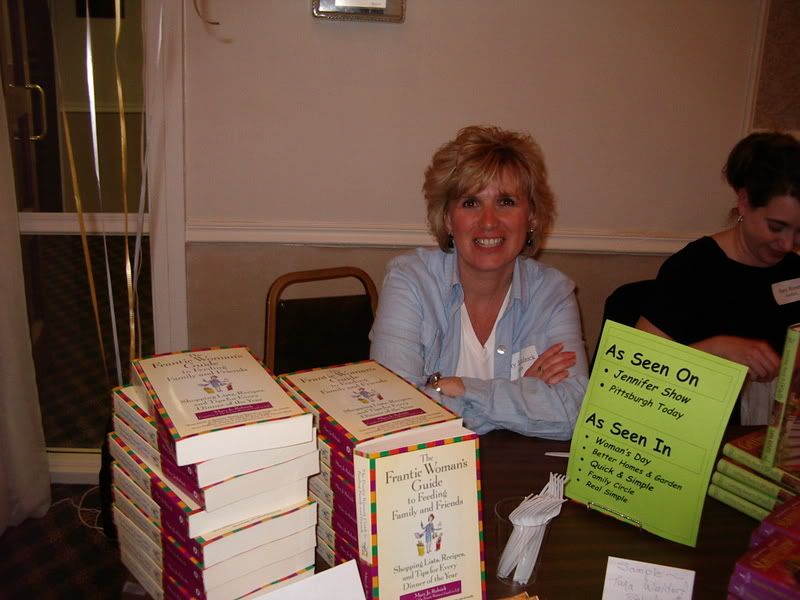
Mary Jo Rulnick was there with her Frantic Woman’s Guide.
Kathryn Miller Haines charmed the crowd while being interviewed by Richard Goldman of Mystery Lovers Bookshop.

And the crowd was huge. It was nice to be around so many mystery fans.

Even our own Martha Reed came for a little shopping.

As for me, I came home with a bag full of books and am trying to figure out how to make room for them on my to-be-read shelves. I guess I just need to read FASTER to clear out space.
Next week: Back to Citizens’ Police Academy and the Pittsburgh Police Intelligence Unit/CAT Eyes.
If you’re checking in for my weekly report on Citizens’ Police Academy, I must confess. I played hooky. Gina wrote about the Festival of Mystery on Monday. Well, that’s where I was instead of learning about drugs. Yes, Gina managed to attend the Festival AND still make it to CPA, but I volunteered as an author escort, so I was committed for the long haul.
My assigned author this year was Ellen Crosby who had the misfortune of having her luggage lost by the airlines. (Happy ending: it was ultimately found and returned to her before she left town for New York).
It was great getting to see some old friends and make new ones. Hallie Ephron is one of my favorites. And I’m glad I had a chance to talk to and get to know Kate Flora, too.
And then there were all the local gals.
Nancy Martin signed her Blackbird Sisters mysteries.
Heather Terrell struck a pose between Susan Wright and Marcia Talley.
Mary Jo Rulnick was there with her Frantic Woman’s Guide.
Kathryn Miller Haines charmed the crowd while being interviewed by Richard Goldman of Mystery Lovers Bookshop.
And the crowd was huge. It was nice to be around so many mystery fans.
Even our own Martha Reed came for a little shopping.
As for me, I came home with a bag full of books and am trying to figure out how to make room for them on my to-be-read shelves. I guess I just need to read FASTER to clear out space.
Next week: Back to Citizens’ Police Academy and the Pittsburgh Police Intelligence Unit/CAT Eyes.
Tuesday, April 29, 2008
Law Enforcement personnel are closet writers
by Donnell Ann Bell
I have a theory. A pretty good one if I do say so myself. Inside every law enforcement type there’s a storyteller waiting to be born. Don’t believe me? Just wait. After I share the following tale, I think you’ll agree I’m on to something.
First off, I don’t live in Pennsylvania, I blog here on occasion because Annette Dashofy is my online critique partner and I find her work is a joy to read. So my experience mainly comes from El Paso County, Colorado, but the more I work with Working Stiffs, I see that when it comes to law enforcement, we’re really not that far apart.
So here’s where I prove my case. Christina Herndon is the Deputy Coroner for El Paso County, and she’s one busy lady. She’s also my friend, with an irreverent sense of humor, I suspect because of her job. It’s a protective mechanism. She can either laugh or she can cry. I enjoy her because she makes me laugh, and naturally, she always makes me think.
Chris is also a very generous soul. I found this out when I would be typing away on a manuscript, I’d come to a point where I’d groan and say, “I’m not sure how to kill this guy.” I would pick up the phone, call the Coroner’s office, Chris would answer, saying, “You’re who? You want to know how to do what?”
Instead of having me arrested, she became my friend. And that’s troublesome for people in law enforcement, because once they befriend me, they end up befriending a whole lot of writers and speaking at a whole lot of functions. With that said, I’d like to tell you why I determined that if you’re in law enforcement, you’re also a closet writer.
A few months back, Chris told me that she teaches coroners how to conduct inquests, and naturally, I found this fascinating and abused our friendship further and said you need to put on a workshop for Sisters in Crime.
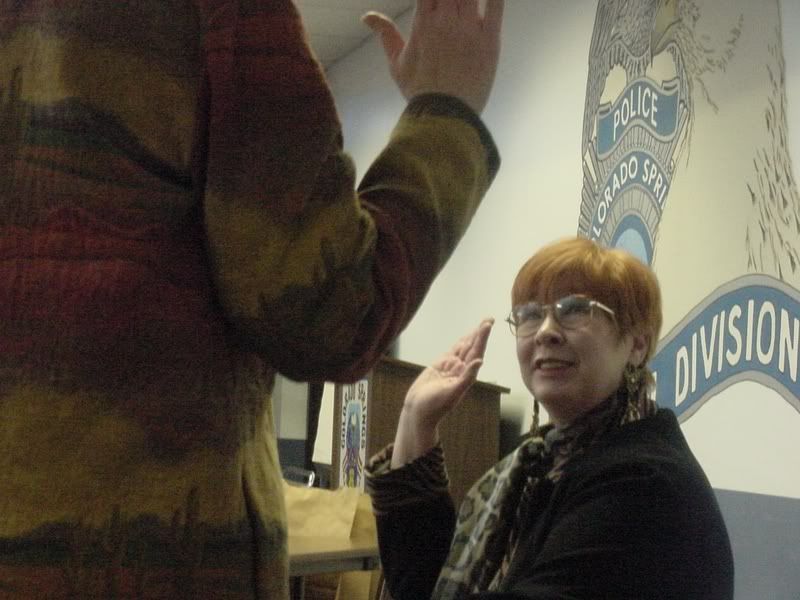
She never gets mad, she just says okay, and as we put our heads together, a mock coroner’s inquest came to life, with me as the melodramatic producer and Chris the “acting coroner” who also filled in the technical blanks.
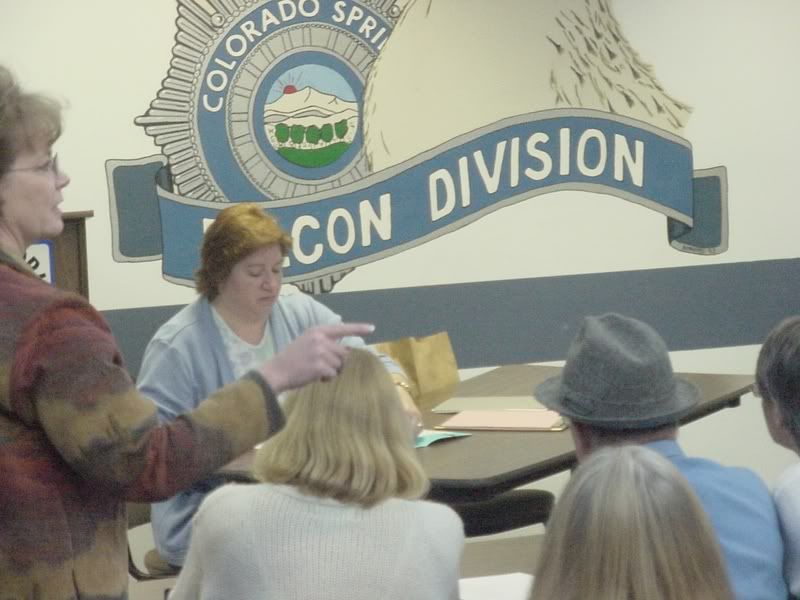
Now, I’ve talked about Chris, I’d also like to talk to you about fellow members of the Rocky Mountain Chapter of Sisters of Crime. Don’t tell any of them that I said this – “ahem,” – but they’re hams. Really big hams as well as darn good sports and actors. I told them what Chris and I were contemplating, and as our skit came together, my chapter mates good-naturedly did as they were told. Below is the cast of characters, and the set up that Chris and I wrote that turned out to be hysterical to watch and equally fun to participate in. Without further ado, I give you…
The Demise of Penelope Pierce
Deceased: Penelope Pierce
Victim’s Mother: Elizabeth Pierce (Kari Wainright)
Cop: Officer Ruthie Guyless (Beth Groundwater)
Reporting Party: Ms. Amelia Onlooker (Maria Faulconer)
Pathologist: Dr. Clara de Colon (Madge Walls)
Coroner Investigator: Racine Sharpastak (Barb Nickless)
Counselor: Dr. Lula Wannadish (Laura Pellerin)
Victim’s Roommate: Therma Dorr (Lise Fuller)
Victim’s Ex-husband: William Love-Levam (Robert Spiller)
Private Detective: Phineas Stump (Karl Herndon)
Court Reporter: Donnell Bell (no named court reporter)
On April 15th, in the town of Nogoingson, Colorado, an officer responded to a call requesting a welfare check. The Reporting Party, Amelia Onlooker
as well as the manager of the S-h-h-h apartments, said she hadn’t heard any activity from the apartment next door, a rare thing, as her numerous complaints will attest – loud music and constant parties involving Penelope Pierce and Therma Dorr, tenants of Apartment 2B. Earlier that morning, Ms. Onlooker claims a noise that sounded like a car backfiring twice roused her from a deep sleep. Later, Ms. Onlooker grew concerned at the unheard of quiet and dialed 9-1-1. At approximately 7:25 a.m. an operator dispatched the Nogoingson Police.

Twenty seconds later -- as there really isn’t much going on in Nogoingson -- Officer Ruthie Guyless arrived on scene. Ms. Onlooker let her into the apartment in question. Therma Dorr was found sitting on the couch, rocking back and forth and mumbling. Officer Guyless requested that a Medical Unit respond to check her out. Dorr was making random statements: “I didn't want her to die.” “She was going to move out, but I didn't want her too.” “She was going to go back to that bastard.” Then, Officer Guyless found the terrace door open and observed what appeared to be a body on the balcony outside. Upon closer inspection, Officer Guyless determined that an approximately 30-year-old, 110 pound, female Caucasion lay on the 10’ x 5’ wood-slatted balcony. Guyless checked the vitals of the victim and determined that Ms. Penelope Pierce was dead. Officer Guyless then requested that the Coroner be notified to respond to the scene.
Therma Dorr was escorted outside the apartment so that EMTs could check her out. Guyless and the Coroner were searching the bedroom when Penelope's mother showed up. She rushed into the apartment, whereupon seeing Penelope's body she became hysterical. She threw herself on the body and then had to be physically removed. Mrs. Pierce was accusing the ex-husband of murder and yelling at Therma Dorr. When Mrs. Pierce saw the scratch on the decease’s neck, she became incensed, insisting that this was a murder. "Somebody killed my baby.”
While searching the bedroom the investigators found divorce papers that indicated Penelope and William were separated, the divorce papers had been filed but the decree not final yet. (Because of this revelation, William is Penelope's legal next of kin and Mom has no say so in any of the final decisions -- which really upsets Mom…)
Guyless did a GSR kit on Therma Dorr and she was then taken by ambulance to the hospital where she was interviewed later by Guyless.
The Coroner Investigator, Racine Sharpastak and Guyless investigated the scene together. The scene was photographed by Sharpastak. Guyless had no batteries in her camera and they agreed to share the scene photos. Unfortunately Sharpastak's camera had a bad memory card and none of the scene photos were captured.
They noted that the deceased’s right arm was upright at an angle, perpendicular to her shoulder, elbow bent, her forearm lying near her head. A .22 Charter Arms semi automatic pistol was found near the door. One spent casing was found near the deceased’s left foot. The gun was made safe by Guyless and then examined to reveal that the gun’s clip, which could hold 6 bullets, was found to have 4 live rounds remaining in the clip. Investigator Sharpastak then determined that there appeared to be a gunshot wound to the right temple area that was consistent with an entrance wound, but no exit wound was found. No projectiles (bullets) were found on the balcony or in the adjoining walls.
Inside on the glass coffee table, the officers discovered a bottle of wine and two glasses, one containing a small amount of white wine. The bedroom was searched and drug paraphernalia (pipes) and small plastic envelopes containing a white powdery substance (meth) was found in a drawer of the nightstand along with a green leafy substance (marijuana). In the bathroom medicine chest, the prescription antidepressant Respirdol was also found. The prescription was for the deceased, had been filled just 2 weeks prior and was empty.
(Temperature was 67°)
The Coroner assumed custody of the body, (after placing paper bags on the hands for GSR testing) the body was taken to the Coroner's Office for an autopsy.
Guyless and Sharpastak went to William Love-Levam's residence to notify him of Penelope's death. He was interviewed there.
After being x-rayed an autopsy was performed by Dr. Clara de Colon. Dr. de Colon was able to determine that the wound to the right temporal area was a contact wound, consistent with a self-inflicted injury. The projectile was recovered during the autopsy and given to Officer Guyless for further testing at CBI, if needed. Another gunshot wound was found in the deceased's left groin area. This had not been visible on scene as there was very little blood. This projectile was located in the left butt cheek.
The investigation done by Guyless and Sharpastak concluded the following:
Ms. Penelope Pierce had been separated for a period of six months and was apparently despondent after her breakup with her spouse, William Love-Levam.
Immediately after the divorce Ms. Pierce moved into the apartment and resided with a female roommate, Ms. Therma Dorr. They became lovers, but Penelope hadn't told anyone that she was involved with Dorr.
Ms. Pierce had sought counseling from Dr. Lula Wannadish M.D. Nogoingson’s resident psychiatrist who prescribed the antidepressant and had been treating the deceased for the last two months. Dr. Wannadish has been reluctant to share any information or records until threatened with court action.
Ex-husband, William Love-Levam claims he was in his house alone at the time of death, asleep after the previous evening of writing his memoirs. Officer Guyless ran the serial number of the .22 pistol through ATF and found that it was registered to William. He denied giving Penelope the gun, but she had been at his house the previous week asking for money.
Further analysis determined that the roommate’s fingerprints, Therma Dorr, were found on one of the wine glasses, the bottle of wine and on the .22. Ms. Dorr claims that they had been arguing most of the night, at one point she tried to grab Penelope to stop her from leaving the apartment and scratched her neck with her unnaturally long fingernails. They had fallen asleep around 4 a.m. She woke up when she heard loud noises and went looking for Penelope when she realized that she wasn't in bed. Ms. Dorr found the victim with the .22 resting in her hand, and in an unthinking moment Therma Dorr picked it up, put it next to the door then went inside and started drinking.
GSR tests were done on Penelope and Therma, both were sent to CBI and both tests came back positive. CBI also did ballistic tests on the projectiles recovered from the body and the gun found on scene and they matched.
 After two months, Mrs. Elizabeth Pierce the victim’s mother has become increasingly frustrated at the coroner’s assessment that Ms. Penelope Pierce died at her own hand. Penelope was a former model, and her mother claims Penelope would never have committed an act which destroyed her looks. Mrs. Pierce is suspicious because Ms. Dorr’s fingerprints are on the gun, and therefore has demanded further investigation.
She has hired a private investigator who agrees with Mrs. Pierce that this death is suspicious.
~~~
As you can see Chris gave this writer a lot of help in preparing this skit, and my fellow chapter mates played their parts, ad libbing to perfection. Also, Chris’s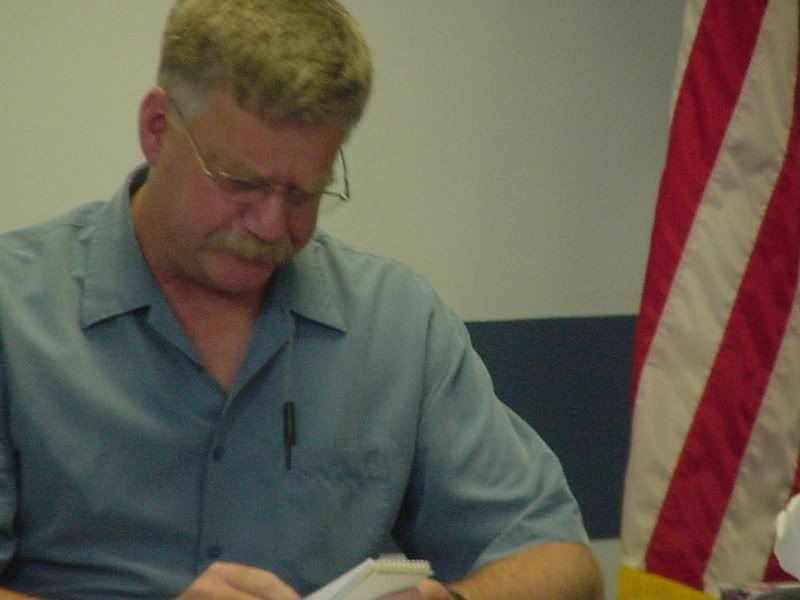
husband, Karl, a deputy sheriff for El Paso County came to our aid by playing the private detective, Phineas Stump, even to the point of handing out business cards that read Phineas Stump. Try to Stump me, I dare ya!
 To my dear friend, Lise Fuller, this woman was such a good sport, virtually stealing the show while she played the bi-sexual roommate of the deceased, while her real-life husband, Major Tom Fuller participated in the jury.
Pictured below are a couple of our participants books.

All in all, the event was educational, funny and a tremendous success.
Get involved with your local law enforcement and see if you don’t agree. Many of them, like Chris, are would-be writers. I guarantee the majority are generous souls.
Donnell Ann Bell is an award-winning aspiring author, a member of Sisters in Crime, Romance Writers of America’s Kiss of Death Chapter and other RWA Colorado chapters. Check out her website at www.donnellannbell.com
First off, I don’t live in Pennsylvania, I blog here on occasion because Annette Dashofy is my online critique partner and I find her work is a joy to read. So my experience mainly comes from El Paso County, Colorado, but the more I work with Working Stiffs, I see that when it comes to law enforcement, we’re really not that far apart.
So here’s where I prove my case. Christina Herndon is the Deputy Coroner for El Paso County, and she’s one busy lady. She’s also my friend, with an irreverent sense of humor, I suspect because of her job. It’s a protective mechanism. She can either laugh or she can cry. I enjoy her because she makes me laugh, and naturally, she always makes me think.
Chris is also a very generous soul. I found this out when I would be typing away on a manuscript, I’d come to a point where I’d groan and say, “I’m not sure how to kill this guy.” I would pick up the phone, call the Coroner’s office, Chris would answer, saying, “You’re who? You want to know how to do what?”
Instead of having me arrested, she became my friend. And that’s troublesome for people in law enforcement, because once they befriend me, they end up befriending a whole lot of writers and speaking at a whole lot of functions. With that said, I’d like to tell you why I determined that if you’re in law enforcement, you’re also a closet writer.
A few months back, Chris told me that she teaches coroners how to conduct inquests, and naturally, I found this fascinating and abused our friendship further and said you need to put on a workshop for Sisters in Crime.
She never gets mad, she just says okay, and as we put our heads together, a mock coroner’s inquest came to life, with me as the melodramatic producer and Chris the “acting coroner” who also filled in the technical blanks.
Now, I’ve talked about Chris, I’d also like to talk to you about fellow members of the Rocky Mountain Chapter of Sisters of Crime. Don’t tell any of them that I said this – “ahem,” – but they’re hams. Really big hams as well as darn good sports and actors. I told them what Chris and I were contemplating, and as our skit came together, my chapter mates good-naturedly did as they were told. Below is the cast of characters, and the set up that Chris and I wrote that turned out to be hysterical to watch and equally fun to participate in. Without further ado, I give you…
The Demise of Penelope Pierce
Deceased: Penelope Pierce
Victim’s Mother: Elizabeth Pierce (Kari Wainright)
Cop: Officer Ruthie Guyless (Beth Groundwater)
Reporting Party: Ms. Amelia Onlooker (Maria Faulconer)
Pathologist: Dr. Clara de Colon (Madge Walls)
Coroner Investigator: Racine Sharpastak (Barb Nickless)
Counselor: Dr. Lula Wannadish (Laura Pellerin)
Victim’s Roommate: Therma Dorr (Lise Fuller)
Victim’s Ex-husband: William Love-Levam (Robert Spiller)
Private Detective: Phineas Stump (Karl Herndon)
Court Reporter: Donnell Bell (no named court reporter)
On April 15th, in the town of Nogoingson, Colorado, an officer responded to a call requesting a welfare check. The Reporting Party, Amelia Onlooker
as well as the manager of the S-h-h-h apartments, said she hadn’t heard any activity from the apartment next door, a rare thing, as her numerous complaints will attest – loud music and constant parties involving Penelope Pierce and Therma Dorr, tenants of Apartment 2B. Earlier that morning, Ms. Onlooker claims a noise that sounded like a car backfiring twice roused her from a deep sleep. Later, Ms. Onlooker grew concerned at the unheard of quiet and dialed 9-1-1. At approximately 7:25 a.m. an operator dispatched the Nogoingson Police.
Twenty seconds later -- as there really isn’t much going on in Nogoingson -- Officer Ruthie Guyless arrived on scene. Ms. Onlooker let her into the apartment in question. Therma Dorr was found sitting on the couch, rocking back and forth and mumbling. Officer Guyless requested that a Medical Unit respond to check her out. Dorr was making random statements: “I didn't want her to die.” “She was going to move out, but I didn't want her too.” “She was going to go back to that bastard.” Then, Officer Guyless found the terrace door open and observed what appeared to be a body on the balcony outside. Upon closer inspection, Officer Guyless determined that an approximately 30-year-old, 110 pound, female Caucasion lay on the 10’ x 5’ wood-slatted balcony. Guyless checked the vitals of the victim and determined that Ms. Penelope Pierce was dead. Officer Guyless then requested that the Coroner be notified to respond to the scene.
Therma Dorr was escorted outside the apartment so that EMTs could check her out. Guyless and the Coroner were searching the bedroom when Penelope's mother showed up. She rushed into the apartment, whereupon seeing Penelope's body she became hysterical. She threw herself on the body and then had to be physically removed. Mrs. Pierce was accusing the ex-husband of murder and yelling at Therma Dorr. When Mrs. Pierce saw the scratch on the decease’s neck, she became incensed, insisting that this was a murder. "Somebody killed my baby.”
While searching the bedroom the investigators found divorce papers that indicated Penelope and William were separated, the divorce papers had been filed but the decree not final yet. (Because of this revelation, William is Penelope's legal next of kin and Mom has no say so in any of the final decisions -- which really upsets Mom…)
Guyless did a GSR kit on Therma Dorr and she was then taken by ambulance to the hospital where she was interviewed later by Guyless.
The Coroner Investigator, Racine Sharpastak and Guyless investigated the scene together. The scene was photographed by Sharpastak. Guyless had no batteries in her camera and they agreed to share the scene photos. Unfortunately Sharpastak's camera had a bad memory card and none of the scene photos were captured.
They noted that the deceased’s right arm was upright at an angle, perpendicular to her shoulder, elbow bent, her forearm lying near her head. A .22 Charter Arms semi automatic pistol was found near the door. One spent casing was found near the deceased’s left foot. The gun was made safe by Guyless and then examined to reveal that the gun’s clip, which could hold 6 bullets, was found to have 4 live rounds remaining in the clip. Investigator Sharpastak then determined that there appeared to be a gunshot wound to the right temple area that was consistent with an entrance wound, but no exit wound was found. No projectiles (bullets) were found on the balcony or in the adjoining walls.
Inside on the glass coffee table, the officers discovered a bottle of wine and two glasses, one containing a small amount of white wine. The bedroom was searched and drug paraphernalia (pipes) and small plastic envelopes containing a white powdery substance (meth) was found in a drawer of the nightstand along with a green leafy substance (marijuana). In the bathroom medicine chest, the prescription antidepressant Respirdol was also found. The prescription was for the deceased, had been filled just 2 weeks prior and was empty.
(Temperature was 67°)
The Coroner assumed custody of the body, (after placing paper bags on the hands for GSR testing) the body was taken to the Coroner's Office for an autopsy.
Guyless and Sharpastak went to William Love-Levam's residence to notify him of Penelope's death. He was interviewed there.
After being x-rayed an autopsy was performed by Dr. Clara de Colon. Dr. de Colon was able to determine that the wound to the right temporal area was a contact wound, consistent with a self-inflicted injury. The projectile was recovered during the autopsy and given to Officer Guyless for further testing at CBI, if needed. Another gunshot wound was found in the deceased's left groin area. This had not been visible on scene as there was very little blood. This projectile was located in the left butt cheek.
The investigation done by Guyless and Sharpastak concluded the following:
Ms. Penelope Pierce had been separated for a period of six months and was apparently despondent after her breakup with her spouse, William Love-Levam.
Immediately after the divorce Ms. Pierce moved into the apartment and resided with a female roommate, Ms. Therma Dorr. They became lovers, but Penelope hadn't told anyone that she was involved with Dorr.
Ms. Pierce had sought counseling from Dr. Lula Wannadish M.D. Nogoingson’s resident psychiatrist who prescribed the antidepressant and had been treating the deceased for the last two months. Dr. Wannadish has been reluctant to share any information or records until threatened with court action.
Ex-husband, William Love-Levam claims he was in his house alone at the time of death, asleep after the previous evening of writing his memoirs. Officer Guyless ran the serial number of the .22 pistol through ATF and found that it was registered to William. He denied giving Penelope the gun, but she had been at his house the previous week asking for money.
Further analysis determined that the roommate’s fingerprints, Therma Dorr, were found on one of the wine glasses, the bottle of wine and on the .22. Ms. Dorr claims that they had been arguing most of the night, at one point she tried to grab Penelope to stop her from leaving the apartment and scratched her neck with her unnaturally long fingernails. They had fallen asleep around 4 a.m. She woke up when she heard loud noises and went looking for Penelope when she realized that she wasn't in bed. Ms. Dorr found the victim with the .22 resting in her hand, and in an unthinking moment Therma Dorr picked it up, put it next to the door then went inside and started drinking.
GSR tests were done on Penelope and Therma, both were sent to CBI and both tests came back positive. CBI also did ballistic tests on the projectiles recovered from the body and the gun found on scene and they matched.
After two months, Mrs. Elizabeth Pierce the victim’s mother has become increasingly frustrated at the coroner’s assessment that Ms. Penelope Pierce died at her own hand. Penelope was a former model, and her mother claims Penelope would never have committed an act which destroyed her looks. Mrs. Pierce is suspicious because Ms. Dorr’s fingerprints are on the gun, and therefore has demanded further investigation.She has hired a private investigator who agrees with Mrs. Pierce that this death is suspicious.
~~~
As you can see Chris gave this writer a lot of help in preparing this skit, and my fellow chapter mates played their parts, ad libbing to perfection. Also, Chris’s
husband, Karl, a deputy sheriff for El Paso County came to our aid by playing the private detective, Phineas Stump, even to the point of handing out business cards that read Phineas Stump. Try to Stump me, I dare ya!
To my dear friend, Lise Fuller, this woman was such a good sport, virtually stealing the show while she played the bi-sexual roommate of the deceased, while her real-life husband, Major Tom Fuller participated in the jury.Pictured below are a couple of our participants books.
All in all, the event was educational, funny and a tremendous success.
Get involved with your local law enforcement and see if you don’t agree. Many of them, like Chris, are would-be writers. I guarantee the majority are generous souls.
Donnell Ann Bell is an award-winning aspiring author, a member of Sisters in Crime, Romance Writers of America’s Kiss of Death Chapter and other RWA Colorado chapters. Check out her website at www.donnellannbell.com
Monday, April 28, 2008
IT'S THAT TIME AGAIN
by Gina Sestak
Now that the Earth has traveled once more to the warm side of the Sun (hush, I know that stuff about the hemispheres and axis tilt -- I'm just trying to be poetic) and tiny plants have pushed their soft green heads out of the ground, it's time to -- READ. What? Not garden? Not stroll through blossom-scented meadows seeking newly returned birds? NO. That's not what we here at the stiffs are all about.
Today marks the 13th Annual Festival of Mystery.
That's right. In a Greek Orthodox Church hall in beautiful Oakmont, Pennsylvania, the Mystery Lovers Bookshop will present more than four dozen of our favorite authors, live and in person, signing (and selling) their books. [You understand now why this is a time to read, I trust?] A complete list of authors can be found at the Festival website. Suffice it to say that some of our own local favorites (and working stiffs bloggers) will be among them, as well as writers from all over the country and beyond.
For anyone who hasn't attended the Festival before, getting there is easy. Just follow the Allegheny River away from Downtown Pittsburgh until you get to Oakmont. You'll know you've arrived when you see oak leaves on the street signs. More reliable driving directions can be obtained through mapquest or yahoo: the Church Hall address is 12 Washington Avenue, Oakmont, PA.
The atmosphere is relaxed. Authors sit behind stacks of their work, signing books and chatting with passing fans. It's a chance to see what these folks look like in the flesh, not just in that studio portrait on the book jacket. There is also a program in which the authors get to speak briefly from a stage. The hard part is not buying every book from everyone, although I'm sure Mystery Lovers wouldn't mind at all if you did.
So pick yourselves up, gather up plenty of cash and charge cards, and, if you don't already own one, borrow a vehicle sturdy enough to carry a humungous load of books. I hope to see each and every one of you at the Festival.
Thursday, April 24, 2008
Finding Big Plot...Finally
by,
Kathie Shoop
Well, in the last nine months I’ve researched and written another book. This one is very different than my typical women’s fiction fare. Writing comtemperary fiction, for me, was hard and easy at the same time. First, I was fully invested in writing about the world as I see it, as I feel it as a woman. I enjoyed it. BUT, what I enjoy about the contemporary world are the small things that create character rather than the big things that make for highly conceptual/big plots.
Some comments from my agent and others were that my novels were quite good, but small and quiet. Meaning, not enough plot, sister. I never understood that. Who cares? There’s a plot there—Sideways was small, right?
Well, fate intervened in the form of my mother. She handed over the 125 year old love letters written by my great great grandmother to my g.g. grandfather during the year of their engagement. They were unbelievable, moving, sappy, bizarre, optimistic, and totally engrossing. I think they could stand alone as a book as they have their own story arc…but we all know what the answer is to publishing letters of people of zero consequence.
Completely compelled by the content—my g. grandparents subsequent pioneering life, the birth of six kids and shocking divorce as my grandfather left her for another woman—I couldn’t get the characters out of my mind. So, I’ve taken some famous events that occurred while they were pioneering and built a story around huge plot elements, making use of tremendous characters that literally came to me through these letters.
It wasn’t until about halfway through this process that I realized (hit on head with frying pan kind of thing) what my agent and others meant by big plot. In the past I understood the difference between say, Mission Impossible and Sideways, but for me there seemed to be a subtle middle ground that was so interesting. But with this book under my belt, with characters who have environmental and internal obstacles to overcome, I get it. I suddenly, fully get it.
Here’s to learning—the process that hopefully never stops for any human being. And fate, I guess. My mother had been waving those letters at me for years and I ignored them…then one day I sat and read. Boy, I’m glad I did.
Pet Peeves
by Joyce Tremel
Things are very quiet at work these days which is good for the residents of Shaler, but bad for coming up with blog topics. I had thoughts of writing about this article, but I think the title pretty much tells me everything I want to know about it.
The other day on The Graveyard Shift , agent Scott Hoffman blogged about what really bugs us when we read a book. I've seen the same topic on a few other blogs and lists lately, so I must not be the only one who has pet peeves. Have you ever been engrossed in a novel where the plot seems to be rolling along just fine, the characters are three dimensional, the dialogue is snappy, then--wham! It all falls apart because of one little thing. That one thing that drives you nuts. Whether it's a Glock with a safety or DNA results back in an hour, you put the book down.
One of my pet peeves is info dumps. Every once in awhile I'll come across an author who has done her research, but instead of using bits and pieces here and there, or only using enough to get the point across, she insists on giving the reader a lecture. It takes me right out of the story.
Another one is when a writer keeps repeating himself. I read a book once where every time the author drew his gun, he made sure he used the complete brand name and model number. Once would have been enough.
So, what are your pet peeves when you read a book? What takes you right out of the story? Is there anything that would cause you to never pick up one of that author's books again?
(Oh, and for a little bit of fun, here's a quiz you can take. It has nothing to do with this topic, but it's a hoot anyway.)
Wednesday, April 23, 2008
Citizens' Police Academy: Something Old, Something New
By Annette Dashofy
This week’s Citizens’ Police Academy was a two-fer. A little bit of something new and a little bit of something old was presented during our field trip to the training center.
Relatively new to Pittsburgh is the Crisis Intervention Team. Unlike SWAT, this is not a “response” team. Rather it’s a “collaborative” team in which the Pittsburgh Bureau of Police works with the Allegheny County Department of Human Services, Office of Behavioral Heath and state and county correctional institutions. Police training for this program began June 2007.
So much information was thrown at us in such a short span of time, my notes leave much to be desired. Hopefully our resident mental health specialist, Tory, can jump in with some additional comments.
The training gives officers an insight into mental illness so they can possibly de-escalate a mental health crisis when they are faced with those situations.
The police based Crisis Intervention Team (CIT) is the front door of a diversionary process used to divert people BEFORE they’ve done something requiring arrest. The team might be called to the scene if a report comes in of someone out on the street yelling at a stop sign or the neighbor has lined their fence with tin foil.
But it goes further, dealing with the mentally ill who have been arrested for nonviolent crimes. It’s a volunteer program allowing a person to be released on bond to Allegheny County Mental Health rather than being held in jail
It also can help when a mentally ill prisoner is released by bringing them into half-way houses and closely monitoring them during the transition back into the community.
Pittsburgh has a Central Recovery Center that opened in August 2007. It has a no eject/no reject policy and is an alternative to hospital or jail. It provides screening, assessment, and crisis prevention on a voluntary basis (a person cannot be involuntarily committed here). It also offers access to longer-term respite beds when needed and offers referrals to Behavioral Health Forensics Services as well as providing communication with family and significant others.
To date, 55 Pittsburgh officers have been trained and 15 other officers from outside the city. The goal is to eventually have enough officers with crisis intervention training so that someone will always be on duty and available to respond.
The second portion of this week’s class brought us in contact with a slightly older program. Pittsburgh has had a K-9 unit since November of 1958, making it the second oldest continuously running K-9 program in the United States (the oldest, by a mere matter of months, is Baltimore County, Maryland). Unlike many police dog programs across the country, Pittsburgh Police train their own dogs and provide in service training.
We were fortunate to be able to watch several dogs put through their paces including an obstacle course and going after a “suspect” dressed in a bulky bite suit. Think the Michelin Man with bite marks.
A police canine’s greatest asset to the department is its nose. They can provide a search for drugs or explosives (depending on how the dog is trained) faster than a human could and with less intrusion. A dog doesn’t have to open a bag to tell what’s in it.
A dog sniffing (or “snearching” as Sgt. Chris Micknowski called a sniff and search) drugs is trained to respond differently than a dog searching for explosives. A drug sniffing dog will act more aggressively when it has located an illegal substance, biting and scratching at the area where it’s hidden. With an explosive, understandably, you don’t want such an aggressive reaction. Those dogs are trained to respond more passively, such as sitting and looking at the area.
Something else I found interesting is that when a dog is to go into a building to locate a suspect who may be hiding there, there is no rush to get started. Time is on the officers’ side, because the longer a suspect remains in there, the stronger his odor becomes and the easier it is for the dog to find. Sgt. Micknowski used the example of peeling an onion and letting it sit. At first, only those closest to it would be able to smell it. But after a half hour, even those in the back of the room would be aware of that onion.
And it was stressed that the police need to call in a dog first, NOT AFTER they’ve already searched the building, adding their own odors and disturbing the suspect’s odor.
Also, unlike all other departments, in Pittsburgh, our dogs are trained to locate and bark at a suspect as long as he doesn’t attempt to flee or act aggressively. And when a dog goes after someone, it is not considered “attacking.” It’s one bite and hold. The dogs are trained to go for the back of the arms, shoulders, and the upper back of the suspect, the closer to the center of the upper back, the better. That way, the suspect is less likely to be able to harm the dog. We were able to witness several examples of this training. Believe me, if you ever encounter an unleashed police canine, DO NOT MOVE.
Police canines are considered a non-deadly type of force and therefore is safer for the suspect. If a human police officer were to go into a situation, he may need to pull his gun and use deadly force. A dog will cause pain, but won’t kill. How many times have you heard of people dying after being “tased”? How many times have you heard of people being killed by police canines?
The dogs also provide safety for their handlers. Often their mere presence is enough to cause a suspect to surrender. That’s also one of the reasons that German Sheppard’s are used so extensively. They have “the look.”
And they don’t need a piece of clothing to locate someone. They search by ground disturbance odors (at least, Pittsburgh’s dogs do).
Next week: Playing hooky.
Subscribe to:
Posts (Atom)