by Joyce
I've come to the conclusion that I'm a fuddy-duddy (how do you spell that, anyway?). I like things to be a certain way, to be done at a certain time, etc. When something comes up to screw all that up, I can't seem to get anything done.
I've been rolling right along with my WIP, sticking pretty close to my goal of writing an average of four pages a day, or about 20 pages a week. But there has been so much distraction this week, that I've only written five pages in four days. You would think that with almost three feet of snow piled up and nowhere to go, that I'd have the whole frickin' book finished.
Part of the problem is that I'm used to being home alone during the day. Just me and the cat. Peace and quiet. Lots of writing time with no interruptions. This week I've had more than my share of interruptions. Number one son is home from DC for a few days, which is turning into all week because the district is shut down. Number two son, who works at the University of Pittsburgh has been home because Pitt is closed. And to top it off, hubby was home on Wednesday because of the snow. Now, don't get me wrong, I love my family dearly, but they ARE a distraction. It's hard to concentrate on a scene when someone wants to know how to work the washer or can't find anything to eat even though the refrigerator is full.
I've found the best thing to do is just "go with the flow," although I hate that cliche. On Tuesday night, we even went out to dinner and came home and played a board game. I didn't think about the WIP once. On Wednesday, I did squeeze in some writing while the "boys" were out shoveling snow off the driveway.
So maybe I'm not such a fuddy-duddy after all.
How do you deal with distractions and interruptions? Go with the flow? Or go crazy?
Reminder: Don't forget to enter our 200 word flash fiction contest running until the end of the month. Go here for details and to post your story!
Thursday, February 11, 2010


Wednesday, February 10, 2010
Plotting a Conference
(A note from Annette) Some of you may recall that last year this time I was up to my eyeballs coordinating the 2009 Pennwriters Conference. Today, I’m pleased to introduce guest blogger, Ayleen Stellhorn who is this year’s conference coordinator and does it with much more grace and serenity (externally, at least!) than I could muster.
Freelancer Ayleen Stellhorn writes for local and regional publications and edits books and magazine articles for the hobby and craft market. A member of Pennwriters, she is coordinating their 23rd Annual Conference, May 14-16, at the Eden Resort in Lancaster, PA.
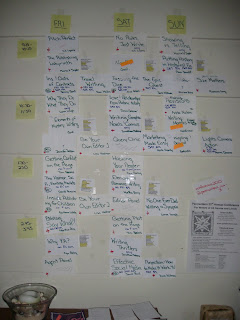 I recently took down all the 3x5 cards mapping out my current WIP and replaced them with index cards for the 2010 Pennwriters Conference. Funny how my Act I, Act II, and Act III column heads were so easily replaced by Friday, Saturday, and Sunday tags. And all those chapter/scene designations down the left edge? They’re now one-hour time slots for workshops.
Maybe it’s just me, but there’s something about a roadmap — granted mine’s a really big, extremely anal-retentive roadmap — that helps me stay on track and think clearer when it comes to making my way from A to Z.
I tried using Excel to plot out the conference. It didn’t work. Having to navigate to the correct file and then scroll down to see all the pieces was too frustrating and time consuming. There’s just no easy way to capture a 4x6-foot piece of wall on a 17x12-inch computer screen.
May as well face it… I like being able to see the whole picture in one glance. I blame my first boss. One wall of her office was filled with a matrix that let us see an entire year’s worth of magazine issues and articles at one time. Want to know who’s writing the beginning carving article for the July issue? Just look at the wall.
When I moved on to be a book editor, I applied the same principle to my spring and fall lists. Want to know who’s authoring the scroll saw pattern book next fall? Just look at the wall. No tinkering with computer screens or file folders necessary.
So now the 2010 conference schedule is up on the wall. Does the agent/editor class I need to switch to time slot 9:15 to 10:15 on Friday morning conflict with the how-to class during that same time? I just look at the wall.
Now all I have to do is figure out how to take the wall with me when I head to Lancaster for the conference the spring.
To learn more about the 2010 Pennwriters Conference, visit http://www.pennwriters.com/, check out their Facebook page at Pennwriters Annual Writers Conference, or e-mail conference2010@pennwriters.com. Friday’s keynote is best-selling author James Rollins. Visiting agents and editors are Janet Reid, Jenny Bent, Jennifer Jackson, Miriam Kriss, Alex Glass, Barbara Lalicki, Leis Pederson, and David Pomerico.
Freelancer Ayleen Stellhorn writes for local and regional publications and edits books and magazine articles for the hobby and craft market. A member of Pennwriters, she is coordinating their 23rd Annual Conference, May 14-16, at the Eden Resort in Lancaster, PA.

Maybe it’s just me, but there’s something about a roadmap — granted mine’s a really big, extremely anal-retentive roadmap — that helps me stay on track and think clearer when it comes to making my way from A to Z.
I tried using Excel to plot out the conference. It didn’t work. Having to navigate to the correct file and then scroll down to see all the pieces was too frustrating and time consuming. There’s just no easy way to capture a 4x6-foot piece of wall on a 17x12-inch computer screen.
May as well face it… I like being able to see the whole picture in one glance. I blame my first boss. One wall of her office was filled with a matrix that let us see an entire year’s worth of magazine issues and articles at one time. Want to know who’s writing the beginning carving article for the July issue? Just look at the wall.
When I moved on to be a book editor, I applied the same principle to my spring and fall lists. Want to know who’s authoring the scroll saw pattern book next fall? Just look at the wall. No tinkering with computer screens or file folders necessary.
So now the 2010 conference schedule is up on the wall. Does the agent/editor class I need to switch to time slot 9:15 to 10:15 on Friday morning conflict with the how-to class during that same time? I just look at the wall.
Now all I have to do is figure out how to take the wall with me when I head to Lancaster for the conference the spring.
To learn more about the 2010 Pennwriters Conference, visit http://www.pennwriters.com/, check out their Facebook page at Pennwriters Annual Writers Conference, or e-mail conference2010@pennwriters.com. Friday’s keynote is best-selling author James Rollins. Visiting agents and editors are Janet Reid, Jenny Bent, Jennifer Jackson, Miriam Kriss, Alex Glass, Barbara Lalicki, Leis Pederson, and David Pomerico.
Tuesday, February 09, 2010
A Brief Announcement...
Breaking in on Pat's day just for a moment to post the winners of Hank Phillippi Ryan's books.
The winners of any TIME book of their choice:
Debbie
Grammy09
Ramona
Gina
MaryQ
And the winner of PRIME TIME FACE TIME and AIR TIME and a tote bag!
Dana King
You can can email Hank directly through “contact” in her website and send her your mailing addresses. http://www.hankphillippiryan.com/
Congratulations!!! Now back to your regularly scheduled blog...
The winners of any TIME book of their choice:
Debbie
Grammy09
Ramona
Gina
MaryQ
And the winner of PRIME TIME FACE TIME and AIR TIME and a tote bag!
Dana King
You can can email Hank directly through “contact” in her website and send her your mailing addresses. http://www.hankphillippiryan.com/
Congratulations!!! Now back to your regularly scheduled blog...
It can take a long time to write short

As you know, short fiction is our theme this month and after spending a month working on two short stories, I have to echo Wilfred Bereswell’s earlier post that creating a short story can constitute some of the hardest writing you’ll ever do.
I've been rising early to write before work (and believe me, spending your first 1.5 hours awake thinking about murder sets an interesting tone for a workday) and devoting several hours on weekends. It hasn't been easy and the task has consumed me, because when I'm not at my desk, I think about the stories and where they should go next – or where they shouldn’t have gone before.
Telling a story, developing characters the reader will care about, and creating a sense of place are essential elements that require words – and sometimes lots of ‘em. So if there’s a tight limit, such as 3,500 words for one of my stories, finishing a first draft still means many more hours of work ahead to pare it down without losing the essence – or important details. This process of “killing your darlings” -- deleting words or phrases that took hours, and sometimes days or weeks, to craft – is excruciatingl.
My friend Kathleen, who delights in writing very short stories, often brags that if she were to divide the meager payment she receives for publication in an anthology by the number of words written, she’s the highest paid author per-word in that book. Last year, however, her 246-word story was not enough to maintain that distinction because someone else wrote a piece that was only 64 words long.
Think about it – an entire story in 64 words. That’s shorter than most conversations. It’s also fewer words than are being allowed in the flash fiction challenges here. Fortunately, I suspect flash fiction readers have lower expectations about what such a short story has to contain in so few words to be credible, which helps, but all the elements still need to be there.
As you probably know, there are those who contend powerful stories can be told in even fewer words. According to writing legend, Ernest Hemingway once wrote one in six words: “For sale: baby shoes, never worn.”
I've seen writing challenges urging participants to duplicate this feat, including asking them to describe their lives in just six words. Smith Magazine has been publishing collections of these six-word memoirs over the past few years. The latest version is "It All Changed in an Instant: More Six-Word Memoirs by Writers Famous & Obscure.”
Being someone who often writes far too many words, I especially admire the ability of these writers to sum up their lives in so few of them. Here are a few of my favorites:
“Well, I thought it was funny” – Stephen Colbert
“At least I never voted Republican” – Tony Kushner
“I picked passion. Now I'm poor. -- Kathleen E. Whitlock
“So would you believe me anyway?” -- James Frey
If you had to sum up your life in six words, what would they be?
Monday, February 08, 2010
Drumroll, please....
by Jennie Bentley
The results are in for the first part of the Flash Fiction contest, better known as The Guessing Game. The other part, where you, gentle readers, post your own 200 word stories, starting with the sentence, “If you have to die, February is the best month for it,” in the comments section of a certain post you’ll find if you look to the right of this... that’s still ongoing. At the end of February, Wilfred Bereswill is graciously giving away a copy of his book, “A Reason for Dying,” to the guest story determined to be the best of the bunch.
This time around, the prize is one of my DIY books: “Fatal Fixer-Upper,” “Spackled and Spooked,” or “Plaster and Poison,” or an advanced reader copy of “A Cutthroat Business,” first in the Savannah Martin real estate mysteries.
You know, I had no idea when we started this that it would be so hard to match stiffs to stories. I figured everyone would get at least me and Will and John Lutz matched correctly, since our work is readily available even if you’re not familiar with it already. Imagine my surprise when no one – and I do mean no one – guessed that I wrote #2.
Yes, folks, the male POV 3rd person science fiction piece is mine. I figured if I wrote first person female like I always do, you’d know right off the bat that I wrote it. So I decided to be devious. Even so, to me, it still screams in my voice, loud and clear. The sentence structure, the rhythm, the flow... Yet even Will – whom all of you; every single person – thought had written it, told me that he if he didn’t know which entry was his, he’d have thought he wrote mine.
I’m going to take that as a huge compliment, y’all. Little old girly-girl me wrote male POV well enough to fool everybody!
Here’s the actual rundown of who wrote what:
1. Will
2. Jennie
3. Joyce
4. Gina
5. John Lutz
6. Pat R.
Nobody got’em all right. A few of you got a few. The person with the most matches, interestingly enough, was someone who doesn’t know any of us: Kris the Cajun Book Lady! Congratulations, Kris. Email me or DM me with your address and your choice of reading material, and I’ll get a book in the mail to you!
Thanks for playing, everyone! And don’t forget to post your 200 word Flash Fic pieces in the appropriate place for a chance to win “A Reason for Dying.”
The results are in for the first part of the Flash Fiction contest, better known as The Guessing Game. The other part, where you, gentle readers, post your own 200 word stories, starting with the sentence, “If you have to die, February is the best month for it,” in the comments section of a certain post you’ll find if you look to the right of this... that’s still ongoing. At the end of February, Wilfred Bereswill is graciously giving away a copy of his book, “A Reason for Dying,” to the guest story determined to be the best of the bunch.
This time around, the prize is one of my DIY books: “Fatal Fixer-Upper,” “Spackled and Spooked,” or “Plaster and Poison,” or an advanced reader copy of “A Cutthroat Business,” first in the Savannah Martin real estate mysteries.
You know, I had no idea when we started this that it would be so hard to match stiffs to stories. I figured everyone would get at least me and Will and John Lutz matched correctly, since our work is readily available even if you’re not familiar with it already. Imagine my surprise when no one – and I do mean no one – guessed that I wrote #2.
Yes, folks, the male POV 3rd person science fiction piece is mine. I figured if I wrote first person female like I always do, you’d know right off the bat that I wrote it. So I decided to be devious. Even so, to me, it still screams in my voice, loud and clear. The sentence structure, the rhythm, the flow... Yet even Will – whom all of you; every single person – thought had written it, told me that he if he didn’t know which entry was his, he’d have thought he wrote mine.
I’m going to take that as a huge compliment, y’all. Little old girly-girl me wrote male POV well enough to fool everybody!
Here’s the actual rundown of who wrote what:
1. Will
2. Jennie
3. Joyce
4. Gina
5. John Lutz
6. Pat R.
Nobody got’em all right. A few of you got a few. The person with the most matches, interestingly enough, was someone who doesn’t know any of us: Kris the Cajun Book Lady! Congratulations, Kris. Email me or DM me with your address and your choice of reading material, and I’ll get a book in the mail to you!
Thanks for playing, everyone! And don’t forget to post your 200 word Flash Fic pieces in the appropriate place for a chance to win “A Reason for Dying.”
Friday, February 05, 2010
Flash Fiction Friday!!!
by Jennie Bentley
It's time! It's time!
OK, everybody, the flash fiction contest is here. Your mission, should you choose to accept it, is to match the entries below - six of them - with the appropriate writer. Five Working Stiffs and one guest author have contributed. In alphabetical order:
Jennie Bentley
Wilfred Bereswill
Pat Remick
Gina Sestak
Joyce Tremel
and - drumroll please - best selling author John Lutz!
(Thanks, Will, for inviting John! Thanks, John, for being a good sport!)
Without further ado, here they are:
ENTRY 1:
ENTRY 2:
If you have to die, February is the best month for it.
And Quinn Conlan was ready. After a year, three months, and sixteen days in the prison camp on Marica-3, he was more than ready. He’d die today, this hour, this very minute, if it would get him out of another session with the camp medical team.
They were the best in the galaxy. Both when it came to bringing a prisoner to death’s door and to making sure he didn’t walk through it.
And they’d be back. Soon. But maybe this time they wouldn’t revive him afterwards.
A man could dream, right?
Or not. Dreams are dangerous things.
Back on Earth, it was Valentine’s Day. Flowers, candy, sappy cards. Even in 3045, people celebrated a guy who’d been dead almost three centuries.
Someone else was bringing Josie flowers this year. Buying her candy. They’d told him that. Quinn didn’t know whether it was true or just another form of torture, but he’d decided to believe it. Without Josie, he had one less reason to stay alive.
He was ready, dammit. You hearing this, God? It was February. If he had to die anyway, might as well be now.
ENTRY 3:
“If you have to die, February is the best month for it,” Clara said.
“Oh, I know just what you mean,” Marie said. “It’s such a dreary month.” She took a sip of her Earl Grey, made a face, and added more sugar. “Do you know in what month I’d hate to die?”
Clara poured a cup for herself and added only cream. “No, dear.” She didn’t indulge in sweets the way Marie did.
“May. It’s such a lovely month.” Marie finished her tea and closed her eyes. “I can almost feel the sun on my face.”
Clara took the afghan from the back of the sofa and tucked it around her sister. It wouldn’t do for Marie to take a chill. She’d taken good care of her all these years. Mother would have been so proud at how she’d given up everything for Marie. Even given up Lester. But that was years ago. And now Lester was back. A widower!
Marie’s eyes fluttered open. “I’m so tired today. I think I’ll take a little nap.” She closed her eyes again.
Clara smiled and sipped her tea. It would be a nice, long nap. Yes, February was the best month.
ENTRY 4:
"If you have to die, February is the best month for it," I remarked.
"Oh, yeah? Who says?" I looked over at my husband, bloated and belligerent, his mean little bleary eyes splotched with broken blood vessels, and wondered what I'd ever seen in him.
I slid the gun out of my pocket and picked up a pillow to muffle the sound of the shot. "There's one way to find out."
ENTRY 5:
MONTHLY
If you have to die, February is the best month for it. It’s hard to defend that statement. My wife, May, was difficult to convince. But her critically ill mother, June, will have legally adopted little April on the first of March. So another heir, or I should say heiress, will have been created. May is driving now to deliver a very special and deadly sponge cake to her mother, thus creating, shall we say, a larger piece of the inheritance pie. No one will suspect foul play, least of all the doddering coroner in our small town. I knew May would come around to my way of thinking; her entire family is greedy. It’s in their blood, even though they pretend otherwise. I’m going to celebrate now by eating several more of the chocolates just delivered here to the house. They’re delicious, though they taste a little funny. The card that came with them reads “For May and August, with all my love forever.” It’s signed by May’s sister, Jan.
ENTRY 6:
"If you have to die, February is the best month for it," Sheila is saying, “As long as it doesn’t ruin Valentine’s Day, we’ll be able to remember the anniversary because there’s nothing else going on. I hate February.”
Katie shushes her. “Mom, that’s awful. What if Nana hears you?”
Katie is my favorite granddaughter. Unfortunately, she lives in the same house as my least favorite daughter-in-law. Thank goodness Katie takes after my darling Bill. I miss him so much.
“She can’t hear us,” Sheila insists.
“But I heard on NPR about a study that said people in comas are more aware of their surroundings than doctors thought. Maybe Nana knows we’re here.” Katie sounds hopeful.
“Honey, she’s brain dead and she wouldn’t want to live this way. We have to let her go.”
“First Dad, and now Nana,” Katie sobs. “I’m sorry, but I miss them both so much.”
I will miss her, too. But what I am most sorry about is that I didn’t see Sheila add the white powder to my tea or Bill’s evening cocktail – and that I can’t tell anyone what I overheard when she called her lover from this room. What a bitch.
So there you have it. Six authors. Six stories. Who do you think wrote which story?
Leave a comment with your guesses, and I'll tally them up at the end of the weekend and let you know Monday what's what. Winner is the reader who matches all six - or the most - correctly. If we have a tie, I'll draw a winner. At random, I promise.
Oh, yeah; almost forgot the prize!
Since I believe Will is giving a copy of his book, "A Reason for Dying," to the reader who writes the best 200 word flash fic story beginning with the words "If you have to die, February is the best month for it," during the month of February, I guess the winner of this little shindig will get a book of mine. I can offer a choice between the three books in the DIY home renovation series: "Fatal Fixer-Upper," "Spackled and Spooked," and the brand new "Plaster and Poison" (although if you want that one, you'll have to wait; it won't be available for a month). Or, alternatively, the winner can choose an advance reader copy of "A Cutthroat Business," the first book in my new series, about a real estate agent in Nashville, which will be released in June.
Let the games begin!
It's time! It's time!
OK, everybody, the flash fiction contest is here. Your mission, should you choose to accept it, is to match the entries below - six of them - with the appropriate writer. Five Working Stiffs and one guest author have contributed. In alphabetical order:
Jennie Bentley
Wilfred Bereswill
Pat Remick
Gina Sestak
Joyce Tremel
and - drumroll please - best selling author John Lutz!
(Thanks, Will, for inviting John! Thanks, John, for being a good sport!)
Without further ado, here they are:
ENTRY 1:
If you have to die, February is the best month for it. The days are short, the weather is miserable and cabin fever has firmly taken root. Even the holiday cheer has soured. February seems to amplify the hopelessness of it all.
I never asked for this. All the responsibility, all the work, the finances, the constant bitching. I slave all day and most evenings. And for what? Her clothes, her makeup, her daily lattés at Starbucks and the martini parties. Even her gym membership. I wish the hell I had time for a gym membership.
She complains every night about being alone. She says I should spend more time with her. But the truth is she doesn’t give a damn about me, just my bank account. I’m the one that’s alone and now she wants a divorce? I can’t take it any more. It scares me to do this but it’s my only way out.
“I’m so sorry it had to end this way, but I’ll be sure to toast you with an Apple Martini tonight. Here’s your note. Don’t drop it and don’t forget your gun. Sleep well you cheap bastard.”
ENTRY 2:
If you have to die, February is the best month for it.
And Quinn Conlan was ready. After a year, three months, and sixteen days in the prison camp on Marica-3, he was more than ready. He’d die today, this hour, this very minute, if it would get him out of another session with the camp medical team.
They were the best in the galaxy. Both when it came to bringing a prisoner to death’s door and to making sure he didn’t walk through it.
And they’d be back. Soon. But maybe this time they wouldn’t revive him afterwards.
A man could dream, right?
Or not. Dreams are dangerous things.
Back on Earth, it was Valentine’s Day. Flowers, candy, sappy cards. Even in 3045, people celebrated a guy who’d been dead almost three centuries.
Someone else was bringing Josie flowers this year. Buying her candy. They’d told him that. Quinn didn’t know whether it was true or just another form of torture, but he’d decided to believe it. Without Josie, he had one less reason to stay alive.
He was ready, dammit. You hearing this, God? It was February. If he had to die anyway, might as well be now.
ENTRY 3:
“If you have to die, February is the best month for it,” Clara said.
“Oh, I know just what you mean,” Marie said. “It’s such a dreary month.” She took a sip of her Earl Grey, made a face, and added more sugar. “Do you know in what month I’d hate to die?”
Clara poured a cup for herself and added only cream. “No, dear.” She didn’t indulge in sweets the way Marie did.
“May. It’s such a lovely month.” Marie finished her tea and closed her eyes. “I can almost feel the sun on my face.”
Clara took the afghan from the back of the sofa and tucked it around her sister. It wouldn’t do for Marie to take a chill. She’d taken good care of her all these years. Mother would have been so proud at how she’d given up everything for Marie. Even given up Lester. But that was years ago. And now Lester was back. A widower!
Marie’s eyes fluttered open. “I’m so tired today. I think I’ll take a little nap.” She closed her eyes again.
Clara smiled and sipped her tea. It would be a nice, long nap. Yes, February was the best month.
ENTRY 4:
"If you have to die, February is the best month for it," I remarked.
"Oh, yeah? Who says?" I looked over at my husband, bloated and belligerent, his mean little bleary eyes splotched with broken blood vessels, and wondered what I'd ever seen in him.
I slid the gun out of my pocket and picked up a pillow to muffle the sound of the shot. "There's one way to find out."
ENTRY 5:
MONTHLY
If you have to die, February is the best month for it. It’s hard to defend that statement. My wife, May, was difficult to convince. But her critically ill mother, June, will have legally adopted little April on the first of March. So another heir, or I should say heiress, will have been created. May is driving now to deliver a very special and deadly sponge cake to her mother, thus creating, shall we say, a larger piece of the inheritance pie. No one will suspect foul play, least of all the doddering coroner in our small town. I knew May would come around to my way of thinking; her entire family is greedy. It’s in their blood, even though they pretend otherwise. I’m going to celebrate now by eating several more of the chocolates just delivered here to the house. They’re delicious, though they taste a little funny. The card that came with them reads “For May and August, with all my love forever.” It’s signed by May’s sister, Jan.
ENTRY 6:
"If you have to die, February is the best month for it," Sheila is saying, “As long as it doesn’t ruin Valentine’s Day, we’ll be able to remember the anniversary because there’s nothing else going on. I hate February.”
Katie shushes her. “Mom, that’s awful. What if Nana hears you?”
Katie is my favorite granddaughter. Unfortunately, she lives in the same house as my least favorite daughter-in-law. Thank goodness Katie takes after my darling Bill. I miss him so much.
“She can’t hear us,” Sheila insists.
“But I heard on NPR about a study that said people in comas are more aware of their surroundings than doctors thought. Maybe Nana knows we’re here.” Katie sounds hopeful.
“Honey, she’s brain dead and she wouldn’t want to live this way. We have to let her go.”
“First Dad, and now Nana,” Katie sobs. “I’m sorry, but I miss them both so much.”
I will miss her, too. But what I am most sorry about is that I didn’t see Sheila add the white powder to my tea or Bill’s evening cocktail – and that I can’t tell anyone what I overheard when she called her lover from this room. What a bitch.
# # #
Leave a comment with your guesses, and I'll tally them up at the end of the weekend and let you know Monday what's what. Winner is the reader who matches all six - or the most - correctly. If we have a tie, I'll draw a winner. At random, I promise.
Oh, yeah; almost forgot the prize!
Since I believe Will is giving a copy of his book, "A Reason for Dying," to the reader who writes the best 200 word flash fic story beginning with the words "If you have to die, February is the best month for it," during the month of February, I guess the winner of this little shindig will get a book of mine. I can offer a choice between the three books in the DIY home renovation series: "Fatal Fixer-Upper," "Spackled and Spooked," and the brand new "Plaster and Poison" (although if you want that one, you'll have to wait; it won't be available for a month). Or, alternatively, the winner can choose an advance reader copy of "A Cutthroat Business," the first book in my new series, about a real estate agent in Nashville, which will be released in June.
Let the games begin!
Thursday, February 04, 2010
Let's Twist Again
GIVEAWAY! The choice of any one of Hank’s Charlie McNally series—to five lucky commenters! And one grand prize winner get the first three books--plus a terrific limited edition black canvas tote bag.


by Guest Blogger Hank Phillippi Ryan
 Here’s the scene you’ve got to imagine. Me, and my dear husband, side by side on the couch. (He looks a bit like Donald Sutherland, if that helps. Not scary-spooky Donald Sutherland, but nice Donald.) We have wine. Some little snacks. And a movie.
Jonathan clicks the remote to ‘play’. The mystery thriller—you pick the movie--whirrs into life. Opening credits, big opening scene, setting the stage and introducing the characters. About five minutes in, a woman enters the plot.
“Dead,” I say.
Jonathan pushes pause. “What?”
“Nothing, nothing,” I say, taking the remote and pushing play. “I’m just saying, she’s toast.”
Four minutes later: KABLAM. Jonathan takes a sip of wine. “Anyone could have predicted that,” he says. “Plus, you guessed.”
I shrug.
Soon after, someone who is someone’s friend/lover/teacher/husband/neighborhood cop arrives into our plot. “I like him for it,” I say. “Guilty Guilty Guilty.”
Jonathan, who I might add is a criminal defense attorney and more used to real-life murder than any of us, is not happy. Pauses the video again. “Can’t you just watch the movie? Can’t you just wait and see what happens?”
I push play. Of course, the answer is no. For the rest of the movie, I—mostly—keep my suspicions and guessing to myself. Unless I just can’t stand it.
“I’m…,” the almost-heroine says.
“Pregnant!” I yell.
“Pregnant,” she says.
“Ha!” I say, raising a victory fist. “The twist.”
Jonathan’s face is some combination of annoyed, impressed and affectionate. He’s married an investigative reporter turned mystery writer, and we can’t stand not to predict what’s going to happen. Or think of a way that it could happen better. Or happen more interestingly.
It may have started with Perry Mason. When I was a little girl, with a lawyer for a step-father, when Perry was on, there were rules. Like: total and absolute silence. My little sister and I were not allowed to ask things like—who’s that guy? What’s embezzlement? Why is she crying? If we wanted to watch Perry on our 17 inch Philco (or whatever it was) we had to be very, very quiet.
Even my dad was quiet. But my 12-year-old brain began to figure things out. Like—the pattern. Of course, you had a head start with Perry. His client, except for that one famous time (what was the name of the case he lost? Anyone?) was not guilty. And the most obvious second choice didn’t do it either. The twist was--it was always the third person, kind of the guy who was not in the forefront until about two-thirds of the way in. And soon, I could always guess. And I was always right. Of course, I was never allowed to say it out loud.
((“Foreshadowing!” I say, all grown up now and on my own couch. “See the river in the background? Someone’s going to drown.”))
Figuring out Nancy Drew was a snap, even though I loved her. Sherlock Holmes? Yeah, even Arthur Conan Doyle had a pattern. I realized that after devouring every Holmes story I could find. It was kind of—a rhythm you could tap in to and figure out the end. Like Law and Order, right? They’re fun to watch. But get the rhythm, and you get the bad guy. (Tum TUM)
And when I read now, I still can’t just let go and let the author take me away. I do try. Try not to think ahead, nail the foreshadowing, find the clues, figure out whodunit before the author tells me. I always, always fail. (But that’s also why I don’t read mysteries while I’m writing. I can’t. I only want my story in my head. I don’t want to be trying to solve someone else’s puzzle.)
Of course, I don’t always guess the bad guy. And it doesn’t really matter. If I do, that’s okay. If the author has written a careful, fair and clever book, I give them props for that.
When I don’t, though, that’s just great. I go back through; looking for the clues I missed, seeing if it was fair. And when it is, when I’m fooled and deceived and misled, that’s the best.
But know what I’m wondering now? Is it fair to promise a “twist ending”? If I’m told there’s going to be a twist, I read the whole book differently. Looking for the twist. Which is somewhat distracting. Isn’t it twistier not to say so? All my promo material for Prime Time promises a twist ending. Which it does have. And people say they never guessed it. But I wonder—should I have left it a surprise? Or does promising a twist make it more of a challenge?
And DRIVE TIME…well, at first. I had a big twist ending. Then I took it out. Then I put it back. Then I…well, you’ll just have to read it and see.
What do you think? Do you try to solve the puzzle as you read or watch? Or can you just—relax and get carried away? And if there’s a twist, do you want to know?

Suzanne Brockmann says: “I love this series!” Sue Grafton says: "This is first-class entertainment." And Library Journal just gave DRIVE TIME a starred review, saying in part “Placing Ryan in the same league as Lisa Scottoline…her latest book catapults the reader into the fast lane and doesn’t relent until the story careens to a stop. New readers will speed to get her earlier books, and diehard fans will hope for another installment.”
Award-winning investigative reporter Hank Phillippi Ryan is on the air at Boston's NBC affiliate. Her work has resulted in new laws, people sent to prison, homes removed from foreclosure, and millions of dollars in restitution. Along with her 26 EMMYs, Hank’s won dozens of other journalism honors. She's been a radio reporter, a legislative aide in the United States Senate and an editorial assistant at Rolling Stone Magazine working with Hunter S. Thompson.
Her first mystery, the best-selling PRIME TIME, won the Agatha for Best First Novel. It was also was a double RITA nominee for Best First Book and Best Romantic Suspense Novel, a DAPHNE nominee, a TOP PICK and an RT Reviewers' Choice Award Winner. FACE TIME (August 2009) and AIR TIME (Sept. 2009) are IMBA bestsellers. DRIVE TIME came February 1 from MIRA Books, to a starred review from Library Journal. Hank is on the national board of Mystery Writers of America, and the New England Board of Sisters in Crime.
Her website is http://www.HankPhillippiRyan.com


by Guest Blogger Hank Phillippi Ryan

Jonathan clicks the remote to ‘play’. The mystery thriller—you pick the movie--whirrs into life. Opening credits, big opening scene, setting the stage and introducing the characters. About five minutes in, a woman enters the plot.
“Dead,” I say.
Jonathan pushes pause. “What?”
“Nothing, nothing,” I say, taking the remote and pushing play. “I’m just saying, she’s toast.”
Four minutes later: KABLAM. Jonathan takes a sip of wine. “Anyone could have predicted that,” he says. “Plus, you guessed.”
I shrug.
Soon after, someone who is someone’s friend/lover/teacher/husband/neighborhood cop arrives into our plot. “I like him for it,” I say. “Guilty Guilty Guilty.”
Jonathan, who I might add is a criminal defense attorney and more used to real-life murder than any of us, is not happy. Pauses the video again. “Can’t you just watch the movie? Can’t you just wait and see what happens?”
I push play. Of course, the answer is no. For the rest of the movie, I—mostly—keep my suspicions and guessing to myself. Unless I just can’t stand it.
“I’m…,” the almost-heroine says.
“Pregnant!” I yell.
“Pregnant,” she says.
“Ha!” I say, raising a victory fist. “The twist.”
Jonathan’s face is some combination of annoyed, impressed and affectionate. He’s married an investigative reporter turned mystery writer, and we can’t stand not to predict what’s going to happen. Or think of a way that it could happen better. Or happen more interestingly.
It may have started with Perry Mason. When I was a little girl, with a lawyer for a step-father, when Perry was on, there were rules. Like: total and absolute silence. My little sister and I were not allowed to ask things like—who’s that guy? What’s embezzlement? Why is she crying? If we wanted to watch Perry on our 17 inch Philco (or whatever it was) we had to be very, very quiet.
Even my dad was quiet. But my 12-year-old brain began to figure things out. Like—the pattern. Of course, you had a head start with Perry. His client, except for that one famous time (what was the name of the case he lost? Anyone?) was not guilty. And the most obvious second choice didn’t do it either. The twist was--it was always the third person, kind of the guy who was not in the forefront until about two-thirds of the way in. And soon, I could always guess. And I was always right. Of course, I was never allowed to say it out loud.
((“Foreshadowing!” I say, all grown up now and on my own couch. “See the river in the background? Someone’s going to drown.”))
Figuring out Nancy Drew was a snap, even though I loved her. Sherlock Holmes? Yeah, even Arthur Conan Doyle had a pattern. I realized that after devouring every Holmes story I could find. It was kind of—a rhythm you could tap in to and figure out the end. Like Law and Order, right? They’re fun to watch. But get the rhythm, and you get the bad guy. (Tum TUM)
And when I read now, I still can’t just let go and let the author take me away. I do try. Try not to think ahead, nail the foreshadowing, find the clues, figure out whodunit before the author tells me. I always, always fail. (But that’s also why I don’t read mysteries while I’m writing. I can’t. I only want my story in my head. I don’t want to be trying to solve someone else’s puzzle.)
Of course, I don’t always guess the bad guy. And it doesn’t really matter. If I do, that’s okay. If the author has written a careful, fair and clever book, I give them props for that.
When I don’t, though, that’s just great. I go back through; looking for the clues I missed, seeing if it was fair. And when it is, when I’m fooled and deceived and misled, that’s the best.
But know what I’m wondering now? Is it fair to promise a “twist ending”? If I’m told there’s going to be a twist, I read the whole book differently. Looking for the twist. Which is somewhat distracting. Isn’t it twistier not to say so? All my promo material for Prime Time promises a twist ending. Which it does have. And people say they never guessed it. But I wonder—should I have left it a surprise? Or does promising a twist make it more of a challenge?
And DRIVE TIME…well, at first. I had a big twist ending. Then I took it out. Then I put it back. Then I…well, you’ll just have to read it and see.
What do you think? Do you try to solve the puzzle as you read or watch? Or can you just—relax and get carried away? And if there’s a twist, do you want to know?

Suzanne Brockmann says: “I love this series!” Sue Grafton says: "This is first-class entertainment." And Library Journal just gave DRIVE TIME a starred review, saying in part “Placing Ryan in the same league as Lisa Scottoline…her latest book catapults the reader into the fast lane and doesn’t relent until the story careens to a stop. New readers will speed to get her earlier books, and diehard fans will hope for another installment.”
Award-winning investigative reporter Hank Phillippi Ryan is on the air at Boston's NBC affiliate. Her work has resulted in new laws, people sent to prison, homes removed from foreclosure, and millions of dollars in restitution. Along with her 26 EMMYs, Hank’s won dozens of other journalism honors. She's been a radio reporter, a legislative aide in the United States Senate and an editorial assistant at Rolling Stone Magazine working with Hunter S. Thompson.
Her first mystery, the best-selling PRIME TIME, won the Agatha for Best First Novel. It was also was a double RITA nominee for Best First Book and Best Romantic Suspense Novel, a DAPHNE nominee, a TOP PICK and an RT Reviewers' Choice Award Winner. FACE TIME (August 2009) and AIR TIME (Sept. 2009) are IMBA bestsellers. DRIVE TIME came February 1 from MIRA Books, to a starred review from Library Journal. Hank is on the national board of Mystery Writers of America, and the New England Board of Sisters in Crime.
Her website is http://www.HankPhillippiRyan.com
Wednesday, February 03, 2010
Ode to February
By Annette Dashofy
Good ol’ Punxsutawney Phil saw his shadow yesterday. No big surprise there. And I’m not going to launch into my usual round of curses on groundhogs, because it never works. We’re going to have to face it. Shadow or not, we still have six weeks of crappy weather ahead of us.
Around here, folks start getting a glazed look in their eyes in February. I think the main reason someone decided to plunk Valentine’s Day smack in the middle of the month was so we wouldn’t all go postal on each other. Instead, we bribe those closest to us (and therefore, those who are the most annoyed with us) with gifts of chocolate and flowers and trinkets. Just a little something to tide us over to blue skies and sunshine.
I’m sure the sun comes out somewhere in February, but not in southwestern Pennsylvania. Here, the gray clouds roll in shortly after Thanksgiving and stay until May.
Perhaps I exaggerate. But not much.
Worse, though, than the clouds in February, is the dirt. February is a dirty month. January’s snow has melted into grungy gray mounds along the highways. Cars are all the same color: Road Salt. No use washing them. It rains or snows (or both) most days, so they’ll just get slopped up again.
And of course, there are the potholes. It must be February. The potholes are in bloom! My husband recently informed me that my car is in desperate need of an alignment. I laughed. Why in the world would I want to spend the money on that NOW? It would be undone two miles down the road with the first crater I smacked into.
Alignments and car washes have to wait until spring. Which is still six weeks away.
There are only two good things about February as far as I can tell.
1.) It means we survived January.
2.) It’s the shortest month.
Bring on March!
Good ol’ Punxsutawney Phil saw his shadow yesterday. No big surprise there. And I’m not going to launch into my usual round of curses on groundhogs, because it never works. We’re going to have to face it. Shadow or not, we still have six weeks of crappy weather ahead of us.
Around here, folks start getting a glazed look in their eyes in February. I think the main reason someone decided to plunk Valentine’s Day smack in the middle of the month was so we wouldn’t all go postal on each other. Instead, we bribe those closest to us (and therefore, those who are the most annoyed with us) with gifts of chocolate and flowers and trinkets. Just a little something to tide us over to blue skies and sunshine.
I’m sure the sun comes out somewhere in February, but not in southwestern Pennsylvania. Here, the gray clouds roll in shortly after Thanksgiving and stay until May.
Perhaps I exaggerate. But not much.
Worse, though, than the clouds in February, is the dirt. February is a dirty month. January’s snow has melted into grungy gray mounds along the highways. Cars are all the same color: Road Salt. No use washing them. It rains or snows (or both) most days, so they’ll just get slopped up again.
And of course, there are the potholes. It must be February. The potholes are in bloom! My husband recently informed me that my car is in desperate need of an alignment. I laughed. Why in the world would I want to spend the money on that NOW? It would be undone two miles down the road with the first crater I smacked into.
Alignments and car washes have to wait until spring. Which is still six weeks away.
There are only two good things about February as far as I can tell.
1.) It means we survived January.
2.) It’s the shortest month.
Bring on March!
Tuesday, February 02, 2010
Digital Media Wars - The Saga Continues
By Martha Reed
Amazon has done it again and in the interest of public service I’m going to post the topic in an effort to raise awareness of the on-going situation.
Last Saturday, the Buy Buttons on Amazon for all of MacMillan’s books including Kindle editions were removed. Going forward MacMillan editions can only be bought through third-party sellers. This Amazon change came in response to MacMillan’s efforts to reset ebook pricing above the wholesale price of $9.99 and move it to a higher agency selling model ($14.99 and $12.99) for ebooks published simultaneously with new hardcover releases.
Kindle users were appalled when MacMillan book selections they had already downloaded to their Wish Lists plus MacMillan sample chapters vanished off their Kindles without prior notice.
Eric Simonoff, co-head of William Morris Endeavor books said: “The current model of Amazon selling Kindle editions as a loss-leader is fair for publishers and authors in the short-term but as we have told Amazon we don’t believe it is sustainable in the long term. Something had to give to prevent the ongoing devaluation of e-books. MacMillan is the first to draw the line in the sand but we expect not the last.”
“Devaluation of ebooks” may translate into simply meaning that the publishing houses want a bigger slice of the digital media pie and cynical me can’t help but wonder how the timing of this Amazon event played out against Apple’s iPad digital reader Kindle-competitor product launch last Wednesday.
Either way, the move by Amazon doesn’t surprise me; they’ve done it before. A few years’ back they used this same strong-arm tactic on independent POD publishers by trying to insist that POD publishers only use Amazon’s specific print media source BookSurge or Amazon would no longer host the publisher’s product line on the Amazon web site. So today we see that same Amazon business strategy shaped to fit the new digital media topic.
Yes, I know the publishing world is in flux. I know the publishing houses are scrambling to develop new business models. What I don't see is any proactive discussion of how this impacts long-term larger readership issues like product quality, the development and attraction of a younger marketplace, changing cultural demographics or even concern over author rights. This discussion is still very much one-sided and I’m not convinced that’s a good place to be.
Addendum: Talk about flux! I've been following this story and yes, MacMillan will be selling their books through iStore (Apple's digital venue) and Amazon caved in to pressure yesterday; going forward publishing houses will be setting digital pricing. More to come, I'm sure!
Sunday, January 31, 2010
Flash Fiction February
By
Well, I get to kick off Flash Fiction February. First things first: enter the Flash Fiction contest. BIG PRIZES and PRESTIGE! A win will go on your permanent record, although it probably won't land you an agent. See Joyce's post immediately preceeding (SCROLL DOWN) this one for details. WAIT! Don't click the link yet, finish reading, then go back.
We're hoping this is a very interactive and fun month. Short month, short stories. So what’s the big deal? I think most people believe that writing a short story is easy, or at least easier than writing a full blown novel. Personally, I don’t think so.
We're hoping this is a very interactive and fun month. Short month, short stories. So what’s the big deal? I think most people believe that writing a short story is easy, or at least easier than writing a full blown novel. Personally, I don’t think so.
When my aunt encouraged me to try writing, she meant I should write a short story, not a novel. I didn't listen. The first thing I wrote was a novel of 105,000 words. That became A Reason For Dying. My second manuscript is currently at 110,000 words. While I was writing my first novel, I took an advanced fiction class put on by the University of Missouri’s MFA Program. The entire class was dedicated to short stories. About halfway through the class we were given an assignment to write an original short story. Of course, it had to have a clear beginning, middle and end. It had to be no more than 2,500 words. Since the novel I was writing about was about a natural viral outbreak that was mistaken for an act of terrorism, I decided to write a story about the hopelessness of the Spanish Flu Pandemic. In Flew Enza was the title.
The first draft was over 4,000 words. After some serious cuts I pared it down to 3,200. I went back gutted it down to 2,800 words and that was it. I couldn’t take it down any further. Or so I thought.
That’s when I really learned about economy of words, that in a short story, every word counts. If a word can serve double duty, well it would have to take on the extra work. Your adjectives and verbs need to be especially powerful. Here are a few really bad examples.
A man leaves a bar. Well, you could say:
He sipped the last of the cognac, flipped a twenty to the valet and slid behind the wheel of the Mercedes.
Or
He crushed the empty beer can against his forehead and stumbled across the parking lot to his rusty Chevy.
Basically the same action, but you’ve said volumes about the characters without going into details. Each picture you gain from reading the sentence is completely different.
In a novel you have the luxury to devote a chapter to show (not tell) the reader how stressed your character is. In a short story that chapter can be replaced by: She popped her last Valium and flushed it down her throat with the last of the whiskey.
Okay, that’s an extreme case, but I hope you get the point.
Anybody who has written a manuscript and prepared a query knows how difficult writing short concise stories can be. Try taking a 105,000 word, high concept thriller and distill it down to a 5 page synopsis. Then, concentrate it down to 2 pages. Then one. And finally, write 2 or 3 paragraphs that would go on the back jacket. Oh, and try doing all that in the same writing style you used in the novel. It’s some of the hardest writing you’ll ever do. If it’s easy for you, you are insanely talented and I'm insanely jealous.
It is merely my opinion, but I think in the age of the Kindle, e-Reader, and now the iPad, short fiction could become popular again. Priced similar to a song on iTunes, a digital short story is cheap, an easy read and in our fast paced lives, can be read in one sitting.
I hope you enjoy this month and I really hope you give our little flash fiction challenge a go. Flash fiction puts you to the extreme test and I’m putting up a signed copy of A Reason For Dying to the reader story I like best.
And just maybe, some special guests will stop by and post a flash fiction piece of their own.
And just maybe, some special guests will stop by and post a flash fiction piece of their own.
So, what do you think? Is it harder to write a good short story or a novel?
This just in. Speaking of Short Fiction February, The Kill Zone members, a group of great authors and equally great people has released an anthology of short stories in ebook format callled Fresh Kills. They are talking about it on their blog this week. You might go visit them.
This just in. Speaking of Short Fiction February, The Kill Zone members, a group of great authors and equally great people has released an anthology of short stories in ebook format callled Fresh Kills. They are talking about it on their blog this week. You might go visit them.
Friday, January 29, 2010
Living la Vida... Misa!!!

And just because I couldn't resist, I snagged this from Misa's website so I could introduce her properly:
Q: Where does a blonde-haired, green-eyed All-American girl get a name like Misa Ramirez?
A: Part A~ The Misa came from the Chinese cooks at the Orange Hut, a restaurant I worked at during my third year in college. They couldn’t quite say Missy, my nickname since childhood, and it came out Misa. They also called me ‘chicken legs’ in Chinese–small favor that one didn’t stick!
Part B~ I met my husband at the Orange Hut, so he’s only ever known me as Misa. Coincidentally, Misa also means Mass in Spanish, his native language. Coincidence? I don’t think so.
Part C~ Love and marriage equal the last name Ramirez and a passel of kids in a baby carriage.
Take it away, Misa!!!
***
When you aren’t a regular on a blog, it can be hard to know what to write, and how to present it to a brand new audience. Should I be funny, like in my books? Serious, because murder is serious business? Or some combination of the two, perhaps?
The truth is, I’m no stand up comedian (not by a long shot), but I am funny--in my books. Like any fleshed out character, I’m a combination of things. I love a good mystery (cutting my teeth on Nancy Drew, graduating to Agatha Christie, and branching out from there), read the occasional romance (Julia Quinn makes me laugh), but stick mostly with women’s and/or literary fiction (The Help is my new favorite book).
How, then, did I come to write mysteries, and why aren’t my mysteries serious instead of sexy and sassy?
The short answer is, I like the mystery device. What better way to propel a plot forward than to have a crime to solve?
The little-bit-longer answer is that crafting a puzzle that the sleuth and readers need to piece together is challenging--and fun; watching characters you love to spend time with grow and discover themselves--and each other--is rewarding. Having humor and wit in a book is icing on the cake.
For me, then, the mystery is only half the story. Lola Cruz came about long before the framework of Living the Vida Lola. She came to me as a character who was at once sassy, smart, sexy, determined, strong, feminine, Latina, black belt in kung fu, idealistic, American, sister, daughter, friend, and so much more. When it was time to figure out how I was going to tell her story, it made perfect sense to put her into an investigative role. Elements of the mystery, I knew, could pit Lola against external conflicts, as well as internal conflicts, of which she has many. It would force her to evaluate her life, her choices, her dreams, her desires, and her future (all in a funny, light way). Balancing her drive to be a detective, her traditional Mexican family, cultural expectations, her American sensibilities, and her love life is no easy task. Add in a mystery, and it’s a wild ride!
Lola Cruz Mysteries are character driven more than anything, but the mysteries really interest me. They’re ‘ripped from the headlines’, twisted, redefined, and Lola-fied. The mysteries shape, form, and/or enlighten Lola in her personal life or with her decision-making. They are equal, then, to Lola’s own story, which spans the arc of the series (we’re only on book 2, so have a ways to go yet).
I’m always curious to find out from mystery readers if you like your mysteries straight up, or do you enjoy the zany, romantic elements which are in many series?
Visit Misa and learn more about Lola Cruz Mysteries at http://misaramirez.com/, at Chasing Heroes, and at The Stiletto Gang.
Thursday, January 28, 2010
The Deadly Sins ... of Writing
by Joyce
Sorry for the late post--blame it on Verizon/Yahoo. I mean, really. What's the point of high-speed internet when the speed is slower than dial-up???
Back to the subject...
Yesterday, Annette touched on a topic that could be considered one of the Deadly Sins of Writing--time management. It's so easy to overextend ourselves, even those of us who don't work normal jobs. Sometimes I think managing our time is harder when we don't have regular jobs. It's really easy to tell ourselves, oh, I can do that later. Or we try to do too much in a day. What works for me is a schedule. It's certainly not a rigid one, but it's a schedule nonetheless. Otherwise, I'll put things off till later--which leads to the next deadly sin.
Procrastination. I'm a recovering procrastinator. I really have to work at not putting things off. My husband is the complete opposite. If someone mentions something to him, he'll get it done right away. Me? I have two weeks to do it, so I'll start on day thirteen. Drives him crazy. But I'm getting better.
I procrastinate with my writing, too. So far this year, though, I've made it my goal to stop doing that. And so far, it's working--for the most part. I've been scheduling my writing, just like I'd schedule a doctor's appointment, or lunch with a friend. There have been a few days (ok, more than a few) when I blew off the schedule, and it made me very cranky. Nothing went right on those days.
Tinkering is another deadly sin of writing, especially for me. I've been known to play around with the same chapter (hell, the same sentence!) and as a result, it takes me forever to finish a book. As hard as I try, I can't just sit down and pound out a rough draft. I have to edit as I go along. I finally quit fighting it and I'm much happier and much more productive. The trick was to not obsess. Every day I go back and read over what I wrote the day before and rewrite whatever is necessary. When I'm reasonably happy with it, I move on. It doesn't have to be perfect--just good enough.
I've set a goal to finish my first draft (which is really a second or third draft because of the way I work) by the end of March. I can do it. That's only 4 pages, 5 days a week, with a couple weeks leeway in case I backslide into procrastination and tinkering.
They don't have a 12 step program for that, do they?
So, what are your Deadly Sins of Writing? How do keep yourself on the straight and narrow?
Sorry for the late post--blame it on Verizon/Yahoo. I mean, really. What's the point of high-speed internet when the speed is slower than dial-up???
Back to the subject...
Yesterday, Annette touched on a topic that could be considered one of the Deadly Sins of Writing--time management. It's so easy to overextend ourselves, even those of us who don't work normal jobs. Sometimes I think managing our time is harder when we don't have regular jobs. It's really easy to tell ourselves, oh, I can do that later. Or we try to do too much in a day. What works for me is a schedule. It's certainly not a rigid one, but it's a schedule nonetheless. Otherwise, I'll put things off till later--which leads to the next deadly sin.
Procrastination. I'm a recovering procrastinator. I really have to work at not putting things off. My husband is the complete opposite. If someone mentions something to him, he'll get it done right away. Me? I have two weeks to do it, so I'll start on day thirteen. Drives him crazy. But I'm getting better.
I procrastinate with my writing, too. So far this year, though, I've made it my goal to stop doing that. And so far, it's working--for the most part. I've been scheduling my writing, just like I'd schedule a doctor's appointment, or lunch with a friend. There have been a few days (ok, more than a few) when I blew off the schedule, and it made me very cranky. Nothing went right on those days.
Tinkering is another deadly sin of writing, especially for me. I've been known to play around with the same chapter (hell, the same sentence!) and as a result, it takes me forever to finish a book. As hard as I try, I can't just sit down and pound out a rough draft. I have to edit as I go along. I finally quit fighting it and I'm much happier and much more productive. The trick was to not obsess. Every day I go back and read over what I wrote the day before and rewrite whatever is necessary. When I'm reasonably happy with it, I move on. It doesn't have to be perfect--just good enough.
I've set a goal to finish my first draft (which is really a second or third draft because of the way I work) by the end of March. I can do it. That's only 4 pages, 5 days a week, with a couple weeks leeway in case I backslide into procrastination and tinkering.
They don't have a 12 step program for that, do they?
So, what are your Deadly Sins of Writing? How do keep yourself on the straight and narrow?
Wednesday, January 27, 2010
Time Management HELP!
By Annette Dashofy
I need some time management help. Or maybe lessons in juggling.
Or maybe psychiatric treatment. What leads a person to completely overload their life? It’s a sickness. And I have it.
Remember last year when I was losing my mind as conference coordinator? At that time, I dreamt of being done with the job so I could have free time. And what do I do with free time? I fill it with other stuff.
Part of it, I blame on my darling hubby. A few months ago, it looked that he might be unemployed by the end of 2009. So far, his job is intact. Knock wood. But at the time, there was much discussion that I should consider “getting a real job.” Never mind that I already work hard at writing, teach some yoga classes, and am primary caregiver for my mom (who, thankfully, is fairly self-sufficient most days). Never mind that I’m area rep for Pennwriters.
I don’t have time for a “real job.”
My solution?
I am now an Independent Sales Representative for Avon. As in Avon Lady.
I love it! For much of my life, I’ve been something of a Tom Boy. Now I get to play with jewelry and makeup and lotions and perfumes. Suddenly, I’m a Girly Girl.
This wasn’t exactly what my husband had in mind. Starting your own business does not result in reeling in copious amounts of cash. I think I’m doing pretty well because I’m not spending more than I’m making. Even with my new collection of cute Girly Girl earrings! But since his job doesn’t APPEAR to be in immediate jeopardy at the moment, he’s ceased the “real job” rumblings. For the moment.
So I’m now juggling THREE jobs. Plus the Pennwriters Area Rep gig.
What, then, incensed me to agree to take on the presidency of the Mary Roberts Rinehart Chapter of Sisters in Crime??? Okay. That one’s easy. No one else would take it.
I’m considering changing my name to Ado Annie. Remember her? From the Rodgers and Hammerstein musical Oklahoma? “I’m just a girl who cain’t say no…”
Which brings me back to the time management thing. I figure if I can find a way to balance my writing, my Avon business, my yoga students, my Pennwriters duties, AND my Sisters in Crime presidential duties, I should rank as a time management expert. I could write the book.
If I could find the time.
And now, for your musical enjoyment:
I need some time management help. Or maybe lessons in juggling.
Or maybe psychiatric treatment. What leads a person to completely overload their life? It’s a sickness. And I have it.
Remember last year when I was losing my mind as conference coordinator? At that time, I dreamt of being done with the job so I could have free time. And what do I do with free time? I fill it with other stuff.
Part of it, I blame on my darling hubby. A few months ago, it looked that he might be unemployed by the end of 2009. So far, his job is intact. Knock wood. But at the time, there was much discussion that I should consider “getting a real job.” Never mind that I already work hard at writing, teach some yoga classes, and am primary caregiver for my mom (who, thankfully, is fairly self-sufficient most days). Never mind that I’m area rep for Pennwriters.
I don’t have time for a “real job.”
My solution?
I am now an Independent Sales Representative for Avon. As in Avon Lady.
I love it! For much of my life, I’ve been something of a Tom Boy. Now I get to play with jewelry and makeup and lotions and perfumes. Suddenly, I’m a Girly Girl.
This wasn’t exactly what my husband had in mind. Starting your own business does not result in reeling in copious amounts of cash. I think I’m doing pretty well because I’m not spending more than I’m making. Even with my new collection of cute Girly Girl earrings! But since his job doesn’t APPEAR to be in immediate jeopardy at the moment, he’s ceased the “real job” rumblings. For the moment.
So I’m now juggling THREE jobs. Plus the Pennwriters Area Rep gig.
What, then, incensed me to agree to take on the presidency of the Mary Roberts Rinehart Chapter of Sisters in Crime??? Okay. That one’s easy. No one else would take it.
I’m considering changing my name to Ado Annie. Remember her? From the Rodgers and Hammerstein musical Oklahoma? “I’m just a girl who cain’t say no…”
Which brings me back to the time management thing. I figure if I can find a way to balance my writing, my Avon business, my yoga students, my Pennwriters duties, AND my Sisters in Crime presidential duties, I should rank as a time management expert. I could write the book.
If I could find the time.
And now, for your musical enjoyment:
Tuesday, January 26, 2010
Random Thoughts & Thanks
By Paula Matter
Just when I was appreciating the fact that I don't have to blog until April, having Kelli Stanley here yesterday prompted this post.
I haven't met Kelli yet, but I'm sure looking forward to it when it happens. I friended her through Facebook probably because she's the friend of a friend of friend. Or some such. I really don't remember.
Thing is it wasn't until after friending her that I learned what a very cool, delightful person she is. I joined her Facebook fan page mainly because she had NOT invited me to do so. It really ticks me off when I get those e-mails. I mean, how --
No. Keep this post positive.
I got to thinking this morning how incredibly wonderful and supportive the mystery community is. Yeah, I'm sure sci-fi and romance and etc. are great, but I don't belong there, so...
This is a shout-out to all of the people who have helped me with my writing in one way or another the past several months. Hell, some of them have been helping me for MUCH longer than that. You know who you are.
In no particular order, I'd like to publicly thank the following folks. And, please, dear Lord, don't let me leave someone out. It'll be easy to do, so I apologize now. I'm sure more names will come to me as soon as I hit send. I'll try to update during the day. Key word being "try."
Susan Meier
Annette Dashofy
Nancy Martin
Hallie Ephron
Jan Brogan
S.J. Rozan
Donnell Bell
Lucienne Diver
Janet Reid (who still owes me $20 for the Patrick Lee shout-out last Saturday)
Kristen Weber
Linda Landrigan
Keith Kahla
Roberta Isleib
Might as well stop at lucky 13. I always was a rebel.
Now, back to work. All of us. Especially me. With all of those people behind me, I'd better not slack off. Some of them know where I live...
Just when I was appreciating the fact that I don't have to blog until April, having Kelli Stanley here yesterday prompted this post.
I haven't met Kelli yet, but I'm sure looking forward to it when it happens. I friended her through Facebook probably because she's the friend of a friend of friend. Or some such. I really don't remember.
Thing is it wasn't until after friending her that I learned what a very cool, delightful person she is. I joined her Facebook fan page mainly because she had NOT invited me to do so. It really ticks me off when I get those e-mails. I mean, how --
No. Keep this post positive.
I got to thinking this morning how incredibly wonderful and supportive the mystery community is. Yeah, I'm sure sci-fi and romance and etc. are great, but I don't belong there, so...
This is a shout-out to all of the people who have helped me with my writing in one way or another the past several months. Hell, some of them have been helping me for MUCH longer than that. You know who you are.
In no particular order, I'd like to publicly thank the following folks. And, please, dear Lord, don't let me leave someone out. It'll be easy to do, so I apologize now. I'm sure more names will come to me as soon as I hit send. I'll try to update during the day. Key word being "try."
Susan Meier
Annette Dashofy
Nancy Martin
Hallie Ephron
Jan Brogan
S.J. Rozan
Donnell Bell
Lucienne Diver
Janet Reid (who still owes me $20 for the Patrick Lee shout-out last Saturday)
Kristen Weber
Linda Landrigan
Keith Kahla
Roberta Isleib
Might as well stop at lucky 13. I always was a rebel.
Now, back to work. All of us. Especially me. With all of those people behind me, I'd better not slack off. Some of them know where I live...
Monday, January 25, 2010
She Works Hard For The Money

She Works Hard For The Money
by Kelli Stanley
Hi, everybody! It’s wonderful to be back among my Working Stiffs buddies, stretching my legs in front of the electric fireplace in Annette’s RV. ;) Ha! I loved that post … I remember when camping meant camping, and don’t talk to me unless you’re willing to compare mosquito bites. ;)
Seriously, thank you all so much for having me over! Blog tours are not only fun visitin’ time, but one of the few occasions when authors get to pretend we’re famous and making the rounds of talk shows to talk about our next vehicle. ;) In my case, of course, it’s CITY OF DRAGONS—my second novel, first in a new series, and Bente’s god-child, because she let me borrow her (real) name for a character--Bente Gallagher, an old friend of Miranda Corbie, my PI protagonist. Cool, huh? But I owe the inspiration for the character completely to Jennie. When I heard her real name, I *knew* my Bente—she sprang fully formed.
In my case, I’m following up a blog tour at some of my favorite hang-outs with a face-to-face tour on the West Coast. And I’m trying to figure out what sections of the book to read. I confess that I like reading—I was a Drama major, after all—but CoD has a lot of dialog. What do you guys think? Do you like dialog scenes read aloud or straight prose? Any preferences? Any dislikes?
I’m kind of nervous, as this is my first chance to actually see my book in a lot of stores-- NOX was distribution-challenged. So I’ll be hoofing it like a chorus girl, up and down the coast, talking about 1940 San Francisco and noir and Chinatown and … oh, yeah. Probably the point I’ll get questioned on the most: Miranda was an escort before she earned her PI license.
“Escort” means a lot of things to a lot of people. Most people assume it means she was a prostitute. Some have labeled her a call-girl. I’ve already been asked “Did she or didn’t she?” and the book’s not out until February 2nd …
The truth is that Miranda is an extraordinarily complex woman. I honestly don’t feel like she’s a creation at all—more like a writing partner. She’s someone I know well, but even I don’t know all the answers.
By the time CITY OF DRAGONS opens in February, 1940, she’s already been through:
A rough childhood. The Jazz Age and bootleg gin and women’s emancipation. The Great Depression. Teaching English to dirt poor dirt farmers. Falling deeply, deeply, deeply in love and volunteering as a nurse in the Spanish Civil War. Losing her lover—and herself.
Then there’s the escort experience, working for Burnett, a sleazy detective and her old boss … and finally, the Miranda of CITY OF DRAGONS.
You only get bits and pieces of her backstory, and that’s as it should be. I’m hoping to write about Miranda for a long, long time, and I’ve got some prequels in mind (one is already going to be published—a short story called “Children’s Day”, set almost a year earlier than CITY OF DRAGONS. It’s proud to be included in the next ITW anthology, FIRST THRILLS: High-Octane Stories from the Hottest Thriller Authors—releasing June 22 from Forge).
 So what can I tell you about Miranda? She’s private. She means a lot to me. And I don’t violate her confidences. But I know this: that as a thirty-three year old woman in 1940, she, too, is a working stiff. And whatever she did, she worked damn hard for the money.
Thanks for reading, guys—and thanks again for having me on Working Stiffs!
Friday, January 22, 2010
Lethargic Writer And Brain Whips
by Pat Gulley
I find myself after the holidays in a mood to do just about a total nothing. Can’t get motivated for anything, much less writing. The tree is down, but because I loan out so many decorations, it with the 14 other smaller trees, is sitting in the living room waiting for everything to be packed up properly. Space issues. Valentine’s day décor sitting and waiting half-up, half waiting to go up. All the outdoor lights waiting to be taken down. Well they can just wait; they waited last Christmas so long it was time to put them up again before I got around to it. And besides, the lights around the gazebo were very colorful last summer. And the lights out front are snowflakes that look like stars and go on when I put the porch light on, so they look nice all year long.
With that kind of logic driving me, is it any wonder that I can put off writing things with all sorts of excuses and justifications? Heck, yes. Does this blog suggest I’m not only groping, but grasping desperately? Remember Tom Hanks in You’ve Got Mail when he wanted to send a message to Meg Ryan after she thought he stood her up in the restaurant? Eh, eh, eh, eh, delete, delete, delete.
I have to say, when I get in one of these moods I do feel that everything I write sound useless and worthless. But at the same time, one thing I’ve learned is that you write it anyway. Drivel though it may be, I have found that rewriting is a smidge easier than blank page staring. Just having something there to re-work is easier than that horrific field of white that can bring you to a state of anxiety that leaves you feeling someone dropped you in Antarctica and told the penguins you were not to be disturbed. Horrors!
Right now I see black print on the screen and that gives me courage to keep writing and feeling anything that pours out is okay as long as something is there to rewrite later…..or tomorrow…..or next week, next month, well sometime in the future before the deadline for my blog date is up.
So the mood is dissipating. I’ve actually accomplished something In Writing. I feel a little better and a bit of creativity coming on and I should get over to my WIP and put it to use. Putting it use here, I’m sure, would be your preference, but you know how that works.
Maybe all those themed blogs and flash story competitions are a good idea.
What kinds of brain whipping do you practice to get yourself going?
I find myself after the holidays in a mood to do just about a total nothing. Can’t get motivated for anything, much less writing. The tree is down, but because I loan out so many decorations, it with the 14 other smaller trees, is sitting in the living room waiting for everything to be packed up properly. Space issues. Valentine’s day décor sitting and waiting half-up, half waiting to go up. All the outdoor lights waiting to be taken down. Well they can just wait; they waited last Christmas so long it was time to put them up again before I got around to it. And besides, the lights around the gazebo were very colorful last summer. And the lights out front are snowflakes that look like stars and go on when I put the porch light on, so they look nice all year long.
With that kind of logic driving me, is it any wonder that I can put off writing things with all sorts of excuses and justifications? Heck, yes. Does this blog suggest I’m not only groping, but grasping desperately? Remember Tom Hanks in You’ve Got Mail when he wanted to send a message to Meg Ryan after she thought he stood her up in the restaurant? Eh, eh, eh, eh, delete, delete, delete.
I have to say, when I get in one of these moods I do feel that everything I write sound useless and worthless. But at the same time, one thing I’ve learned is that you write it anyway. Drivel though it may be, I have found that rewriting is a smidge easier than blank page staring. Just having something there to re-work is easier than that horrific field of white that can bring you to a state of anxiety that leaves you feeling someone dropped you in Antarctica and told the penguins you were not to be disturbed. Horrors!
Right now I see black print on the screen and that gives me courage to keep writing and feeling anything that pours out is okay as long as something is there to rewrite later…..or tomorrow…..or next week, next month, well sometime in the future before the deadline for my blog date is up.
So the mood is dissipating. I’ve actually accomplished something In Writing. I feel a little better and a bit of creativity coming on and I should get over to my WIP and put it to use. Putting it use here, I’m sure, would be your preference, but you know how that works.
Maybe all those themed blogs and flash story competitions are a good idea.
What kinds of brain whipping do you practice to get yourself going?
Thursday, January 21, 2010
Welcome Guest Toni L.P. Kelner
Working Stiff Paula Matter is pleased to give up her usual spot to welcome the delightfully funny Toni L.P. Kelner........
Writing is funny. No matter how much I think I’m keeping myself out of my novels, I manage to sneak in.
Take my latest, Who Killed the Pinup Queen? If you’d seen me while I was writing it and asked, “What are you working on?,” I could have given you a bunch of answers.
1) * A murder mystery.
2) * The second in my series about Tilda Harper, a freelance entertainment reporter who specializes in “Where are they now?” stories.
3) * A homage to TV cowboys.
4) * A celebration of fifties pin-up queens.
I would not have said, “It’s about freelancing versus keeping a steady job.” But that’s partly what it turned out to be.
Fifteen years ago, I left my day job. I’d been a technical writer for ten years, and I liked the work. During most of that time, I’d also been writing, and in 1993, Down Home Murder, my first novel, came out. Dead Ringer followed in February 1994, and I went right to work on Trouble Looking for a Place to Happen. Speaking of trouble, in late 1994 I found out I was expecting my first child.
I’d been able to juggle a day job and writing, more or less, but I had a feeling that adding a child to the mix would change things. So I quit the day job to write fulltime. It was not an easy transition. To go from a steady job to working as a freelancer in an uncertain field was a blow to my ego. Even though my husband’s income was enough, I felt guilty about letting him support me, particularly during the inevitable slow periods and dry spells. I often wondered if I was nuts for trading a salary with benefits for a career filled with uncertainty.
Eventually, I did come to terms with the change, and these days, I can’t imagine going back to the working world. I like my freedom and the flexibility, and feel very lucky indeed to be able to work in my pajamas. I’m still a fulltime writer, after all.
But I guess a lot of those conflicted emotions were still floating around in my brain. Without my really planning it, I added a subplot to Pinup Queen about freelancer Tilda trying to decide whether or not to take a fulltime job with Entertain Me!, the most lucrative of her usual markets.
Don’t get me wrong. The main thrust of the book is still solving the murder of a former pinup queen with clues and red herrings and danger and all the elements that are supposed to be in a mystery, plus cowboys and Tilda hunting down old TV stars. It’s not all about her career choices.
But I guess those issues strike a chord with people. After my mother-in-law read Pinup Queen, her first comment was “I’m so glad Tilda did the right thing about that job.”
And you know what? Most days, I think I did the right thing, too.
We at Working Stiffs think so, too!
 Toni L.P. Kelner multitasks. In mysteries, Who Killed the Pinup Queen?, the second in her "Where are they now?" series, has just hit the shelves. In urban fantasy, she edits anthologies with Charlaine Harris. Death's Excellent Vacation is due out in August. In short stories, she has her first noir story coming out in March in Carolyn Haine's anthology Delta Blues. Kelner has won the Agatha Award and a Romantic Times Career Achievement Award, and has been nominated for two other Agathas, four Anthonys, and two Macavitys. She lives north of Boston with author/husband Stephen Kelner, two daughters, and two guinea pigs.
CONTEST!!
One lucky commenter will win his or her choice of one of Toni's books! Winner will be picked at random and will get to choose between the first of the "Where are they now?" series: CURSE OF THE KISSING COUSINS or Toni's newest, WHO KILLED THE PINUP QUEEN?

Winner will be announced tomorrow morning!
Writing is funny. No matter how much I think I’m keeping myself out of my novels, I manage to sneak in.
Take my latest, Who Killed the Pinup Queen? If you’d seen me while I was writing it and asked, “What are you working on?,” I could have given you a bunch of answers.
1) * A murder mystery.
2) * The second in my series about Tilda Harper, a freelance entertainment reporter who specializes in “Where are they now?” stories.
3) * A homage to TV cowboys.
4) * A celebration of fifties pin-up queens.
I would not have said, “It’s about freelancing versus keeping a steady job.” But that’s partly what it turned out to be.
Fifteen years ago, I left my day job. I’d been a technical writer for ten years, and I liked the work. During most of that time, I’d also been writing, and in 1993, Down Home Murder, my first novel, came out. Dead Ringer followed in February 1994, and I went right to work on Trouble Looking for a Place to Happen. Speaking of trouble, in late 1994 I found out I was expecting my first child.
I’d been able to juggle a day job and writing, more or less, but I had a feeling that adding a child to the mix would change things. So I quit the day job to write fulltime. It was not an easy transition. To go from a steady job to working as a freelancer in an uncertain field was a blow to my ego. Even though my husband’s income was enough, I felt guilty about letting him support me, particularly during the inevitable slow periods and dry spells. I often wondered if I was nuts for trading a salary with benefits for a career filled with uncertainty.
Eventually, I did come to terms with the change, and these days, I can’t imagine going back to the working world. I like my freedom and the flexibility, and feel very lucky indeed to be able to work in my pajamas. I’m still a fulltime writer, after all.
But I guess a lot of those conflicted emotions were still floating around in my brain. Without my really planning it, I added a subplot to Pinup Queen about freelancer Tilda trying to decide whether or not to take a fulltime job with Entertain Me!, the most lucrative of her usual markets.
Don’t get me wrong. The main thrust of the book is still solving the murder of a former pinup queen with clues and red herrings and danger and all the elements that are supposed to be in a mystery, plus cowboys and Tilda hunting down old TV stars. It’s not all about her career choices.
But I guess those issues strike a chord with people. After my mother-in-law read Pinup Queen, her first comment was “I’m so glad Tilda did the right thing about that job.”
And you know what? Most days, I think I did the right thing, too.
We at Working Stiffs think so, too!
 Toni L.P. Kelner multitasks. In mysteries, Who Killed the Pinup Queen?, the second in her "Where are they now?" series, has just hit the shelves. In urban fantasy, she edits anthologies with Charlaine Harris. Death's Excellent Vacation is due out in August. In short stories, she has her first noir story coming out in March in Carolyn Haine's anthology Delta Blues. Kelner has won the Agatha Award and a Romantic Times Career Achievement Award, and has been nominated for two other Agathas, four Anthonys, and two Macavitys. She lives north of Boston with author/husband Stephen Kelner, two daughters, and two guinea pigs.
CONTEST!!
One lucky commenter will win his or her choice of one of Toni's books! Winner will be picked at random and will get to choose between the first of the "Where are they now?" series: CURSE OF THE KISSING COUSINS or Toni's newest, WHO KILLED THE PINUP QUEEN?

Winner will be announced tomorrow morning!
Wednesday, January 20, 2010
Roughing It
By Annette Dashofy
Check out this photo.

Is this someplace you could live in? Be comfortable in?
Probably.
Here’s the catch. It’s a camper!
My hubby and I, suffering from cabin fever and longing for spring and a return to our little camper in Confluence, spent Sunday afternoon at the Pittsburgh RV Show. No, we’re not shopping. Drooling? A little. But not shopping.
I flat out refuse to own a camper that is nicer/bigger/more expensive than my house!
Here are some interior shots of some of the RVs we toured.


I should have taken some exterior shots, too. The outsides of some of these beasts are every bit as extravagant as the inside.
I used to poke fun at the folks in the campgrounds in their fancy RVs who went inside after dark and never came out. They watched TV. If I wanted to watch television, I’d stay home.
Someone must have overheard, because a great many of the campers at the show had TVs built into the OUTSIDE of the camper. Pull out your folding chairs and watch this week’s episode of Survivor. How about cooking in the great outdoors? No problem. Lift a compartment door in the exterior shell of the RV and find a marble counter, a sink (with a fancier faucet than I have in my home kitchen!), a gas stove, a refrigerator, AND a microwave!
Oh, don’t panic. There’s a fully equipped kitchen inside as well.
But my absolute favorite is this:

That's an electric fireplace on the right side. In a camper.
Just in case you miss having a campfire. Maybe they need to set one of those into the outside wall of the RV, too.
Next year’s model.
Check out this photo.

Probably.
Here’s the catch. It’s a camper!
My hubby and I, suffering from cabin fever and longing for spring and a return to our little camper in Confluence, spent Sunday afternoon at the Pittsburgh RV Show. No, we’re not shopping. Drooling? A little. But not shopping.
I flat out refuse to own a camper that is nicer/bigger/more expensive than my house!
Here are some interior shots of some of the RVs we toured.


I should have taken some exterior shots, too. The outsides of some of these beasts are every bit as extravagant as the inside.
I used to poke fun at the folks in the campgrounds in their fancy RVs who went inside after dark and never came out. They watched TV. If I wanted to watch television, I’d stay home.
Someone must have overheard, because a great many of the campers at the show had TVs built into the OUTSIDE of the camper. Pull out your folding chairs and watch this week’s episode of Survivor. How about cooking in the great outdoors? No problem. Lift a compartment door in the exterior shell of the RV and find a marble counter, a sink (with a fancier faucet than I have in my home kitchen!), a gas stove, a refrigerator, AND a microwave!
Oh, don’t panic. There’s a fully equipped kitchen inside as well.
But my absolute favorite is this:

That's an electric fireplace on the right side. In a camper.
Just in case you miss having a campfire. Maybe they need to set one of those into the outside wall of the RV, too.
Next year’s model.
Tuesday, January 19, 2010
The Cutting Room Floor
By Martha Reed
There were two hurdles in my latest draft that I was dreading from the onset – an emotional scene between two of my characters (tackling emotion isn’t my strong suit) and a pivotal vehicular accident scene involving precise calculations and quite a bit of math. Math has always been a problem for me – I’m much better using words – and since I’m lazy and most people are kind I can usually con somebody into doing the math for me and just giving me the end result.
But this time it was different and I wanted to do the math for myself. So, I gathered all the pieces of the algebraic formula I imagined I would need (mass, distance, trajectory, speed) and sat down to gut it out. Imagine my surprise when the math evaporated into two tiny paragraphs and the rest of the story continued merrily along as exposition.
It pains me now that all that perfectly good math ended up on the cutting room floor.
Over the weekend I also went back through my notes to make sure my story arc was lining up properly – I’m only forty pages from the finish and I wanted to tie up all the loose ends – and as I was reading through my very early manuscript pages I realized just how far off the mark I had been when I started out and how much the story has mutated to get to the finish line. I have perfectly good whole chapters that I know I slaved over that are now sitting in my deleted bin or in my discard pile. I still find myself hanging on to these pages, though, even though they are mutant creatures because I put so much work into them I can’t simply throw them away. Right now my plan is to keep these pages and chapters in a separate manuscript box in the hope that they may someday shed light on my creative process for some distant future archivist.
Of course, the oddest thing about writing a truly good story is that if you do the job well and really tell the tale so that it comes to life, the last thing that gets shed is the author. Think I’m kidding? Okay, name the author of Treasure Island or The Adventures of Baron Munchasen. See what I mean?
Monday, January 18, 2010
TO BLOG OR NOT TO BLOG, THAT IS THE QUESTION
by Gina Sestak
We working stiffs have been having email discussions about ways in which to modify our posts. Suggestions include contests, flash fiction competitions, theme-of-the-month. I'm not going to ask what anybody thinks about those ideas, though. Somebody already tried that. Today I'm just going to free-form post like I always do, so fasten your seatbelts - here we go.
For the first few years of my participation in Working Stiffs, I wrote about the many jobs I've held. I don't think I've ever properly introduced myself, though. For the record, my name is Regina Marie Germaine Sestak. This is what I look like:

I was born in Wilkinsburg, Pennsylvania, in a hospital that no longer exists. My family lived in Detroit for awhile when I was a baby, then we moved back to Pittsburgh where I've stayed ever since. I expect to turn 60 in a few weeks, so it won't come as any surprise that the grade school and high school I attended are out of existence, too. I think that's one of the most confusing things about getting older. The major institutions of your life just up and disappear.
Working stiffs is a writers blog; you've probably noticed that a lot of contributors focus on writing-related topics. I tend to write free-form here on the theory that there's more to writing than grammar and story structure. Life experience informs the imagination. So I write about experiences that I feel have shaped my writing. Of course, as you regular readers know, I am a highly unsuccessful fiction writer, poet and screenwriter. No success to speak of, or should that be 'of which to speak'?
So where is this going? I haven't a clue.
We working stiffs have been having email discussions about ways in which to modify our posts. Suggestions include contests, flash fiction competitions, theme-of-the-month. I'm not going to ask what anybody thinks about those ideas, though. Somebody already tried that. Today I'm just going to free-form post like I always do, so fasten your seatbelts - here we go.
For the first few years of my participation in Working Stiffs, I wrote about the many jobs I've held. I don't think I've ever properly introduced myself, though. For the record, my name is Regina Marie Germaine Sestak. This is what I look like:

I was born in Wilkinsburg, Pennsylvania, in a hospital that no longer exists. My family lived in Detroit for awhile when I was a baby, then we moved back to Pittsburgh where I've stayed ever since. I expect to turn 60 in a few weeks, so it won't come as any surprise that the grade school and high school I attended are out of existence, too. I think that's one of the most confusing things about getting older. The major institutions of your life just up and disappear.
Working stiffs is a writers blog; you've probably noticed that a lot of contributors focus on writing-related topics. I tend to write free-form here on the theory that there's more to writing than grammar and story structure. Life experience informs the imagination. So I write about experiences that I feel have shaped my writing. Of course, as you regular readers know, I am a highly unsuccessful fiction writer, poet and screenwriter. No success to speak of, or should that be 'of which to speak'?
So where is this going? I haven't a clue.
Wednesday, January 13, 2010
Ask The Reader
by Joyce
I've been emailing back and forth with the other Working Stiffs today trying to come up with some ideas to keep the blog "fresh." Some of us have been doing this blogging thing for over three years and sometimes it's not easy to come up with topics that haven't been done to death.
Pat's flash fiction bit and poll the other day were a lot of fun, and I was thinking maybe we need more of something like that. We've started brainstorming an idea for the month of February that looks promising if we can figure out what the heck we're doing.
I'm going to take this opportunity to ask some questions of our readers.
I've been emailing back and forth with the other Working Stiffs today trying to come up with some ideas to keep the blog "fresh." Some of us have been doing this blogging thing for over three years and sometimes it's not easy to come up with topics that haven't been done to death.
Pat's flash fiction bit and poll the other day were a lot of fun, and I was thinking maybe we need more of something like that. We've started brainstorming an idea for the month of February that looks promising if we can figure out what the heck we're doing.
I'm going to take this opportunity to ask some questions of our readers.
- What kinds of posts would you like to see on Working Stiffs?
- Are there any particular topics you'd like to see covered?
- Would you like us to pick a theme or a central question each week or each month and have the posts relate to it?
- Are there any authors you'd like to see as guest bloggers?
- Would any of you readers like to guest blog?
The Quest for Perfection
Well, gang, I hate to break this string of posts about POV, but I can’t think of a thing to add to the discussion.
I’m currently struggling with the idea of perfection. In other words, I’m revising.
First chapters, especially opening paragraphs, are a huge source of grief for me. I know all too well their importance. Yet I also know better than to try to polish chapter one to a spit shine at the expense of never writing the rest of the novel. So I wrote a crappy first draft of a crappy first chapter and then went on about the business of completing the book. I knew I would have to come back and face those opening lines at some point. But I tried hard to ignore them.
Now here I am. The first draft is done. I’ve completed a hard copy read of the entire manuscript. And I’m staring at PAGE ONE, CHAPTER ONE again.
I have rewritten the opening several times. I like the new versions…briefly. By the next day, however, they’ve lost their charm.
I really want to brush it aside and go on to revise Chapter Two. Or three. Or twenty. Anything but Chapter ONE.
But I NEED to grit my teeth and figure out how to make this blasted first chapter the best it can be. Unfortunately, all I see are all the things about it that are wrong. Maybe I’ve read too many books on writing great openings. That long list of “don’ts” is daunting.
I have written, rewritten, copied, pasted, slashed, and burned. And I’ve thrown in the towel. At least for the moment. I have a few tweaks I want to make, but then I’m moving on to the second chapter!
Or not.
Does the quest for perfection drive you as nuts as it does me???
I’m currently struggling with the idea of perfection. In other words, I’m revising.
First chapters, especially opening paragraphs, are a huge source of grief for me. I know all too well their importance. Yet I also know better than to try to polish chapter one to a spit shine at the expense of never writing the rest of the novel. So I wrote a crappy first draft of a crappy first chapter and then went on about the business of completing the book. I knew I would have to come back and face those opening lines at some point. But I tried hard to ignore them.
Now here I am. The first draft is done. I’ve completed a hard copy read of the entire manuscript. And I’m staring at PAGE ONE, CHAPTER ONE again.
I have rewritten the opening several times. I like the new versions…briefly. By the next day, however, they’ve lost their charm.
I really want to brush it aside and go on to revise Chapter Two. Or three. Or twenty. Anything but Chapter ONE.
But I NEED to grit my teeth and figure out how to make this blasted first chapter the best it can be. Unfortunately, all I see are all the things about it that are wrong. Maybe I’ve read too many books on writing great openings. That long list of “don’ts” is daunting.
I have written, rewritten, copied, pasted, slashed, and burned. And I’ve thrown in the towel. At least for the moment. I have a few tweaks I want to make, but then I’m moving on to the second chapter!
Or not.
Does the quest for perfection drive you as nuts as it does me???
Tuesday, January 12, 2010
A Different Kind of Point of View -- You Can Play, too
By Pat Remick
 Speaking of Point of View... as we have been for the past few days, my husband and I recently entered the same monthly “Flash Fiction” contest sponsored by the New England Chapter of Mystery Writers of America and one of us won (and turned out to be a bad sport about it, too, I might add).
 Speaking of Point of View... as we have been for the past few days, my husband and I recently entered the same monthly “Flash Fiction” contest sponsored by the New England Chapter of Mystery Writers of America and one of us won (and turned out to be a bad sport about it, too, I might add).
The contest rules are simple: Generate the opening of a story with a given sentence, but write no more than 100 words. Our sentence was: “I was glad to find that the ground hadn't frozen yet.” We took those 11 words and each used our individual "point of view" to generate a story. As you'll see in a moment, the results were very different.
And, in what I hope will be a fun experiment, you can weigh in on which one you prefer (the loser is hoping to win the popular vote). My goal in all this is to try to remind the writers and readers among us just how subjective the process of creating - and evaluating -- fiction can be.
I believe it is so important to keep this in mind, especially when we are trying to find agents, publishers and readers. Just because one person doesn't love our writing, doesn't mean another won't -- as long as we don't give up on ourselves. We all need to maintain a positive "point of view."
Now for the Flash Fiction smackdown. I've listed the entries in random order -- well, as random as you can get with 2 entries -- so have a read and decide which one YOU like best.
I was glad to find that the ground hadn’t frozen yet. Mother Nature loved me. Last night at the camp, Harold had humiliated me. “A pistol on the partners hunting trip? Idiot!” This morning in the woods, I’d emptied it into his body. Now a shallow grave, dead leaves across the top, maybe a few branches. Tonight’s snowfall would cover everything. One fewer partner. A growl on the left broke my concentration. A scrawny wolf appeared from the brush, then another straight in front of me, then another to the right, and one behind. Maybe Mother Nature loved Harold more.OR....
I was glad to find that the ground hadn’t frozen yet. It makes it so much easier to clean up the blood. The sight of crimson tentacles spreading through the fresh, white snow would set the wrong tone for the New Year anyway. While most people have traditions like making resolutions they’ll never keep, eating black-eyed peas or buying a new broom, I like to start mine with a clean slate. Unfortunately, that means getting rid of the old by Dec. 31. Good thing the fireworks and popping champagne corks make it hard to hear my Glock do its work.Now go back up to the box at the top right part of the page and vote for the one you prefer. (It's anonymous so no one will know what you think -- but I'd appreciate it if you'd pick mine.) Voting closes at midnight. UPDATE--VOTING NOW CLOSED. Or, if you'd like, go to the comment section and share your 100 words that begin with "I was glad to find that the ground hadn't frozen yet."
Sunday, January 10, 2010
Point Of View Redux
By
I had a whole different topic in mind for today’s blog, but Jennie’s Friday subject intrigued me. You see, I don’t think writers just starting out even think about point of view. I know I didn’t. Good writers make it so seamless that readers don’t even realize it is a device used in writing.
When we read a well-written piece, we instantly know the narrator. We should know whose mind we’re in. A writer can really jar a reader right out of a story by inadvertently switching POV in the middle of a scene.
On Friday, some of you discussed how you like to write and I found it interesting how different we are. As an example, Jennie mentioned that she automatically writes 1st person. I, on the other hand, automatically start writing in 3rd. Several of you mentioned that switching from 1st to 3rd in the same piece could interesting and I mentioned I thought it was a bit of a cheat. So, while there are many ways to attack it, I thought I’d explore how change in POV can affect structure.
My work in progress is a Suspense. Because I automatically think in 3rd person, my first chapter starts on a serene morning with a highway worker mowing the sides of a lonely stretch of road. She jockeys the mower to work around one of those roadside memorials that people erect to remember the spot on a highway where someone they loved died, only to uncover a shallow grave with the remains of a young woman in it. If I do it well, it should give the reader the feeling of horror and surprise one would experience stumbling on something unexpected and horrific, while drawing in the reader with a dead body that sets the tone of the story. My outline has me alternating between my detective protagonist and the killer. At this point I don’t want to give away too much, sorry.

However, if I opted for 1st person, the entire plan would have to change. I can’t have the opening scene with a highway worker unless the worker was the protagonist. I would have to have my protagonist responding to a call, where she finds out how the body was uncovered by the mower. I would also have to get rid of all those scenes that I plan where the Antagonist kidnaps and kills, leaving the trail. I’d have to concentrate on the protagonist uncovering clues as she goes.
Of course when a writer uses 1st, you put yourself in the head of the narrator and write what comes to mind. For me it’s very natural and very personal. Using the word “I” makes it personal. It takes a bit more work using 3rd to get the thoughts of the POV character out there. Because you’re using He and She, it doesn’t seem as personal, not as close. But, 3rd does allow a lot more flexibility. Which is why I call switching in the same book a bit of a cheat. Switching allows the author to write close and personal from the mind of the protagonist, but gives the flexibility of letting the reader know something the protagonist doesn’t. I think it’s a lazier way of writing. You don’t have to work as hard writing your way around 1st but the reader can get to know what is in your protagonist’s mind a lot easier.
I have to admit that the 1st/3rd mixes I’ve read, didn’t hit me in a good way. POV is something to definitely give some thought to well in advance of sitting down and beginning a story. I know we’ve discussed this a bit, but I’d like to hear any additional thoughts you have on the subject.

Jennie's can o worms.

Jennie's can o worms.
Friday, January 08, 2010
A Different Perspective
by Jennie Bentley
I’m going to list a few of my favorite authors for you:
Jennifer Crusie
Julia Spencer-Fleming
Lois McMaster Bujold
Dorothy L. Sayers
JD Robb
Suzanne Brockmann
Terry Pratchett
JK Rowling
Tamora Pierce
(All of them are worth a read, if there are any you’re not familiar with.)
And here are a few more of my favorite authors:
Janet Evanovich
Donna Andrews
Nancy Martin
Tasha Alexander
Nancy Haddock
Lindsey Davis
(Ditto.)
Do you know the difference? Why I didn’t just put them together on the same list?
The top are authors who write in the third person. (He said, she said.) The bottom are authors who write in the first person. (I said.)
I’ve been giving a lot of thought to POV lately. So far, everything I’ve written (published and unpublished) has been in the first person. The Do-It-Yourself books are written from Avery’s point of view; A CUTTHROAT BUSINESS and sequels are written from Savannah’s point of view.
First person singular comes easily to me. I think and talk in first person singular. (Yeah, I know. So does everyone else.) My literary voice is also first person singular. New characters pop into my head and take over. I don’t see my books as movies: I see them through the eyes of the protagonist. When the protag looks in the mirror and describes herself, it's because that's the only way I can see her. All of which makes writing first person very easy.
Of course, there are drawbacks to the first person perspective. The protagonist is only aware of what he or she has seen with his/her own eyes, or what someone else has told him/her. If it happened elsewhere, when the protag wasn’t there, and nobody bothered to mention it, the MC won’t know about it. (MC = main character, not master criminal. I get confused on that sometimes.)
Because the first person perspective is limiting that way, it doesn’t work for every book. Or every genre. Romance, for instance, is usually written in the third person. With multiple points of view, to get hero’s and heroine’s take on the same events. Thrillers are rarely written from the first person perspective, and often have multiple points of view, as well. Ditto for romantic suspense, the romance/thriller hybrid. Fantasy and paranormal seem to lean toward third person, as does science fiction, although I’ll be the first to admit I haven’t read enough of either to be able to say categorically that it’s so. That’s my impression from what I have read, though.
Chick lit, women’s fiction, urban fantasy and YA are often written in the first person. Mysteries are about evenly divided, it seems, although there’s a noticeable distinction between funny, lighthearted mysteries and dark, serious ones. Police procedurals lean toward third (Julia Spencer-Fleming, Ngaio Marsh, Deborah Crombie) while sassy girl sleuths are usually first (Janet Evanovich, Nancy Martin, Donna Andrews). PI novels can go either way. Robert Crais’s Elvis Cole books and Lindsey Davis’s Falco books are written in the first person—and they’re funny. Kelli Stanley’s new book, CITY OF DRAGONS, on the other hand—you have to read this book; it’s fantastic!—is written in third, and it’s pretty dark.
You may wonder why I’m giving so much thought to this.
I’m currently between books. DIY-4 was handed in at the beginning of the week, and I don’t have to start DIY-5 until May. (Deadline is September.) That gives me four months to work on something else. Enough time to nail down a first draft. The problem is, I’m not sure what to write. And whether I shouldn’t break out of my comfort zone and try something new. A new genre, a new point of view.
So what about you? Do you prefer one POV over another? For reading? For writing? Do you confine yourself to one when you write, or do you use both? Some people write books in first and short stories in third; some people do the opposite. Some only write one way. Which are you?
And if you have an opinion on which I should be, I’ll be happy to take that under advisement, too.
I’m going to list a few of my favorite authors for you:
Jennifer Crusie
Julia Spencer-Fleming
Lois McMaster Bujold
Dorothy L. Sayers
JD Robb
Suzanne Brockmann
Terry Pratchett
JK Rowling
Tamora Pierce
(All of them are worth a read, if there are any you’re not familiar with.)
And here are a few more of my favorite authors:
Janet Evanovich
Donna Andrews
Nancy Martin
Tasha Alexander
Nancy Haddock
Lindsey Davis
(Ditto.)
Do you know the difference? Why I didn’t just put them together on the same list?
The top are authors who write in the third person. (He said, she said.) The bottom are authors who write in the first person. (I said.)
I’ve been giving a lot of thought to POV lately. So far, everything I’ve written (published and unpublished) has been in the first person. The Do-It-Yourself books are written from Avery’s point of view; A CUTTHROAT BUSINESS and sequels are written from Savannah’s point of view.
First person singular comes easily to me. I think and talk in first person singular. (Yeah, I know. So does everyone else.) My literary voice is also first person singular. New characters pop into my head and take over. I don’t see my books as movies: I see them through the eyes of the protagonist. When the protag looks in the mirror and describes herself, it's because that's the only way I can see her. All of which makes writing first person very easy.
Of course, there are drawbacks to the first person perspective. The protagonist is only aware of what he or she has seen with his/her own eyes, or what someone else has told him/her. If it happened elsewhere, when the protag wasn’t there, and nobody bothered to mention it, the MC won’t know about it. (MC = main character, not master criminal. I get confused on that sometimes.)
Because the first person perspective is limiting that way, it doesn’t work for every book. Or every genre. Romance, for instance, is usually written in the third person. With multiple points of view, to get hero’s and heroine’s take on the same events. Thrillers are rarely written from the first person perspective, and often have multiple points of view, as well. Ditto for romantic suspense, the romance/thriller hybrid. Fantasy and paranormal seem to lean toward third person, as does science fiction, although I’ll be the first to admit I haven’t read enough of either to be able to say categorically that it’s so. That’s my impression from what I have read, though.
Chick lit, women’s fiction, urban fantasy and YA are often written in the first person. Mysteries are about evenly divided, it seems, although there’s a noticeable distinction between funny, lighthearted mysteries and dark, serious ones. Police procedurals lean toward third (Julia Spencer-Fleming, Ngaio Marsh, Deborah Crombie) while sassy girl sleuths are usually first (Janet Evanovich, Nancy Martin, Donna Andrews). PI novels can go either way. Robert Crais’s Elvis Cole books and Lindsey Davis’s Falco books are written in the first person—and they’re funny. Kelli Stanley’s new book, CITY OF DRAGONS, on the other hand—you have to read this book; it’s fantastic!—is written in third, and it’s pretty dark.
You may wonder why I’m giving so much thought to this.
I’m currently between books. DIY-4 was handed in at the beginning of the week, and I don’t have to start DIY-5 until May. (Deadline is September.) That gives me four months to work on something else. Enough time to nail down a first draft. The problem is, I’m not sure what to write. And whether I shouldn’t break out of my comfort zone and try something new. A new genre, a new point of view.
So what about you? Do you prefer one POV over another? For reading? For writing? Do you confine yourself to one when you write, or do you use both? Some people write books in first and short stories in third; some people do the opposite. Some only write one way. Which are you?
And if you have an opinion on which I should be, I’ll be happy to take that under advisement, too.
Subscribe to:
Posts (Atom)