Friday, April 09, 2010

Presenting...

by Bente Gallagher (yes, I'm Jennie Bentley too...)

Looks like we have a free day today, with no posts. Let me remedy that.

I've got a new book coming in June, the first in a new series. This is actually the book that started it all, the one that caused an editor at Berkley Prime Crime to offer me the opportunity to write the DIY series. It's a case of writing what you know: as a brand new real estate agent in Nashville, Tennessee, going into empty houses with strangers every day of my life, I got to thinking about what might be lurking inside some of these houses. Escaped convicts, crazed axe-murderers, homeless junkies, dead bodies...

That's how A Cutthroat Business was born. Here's the elevator pitch:

Everyone has warned new-minted Realtor® and Southern Belle Savannah Martin that real estate is a cutthroat business. But Savannah doesn't take the warning seriously... until an early morning phone call sends her to an empty house on the other side of town, where she finds herself standing over the butchered body of a competitor, face to face with the boy her mother always warned her about. Now Savannah must figure out who killed real estate queen Brenda Puckett, make a success of her new career, and avoid being killed - or kissed - by Rafe Collier, all before the money in her savings account runs out and she has to go back to selling make-up at the mall. 


Library Journal, bless their little hearts, say that "The hilarious dialog and the tension between Savannah and Rafe will delight fans of chick-lit mysteries and romantic suspense." 


Check it out:

1.

Forewarned is forearmed, they say, and in justice to — well, everyone! — I guess I must admit that I was forewarned. It’s just that when people told me that real estate is a cutthroat business, I didn’t think they meant it literally.

My name is Savannah Martin, and I sell houses. Or I should say that I try, because I’m brand new at my job, and truth be told, haven’t sold so much as a lean-to yet. I should have realized, when the call came in about 101 Potsdam Street, that it was too good to be true.

It was about 8:45 in the morning on the first Saturday in August, and I was at work. As usual. For the past six weeks I’d been on call pretty much 24/7 — not exactly what I’d had in mind when I looked forward to setting my own hours — and I haunted the office like the proverbial ghoul.

I guess I should also mention that I didn’t actually have anything else to do. I used to work at the make-up counter at the mall, but when I got my real estate license, I quit my job and started living off my savings in the hope that my dwindling bank balance would give me the incentive I needed to succeed. So far it hadn’t worked, and if something didn’t change soon, I’d have to crawl to Dillard’s to beg for my old job back. And that was assuming it was still available, with the way the economy was going these days.

But that was why, when the phone rang, I snatched it up on the very first ring, and had to take a couple of steadying breaths before I put the receiver to my ear. “Good morning. Thank you for calling Walker Lamont Realty. Savannah Martin speaking. How may I help you?”

“Savannah Martin?” a male voice repeated.

I nodded. “Yes, sir.”

I waited for him to comment, but instead he just continued chummily, like we were old friends, “See, Savannah, it’s like this. I was supposed to be meeting Miz Puckett at eight, to see 101 Potsdam Street, but I’ve sat here for 45 minutes, and I ain’t seen hide or hair of her.”

“I haven’t seen her this morning, either,” I answered, my heart starting to beat faster. Someone was interested in buying 101 Potsdam? And my colleague and competitor Brenda Puckett had dropped the ball...? “Though it isn’t like her to be late.” Much more like her to be early, so she could feel superior when you merely showed up on time. “Are you able to wait while I try to call her?”

My caller said he was, and I put him on hold before dialing Brenda’s cell phone, and when there was no answer, her home number. There was no answer there either. I got back on the line. “Sir? I’m sorry, I can’t get in touch with her. But if... that is... I mean...”

My tongue tripped over itself in its eagerness to offer help. The caller didn’t say anything, but I could sense amusement through the line. I gritted my teeth and tried again. “If you’d still like to see the house, I’d be happy to come out and open the door for you...?”

I held my breath. The Italianate Victorian and surrounding two acres were listed for almost a quarter million USD, a fairly high price for Nashville, Tennessee. The commission would pay my rent and keep me in gasoline and Ramen noodles for the rest of the year, at least.

“You sure you can spare the time, darlin’?”

I assured him, with all the sincerity I could muster, that there was nothing I’d rather do than be of service to him. He chuckled, but didn’t comment. Even so, the ripeness of the chuckle brought a blush to my cheeks. I ignored it, promising him I’d be there in fifteen minutes, and then I wasted the first thirty seconds of that time doing a (premature) victory dance before I grabbed my purse and headed out the door. If I was going to get from the office to Potsdam Street in the fourteen and a half minutes left to me, I would have to get my tail in gear and keep my foot glued to the gas pedal the whole way.

  ###
 
So there you have it. The first couple pages of A Cutthroat Business, for your delectation. Whatcha think?

Wednesday, April 07, 2010

More on Spring

by Joyce

I thought I'd continue Annette's theme from yesterday. I'm in the same frame of mind--it's hard to get much writing done when the outdoors is calling. In my case, however, the outdoors is not telling me to take a walk with my muse. It's more like it's yelling, "Hey, lazy butt! Get out here and clean out this flower bed!"

A little hard to ignore. Believe me, I tried.

So, I finally gave in and began the annual ritual called Yard Clean-Up. My husband got a head start this year. He decided some of the trees in the back yard were a little too tall. As in, if they fall in the wrong direction, they're taking out the sunroom and maybe part of the roof, too. He bought this nifty thing called a "high-limb chain saw." It's a chain with a rope on each end. You attach a weight to one end, and toss it over the branch you want to cut. At least that's the theory. Most times it lands on every branch except the one you want. When you finally snag the right limb, you just saw your little heart out and hope you run fast enough to keep the branch from landing on your head. I watched from the safety of the kitchen window with my finger on the speed dial for 911. Fortunately, there were no mishaps. And you'd never believe how many logs we got from just a few branches.

Anyway, I've been cleaning dead leaves out of shrubs, raking up the mulch, pulling grass out of the perennial beds (did you ever notice that grass will always grow where you don't want it to?) I even pruned my grape vines, much to the consternation of my Italian neighbor, Mario. "You're notta gonna get any grapes. In Italy, we pruna them in November." I wanted to tell him that the last time I checked, Pittsburgh ain't Italy. Instead I just smiled.

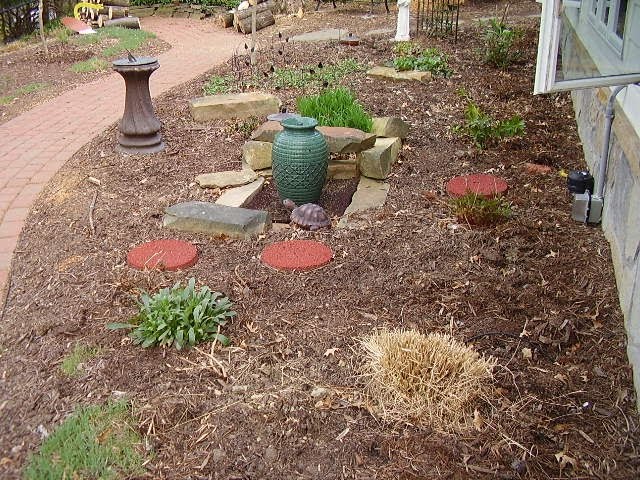
With the temperature in the 80s this week, it's hard to believe that only two months ago the back yard looked like this:


Here's what it looks like now:


And hopefully what it should look like in a couple more months:

Spring Fever

By Annette Dashofy


Yesterday, as I stared at a blank computer screen, struggling to come up with a topic for today’s post, I decided to cheat. I threw it out to my Facebook friends, asking them what I should write. The result? Work vs. Spring.

Yes, after a very long, very cold winter, spring has sprung in southwestern Pennsylvania. Instead of record-breaking snowfalls, we’re now having record-breaking high temperatures. High 80s in early April? Hey, we deserve it.

But with sunshine and warm breezes calling to us, do we give in and head outside? Or apply some of that bum glue and stay planted in our chairs at our computers, hammering out prose?

I have to admit… After months of staring outside at several feet of white snow and stark gray, naked trees, the idea of staying INSIDE staring at black Times New Roman print on a white screen can’t compete with green grass, yellow daffodils and forsythia, and pink magnolias.

Yes, we must be professional about our writing. We must put in the hours at the computer and produce the work.

But… Don’t we need to refill the well? Don’t we need to experience life to write about it? Don’t we need to clear the cobwebs with a long, meditative walk?

Okay, call it rationalizing if you will. However, I feel a need to take advantage of a glorious, sunny day in April after being cooped up in my cave all winter long. It doesn’t mean I’m not working. I can solve all sorts of plot issues while out walking. I can observe all the sensual details of the sun on my face and the warm wind on my skin and USE that in my story.

And isn’t there a cliché about all work and no play?

So instead of reminding everyone to keep writing even when the weather turns nice, I’m going to encourage everyone to seek balance. Don’t miss out on the sunshine (didn’t I hear we only get about 100 days of sunshine a year in this part of the world? No wonder it feels so glorious.) But don’t get so wrapped up in spring fever that you stop writing completely.

Now if you’ll excuse me, I’m going for a walk. It’s supposed to rain tomorrow. There’ll be plenty of time to write then.

Tuesday, April 06, 2010

Final Turn and Heading for Home

by Martha Reed

Easter weekend was a big weekend for me for a lot of reasons, mostly because my late Winter/early Spring calendar booked up quickly and then the events turned challenging: driving up I-79 and over on I-90 in a blizzard for my sisters 50th birthday in Niagara; nervously keeping a wary weather eye on the river in Confluence during our PGH SinC Writer’s Workshop with Ramona Long. Last weekend in Vegas was enough to do anyone in although I have to admit that watching the movie The Hangover when actually in sitting in a hotel room in Vegas in pajamas does add a certain degree of verisimilitude.

But Easter was it! I promised myself, flipping the calendar page into April and May. After we get through with the egg dyeing, chocolate bunnies and cinnamon jellybeans, I am sending the family away for six weeks while I take one final pass at my manuscript in preparation for the PennWriters conference mid-May. It’s my birthday present to myself and I can’t wait to dig in and get it DONE.

Which makes me laugh even as I write it because technically my mss was complete last year when the conference was in Pittsburgh. The hitch occurred when I met an actual retired homicide detective last year and in talking with him for a couple of hours I realized how thin my homicide detective was, which meant – drumroll, please – back to the drawing board.

Which has me curious: have you ever met someone new who triggered a extensive revamping of one of your characters? What was the trigger that did it, and what was your response? Inquiring minds want to know…

Sunday, April 04, 2010

Exhausted!

By Wilfred Bereswill

Did you ever feel like you need to get back to work to rest from a vacation?  That's me right now.  As Jennie Bentley mentioned in her blog Friday, I was in Nashville on Thursday and Friday.

My middle daughter, Kristen, has been an avid hockey fan for many years.  Sometime in her early years, say 7 or 8 years old, she started cuddling next to me on my recliner to watch a St. Louis Blues game.  I guess it was our way of bonding.

For many of those years, the Blues have sponsored a bus trip to a game in Nashville, but you had to be 21 to join in because alcohol was involved.  Every year she reminded me that after she turned 21 we were going to go on the trip.  Well, she turned 21 a couple of months ago and...this year the Blues decided not to have a sponsored trip.  No bus to Nashville with a bunch of noisy, drunk hockey fans.

Well, as it turned out she was on spring break from college and the Blues just happened to be playing in Nashville on Thursday.  So we hopped in the convertible and headed 275 miles south, just the two of us.  We woke up at 5 AM and hit the road, arriving in time to catch the team as they walked from their morning practice to the hotel.  Of course, my 21 year old daughter was in heaven being around a bunch of young, strapping hockey players.  Here are a few of the pictures.


Here is Kristen with (left to right) Jay MacClement, Eric Brewer, Barret Jackman and Roman Polak.  BTW, Barret Jackman inspired a character in my book, an FBI Agent named Bart Jackman.


Kristen with T.J. Oshie.


Kristen with David Backes.

There are about 20 more like this, so you get the picture.  And the smile on her face is genuine.  We walked around downtown Nashville and took in the sights.


Had lunch, dinner and went to the game.


I like Nashville.  They have Ice Girls.


After the game we hit a couple of bars.


Then checked into the Opryland Hotel and Resort.  This place is fabulous, enormous and expensive.

On Friday, we met the fabulous Jennie Bentley for lunch and talked shop.  Jennie is just as wonderful in person as she sounds in her posts and I was really glad she was able to make time in her schedule to meet us.

After lunch, we packed into the car, put the top down and drove 5 hours north.

I had another early day on Saturday, waking at 5 AM again to play golf.  It was the first round of the year and absolutely forgettable.  In other words, I played like crap.

Easter Sunday started early again with our annual Easter Egg hunt.  The hunt is a tradition in our family and the stakes are high.  This year there was about $150 at stake and my three daughters take it seriously.  It's an Easter Egg hunt with attitude.


After the hunt and Sunday Easter Mass we had my wife's family over and they all just left.

I need to get back to work to rest.

Friday, April 02, 2010

O Frabjous Day!

by Jennie Bentley

Twenty three years ago yesterday, my husband called his sister and said, "I'm getting married tomorrow."

It was April Fools Day, so of course she refused to believe him, even though he swore up and down he was telling the truth. As a result, I got married - at the Queens County Courthouse in New York - with no family in attendance. Mine was in Norway, and wouldn't have been able to come anyway. His was in Pennsylvania and thought he was joking.

We got married on a Thursday, because that was the only day my husband had off work. I took the subway to the courthouse. After the ceremony, I crawled into the back off a painters van and drove out to New Jersey, where my husband had a recording session. I ended up leaving my wedding bouquet - sterling silver roses - in the back of that van, and never got them back. We were dropped off in midtown Manhattan sometime after dark, and took the subway back to Queens, where we had an apartment, stopping to pick up a mushroom pizza and a bottle of Diet Coke on the way. Wedding dinner. I refused to let him carry me across the threshold because I was afraid he'd throw his back out.

Swear to God.

Eleven years ago today, I worked a full day at the last job I held - for the Nashville Convention and Visitors Bureau - before I went home and got changed preparatory to go out and celebrate my last wedding anniversary as a childless person. I was hugely pregnant, three days past my due date, and ready to have some fun. Then my water broke. Instead of going to dinner, we went to the hospital. By 2 pm on Saturday, April 3rd 1999, I was a mom.

In other words, this is a big weekend for us, with an anniversary, a kid birthday and accompanying sleepover, and Easter, not to mention that everyone's favorite cross dresser, Freddy, is in town. I'm desperately trying to figure out a way to get together with him, but with school out for Good Friday, don't know that I can. Not much writing is getting done either, which is why I'm cobbling this post together out of bits and pieces of personal information you probably wish I'd just keep to myself.

The weather has finally turned warm in Tennessee. We had so many snow days this year that I thought the kids would have to stay in school until Midsummer. Not so. They're adding to the school day instead: thirty minutes a day for a month and a half. And instead of making it easy for me, they're starting one school thirty minutes early, and letting the other out thirty minutes late. Instead of gaining thirty minutes of writing time, my day just lost an hour.

I'm fretting. DIY-4 is in the can and in New York with my editor. The release date is January 2011, for those of you keeping track. I have to write DIY-5 by September, and at the moment it's heavy going. I'm just not feeling it. I'm sure I will, once I get into it, but I'm already at the end of chapter 3 and ought to be feeling something by now. I like the idea, and the way I've got things set up; I just can't seem to get a handle on the writing of it. Most likely it'll all come together in the end, but at the moment, it feels like book 5 will be one of those disasters that never come out right.

I could use some title ideas, by the way. The prevailing thought these days seems to be that my titles should be based on the example of This & That, as in Spackled and Spooked, Plaster and Poison, and Mortar and Murder. (I wanted to call book 4 Island Getaway. It sums the story up perfectly. My editor disagreed. Not renovatey enough.)


Anyway, book 5 is when my protags, Derek and Avery, film a TV show called Flipping Out, the basis of which is flipping a house - i.e. doing a quick renovation and putting the house back on the market - in a week. It's enough to drive anyone to murder, believe me. I need a title that suggests renovation, murder, mayhem, and television. Just in case anyone has any ideas.

I guess that's it from here. Have a wonderful April, everyone. See you next month!

Thursday, April 01, 2010

Fall Back. Spring Forward. Fade Out.

by Paula Matter


Spring. My favorite time of the year. I love moving the clocks ahead, giving us more daylight. I love seeing the sun set later and later. Just seeing the sun brightens my day! After the awful winter I had, well, more on that later.


Although I don't know the names of all plants, trees and flowers in my yard, they're all bursting with buds. Two trees we thought we were going to lose last fall look happier this spring. And the grass is green! The daffodils (I do know what they are) are in full bloom.


Spring, glorious spring. A time for rebirth. Beginnings. I nearly shouted with joy when I saw my first robin a week or so ago. And a bluejay! Yeah, I know that little guy over there isn't a bluejay, but I'm kind of in a hurry and didn't spend time looking for the correct image.


I haven't seen any butterflies yet, but they can't be too far behind. And bumblebees! Their arrival means the flowers are in full bloom. 


Aren't these the prettiest pictures? So bright, colorful, cheerful. I chose them to make what I have to say a little easier for me. My blogmates and our regular readers know I haven't posted since last year. Instead I invited a bunch of great authors to appear on my scheduled days during the last three months.

I used those three months to weigh the pros and cons of a decision I knew I had to make. A very important decision. And today was my self-imposed deadline for that decision. Once I type the words here, that's it. I won't take them back. There are no do overs which is why I took my time coming to this decision.

Wow. This is much harder than I thought. Okay. Here goes. I've quit writing.

I'm just not cut out for it. Writing well takes discipline, perseverance, confidence, and talent. On a good day I might've accomplished one, two, maybe three of those, but there weren't enough good days. I know when I'm beat.

So instead of wasting my time agonizing over the right word, the right sentence, the right scene, I'm giving up. I have plenty of projects around the house to keep me busy. So much spring cleaning to do! Maybe I'll learn the names of all the plants, trees and flowers.

Thanks for reading. I wish you all the best.

Wednesday, March 31, 2010

Looking for a Popcorn Tree

Today we welcome recently published mystery novelist Norma Huss, who closes out our month of writing inspiration by talking about who and what inspires her. Welcome, Norma!
By Norma Huss
This past winter I looked out my window and saw a popcorn tree. Wow! I had to take a picture.

Well, you know it wasn’t ACTUALLY a popcorn tree. It was a tree with branches completely devoid of leaves, but snow had gathered in so many heavy clumps it reminded me of little popcorn balls. Today, now that I think of it, there has to be a story there somewhere! So, how can I use a popcorn tree?

I’ll go to my inspiration collection, writerly quotes I’ve collected over the years. My very favorite is one I’ve printed up and taped right over my computer. I glance at it every day, and try to do my best to live by this:
“That was the moment I changed from an amateur to a professional. I assumed the burden of the professional which is to write even when you don’t want to, don’t much like what you are writing, and aren’t writing particularly well.” Agatha Christie
But today, I need more advice, something that gathers my notes and gives me direction. Perhaps this one:
“Keep a notebook, honey, and someday it will keep you.” Mae West
Sorry, not that one. (I could only wish!) Aha! How about the next quote?
“The secret of being a bore is to tell everything.” Voltaire
Oops, that does SO not go with Mae’s quote. But I have more quotes.
“Never confuse a single defeat with a final defeat.” F. Scott Fitzgerald
VERY useful when one is busy submitting that lovely manuscript to a multitude of agents, but does it help me today? I must dig deeper.
“Always remember, perseverance is as important as talent.” Dean Koontz
“The professional writer is the amateur who didn’t quit.” Richard Back
Yes, I am inspired. I can do it. Let me think a bit. How about a children’s story. Maybe a picture book manuscript. Except I’m a mystery writer. But are there picture book mysteries? Could be the first of a collection of “what-is-it?” pictures, you know, the close-up that doesn’t provide enough external clues to.... How about an adult mystery. It could make a good title: Dead Under The Popcorn Tree, or Murder By Popcorn. No, no, that’s really bad! How about.... Is that another quote I hear banging on my door?
“Don’t think! Thinking is the enemy of creativity. It’s self-conscious, and anything self-conscious is lousy. You can’t try to do things; you simply must do them.” Ray Bradbury
There you go! And guess what? That’s the quote I’ll use. Just plunk a popcorn tree down on the website, and ramble (with quote collection in hand).

Have you ever seen a popcorn tree? How about some other strange and wonderful sight that inspired you? Did you find advice that really helped? I must admit, the first one I quoted here has helped me through many a session of writing that was not going particularly well. Do you have a favorite quote?

A postscript from Norma:
Wings ePress, Inc. published my first novel, a mystery titled Yesterday’s Body, last October—the same month my mother turned 100. Naturally, I dedicated it to her. Although she has never actually given me writing advice, she’s my inspiration. She’s written poetry all her life, mainly as gifts for others to celebrate birthdays and special events. Last year she wrote one (that didn’t quite have the rhyme and rhythm of her earlier ones) for one of the caregivers at her assisted living home. It was all about the dogs the woman brought for a visit, and they published it in their newsletter.

Tuesday, March 30, 2010

The best writing advice Hallie Ephron received

Today Hallie Ephron -- a terrific novelist, writing teacher, reviewer and non-fiction author -- takes a turn at discussing our March theme.
 
By Hallie Ephron

The best writing advice I ever got came from Arthur Edelstein, a wonderful writing teacher who ran a fiction writing seminar at Radcliffe Seminars. Sadly, Arthur died a few years back but I keep a post-it in my office with two insights. These are so simple but at the they felt like bolts from the blue:
1. Write scenes
2. Kill the narrator
Write scenes? Arthur was the first person to alert me to the fact that scenes (not chapters) are the atomic particles of which novels constructed. A scene is bounded in time and place, though characters can enter and exit. When the scene shifts, the author double spaces. If you keep this in mind, it helps anchor your novel in drama (showing) instead of summary (telling). Chapter breaks can come anywhere, and the author can insert a chapter break in a scene to modulate the pace.

Kill the narrator? Well, not literally. But the point here is that the author’s voice doesn’t belong in (most) modern novels. The voice/viewpoint telling the story shouldn’t be the author but one of the characters, and each scene is narrated start to finish by just one viewpoint character. I know there’s a lot of controversy about this, but I still prefer an anchored viewpoint in each scene.

How do you pick which character narrates if your novel has multiple narrators? Tess Gerritsen gave me some great advice when I asked her how she picks which of her character narrates: “Writers are told to give the point of view to the character who has most to lose in a scene. I would disagree totally. Choose the character who is most uncomfortable, the most off balance.” Great advice.

And finally, following Anne Lamott’s advice from “Bird by Bird,” I long ago gave myself permission to write shitty first drafts.

Hallie Ephron is a writer, book reviewer, and teacher. Her novel "Never Tell a Lie" (1/09, Willliam Morrow) is a finalist for the Mary Higgins Clark Award and for the Salt Lake Libraries Readrers Choice Award. It has been optioned for film and has been translated into 7 languages. Hallie is also an award-winning crime fiction book reviewer for "The Boston Globe." Her Writing and Selling Your Mystery Novel" was nominated for Edgar and Anthony awards. She teaches at writing workshops across the country. She is also the author of "The Bibliophile's Devotional" and "1001 Books for Every Mood."

Tomorrow newly published author Norma Huss will share who--and what--inspires her.

Monday, March 29, 2010

Writing Advice: Is there anything new to be said?

Today we're joined by the fabulous Kate Flora -- writing teacher, mystery novelist, non-fiction writer and short story author. Welcome Kate!
By Kate Flora


I can time the beginning of my writing from the birth of my second son. That’s when I put down my pencil and left the law library, and my yellow legal pad, behind. At home with two small boys and no job after years of working, I panicked, thinking, “But I’ve always had a job. What will I do?” I’d always wanted to write. Writing seemed to be something I could fit into the spaces of a mother’s life, between naps, during preschool and play dates, so I bought a computer and sat down to write a mystery. Nine sleepless, crazy months later, I typed “The End” on the last page of a very bad novel, did the happy dance, put it in the drawer, and started another. That was almost twenty-seven years ago. The second book took twice as long and was worse than the first. Undaunted, I started a third.

All three of those books now sit in a drawer somewhere, though I’ve been known to claim that they’re locked in a safe which is encased in cement, wrapped in chains, and at the bottom of an unnamed river. The first book I sold was the fourth book I’d written. By the time it was published, I’d spent ten years in the unpublished writer’s corner. I learned two important things from those ten years, and those practice books: the value of persistence and discipline, and how important it is to believe in your own work. From the next many up and down years—when my career was going smoothly, when it was tanking, and the times in between, I learned the importance of taking chances.

What about persistence and discipline? Well, I’ve been teaching writing for almost as long as I’ve been published—my first book came out in 1994—and for all of that time, and the many wonderful students I’ve had, I’ve also seen one consistent thing: students who just want to sit there and write down the magic rules, so they can then go out and write a best-seller and become fabulously rich. Many aspiring writers don’t want to hear the word “discipline,” and long to believe in the fluttering muse theory of writing. You sit in coffee houses, drink wine, schmooze with friends, take long, meaningful walks, and when the words are ready, they will tell you and you can go and write them down, channeling them like a medium in an ecstatic trance.

There are a lucky few for whom writing is like that. Sadly, for most of us, writing is more like going to work, even, perhaps, like going to the gym. If you do it consistently and regularly, you get better at it. Stronger, more flexible, able to wrench those words and sentences around without back strain or acute pain. There will still be those days when it seems like every sentence is carved from your forearm and nailed to the page, but that’s part of being a writer. And persistence? It takes a long time to write a book even when you’re showing up at your desk every day. Writing a book is like eating a whale. If you eat a little every day, eventually, you’ve eaten the whole whale. But if you don’t show up at your chair, even on the days when you stare at the daunting blank whiteness of the screen for an hour while you grind your teeth or retype “The quick brown fox jumped over the lazy dog,” until your vision blurs, you won’t be there on the day when it does become like ecstasy. When the words flow, you’re in the zone, you know your characters, and suddenly you’re writing the sentences, the scenes, the dialogue you’ve dreamed of writing.

Are there tricks, strategies to use when the blank screen seems to be winning? A zillion. You can google writing tips and spend the next ten years reading them and taking notes. Or you can, as my mother used to say, “Keep your seat in the seat.” And write. Give yourself a goal, a set number of words you have to write before you can go stand outside and scream. Promise yourself a reward: one first class chocolate when you hit 500 words. Be playful: if your character is about to fall into bed with the guy she’s been hating for the last fifty pages, you might show up at your desk (assuming you write at home and not at the public library) in something sexy or provocative. If your character is confronting the bad guy, you might wear shoes YOU can run in. If you’re feeling like the world isn’t taking you seriously (That painful ‘Are you published?’ question) or you’re not taking yourself seriously, dress for success when you show up at the desk. Choose a type of music or theme song for your character, to play for times when he or she doesn’t seem to be working. Keep a running list of research questions, and when you hit the wall, take a research day and go get yourself some answers. Be kind to yourself—when it’s done well, writing looks effortless. But a lot of effort goes into producing that kind of writing.

And we never did get to the matter of taking chances. Perhaps the next time I visit Working Stiffs?

Kate Flora has earned awards and starred reviews from critics from her mystery and suspense novels, her true crime, and her short fiction. She is the author of eleven books, including series mysteries, a stand-alone suspense novel, and an Edgar-nominated true crime. Flora’s stories have appeared in nine anthologies. She teaches writing for Grub Street in Boston.

Be sure to come back tomorrow when best-selling author and writing instructor Hallie Ephron shares the best writing advice she ever received.

Friday, March 26, 2010

New Beginnings

By Laurissa

The month of March is a fickle one: one day, birds are chirping, and the sun is shining; the next, it’s raining or even possibly snowing. There’s no telling what to expect from Mother Nature during this month. While I’m thinking about it, I guess that’s what I love about this month – waking up each morning, anticipating the warmer weather to come, and knowing there’s a chance that today might be that very day.


It’s this idea that today might be that very day, which I find inspiring, not just during the month of March, but every day. How often have we all heard, “today is the first day of the rest of your life?” Or, to put it another way, “it’s never too late for a fresh start” or a “new beginning.” I’m inspired to know that I don’t have to continue doing the same old thing that didn’t work for me in the past; it’s a new day -- I can do things differently…today. Actually, it doesn’t even have to be a new day for a new beginning. Sometimes it can be just a simple decision to change my attitude or thought process, and I’ve created a fresh start. I’m inspired to know it’s never too late to start over or to make a change.


Throughout this month, I’ve been reading the wonderful advice and insight offered by the other Working Stiffs and guest bloggers. I’ve not only read each and every post and the comments made by readers, but I’ve also been taking notes. As a new writer the insight I’ve gained this month from experienced writers has been invaluable. Thanks so much for sharing your experiences and writing advice.


I think the idea of starting anew is also what draws me to write. Through writing we have the opportunity to create on each new blank sheet of paper whatever we want to create. We don’t have to write what we wrote yesterday and we don’t have to write short stories because that’s “our thing.” We can fill that blank sheet of paper with whatever words we choose…it’s a new page to be filled however we want to fill it, and that to me, is very inspiring.

Thursday, March 25, 2010

Don't Take It Personally

by Joyce

One of the pitfalls of being a writer is having to deal with rejection. I can't think of any other profession where it's possible to get slammed down on a regular basis. Even actors don't get those dreaded letters in their email or mailbox.

And talk about mood swings! Euphoria when the email arrives--you're sure she's asking for more material, or she wants to know a good time to call because she loves your book. You click and start reading. Bam! Another rejection. You go looking for chocolate or alcohol--or both.

Even bestselling authors have had their share of rejection. J.K. Rowling and Stephen King were rejected numerous times before their first books found a home. Gone With the Wind was rejected 38 times. Jonathan Livingston Seagull was rejected a whopping 140 times. The list goes on and on. (Google "writer rejections" sometime. You wouldn't believe the number of sites that come up.)

Believe me, I've had my share of rejections. Over the years they've ranged from the typical form rejection to the send-me-your-next-book kind. Some have been helpful and gave me specific advice on what needed to be fixed. Some were just a "No" scribbled across the top of my query letter. Others were downright blunt ("I thought it would be better."). 

There's no doubt that rejections hurt. Even the "good" ones. But no matter what kind of rejection you receive, learn not to take it personally. I know our manuscripts sometimes feel like our babies. We've poured our hearts and souls into them for months, and in many cases, years. Try and remember that what we've written is only a product. Some will like it--others not so much. Some might even hate it. Remember that the agent or editor is rejecting the product, not you. It's not always easy, but it's part of the process.

I'm not sure where the saying came from, but remember--what doesn't kill you makes you stronger. Polish up that next query and send it off.

Does anyone have any rejections stories to tell? What is the worst rejection you've received? The best?

Wednesday, March 24, 2010

Calling in the Experts

By Annette Dashofy


On Monday, Gina wrote about critique groups. I love my critique buddies. But reading one chapter at a time has its limitations. Therefore, I have a second line of defense, known as my first readers.

Currently, I’ve completed my second draft, and am now sending that complete manuscript to this select group of “experts” to read and vet the story as a whole.

How do you go about choosing your own first readers? There are probably as many answers to that question as there are writers. But here is a list of who I’ve chosen and why.

A friend who writes in another genre and who also happens to work in the field of psychology. There is a psychological aspect to my story and I want to know that my characters are reacting and responding in an appropriate manner for the circumstances.

A non-writer friend who works in the computer field. Part of my story revolves around an old computer and some data contained within it. I need to know if my technological details are correct. I’ve done the research in advance, but does it work in the context of the story?

A non-writer friend who is an avid reader of all genres. She can tell me if the story works for her as a reader. Does it flow? Does it make sense? Have I answered all the questions and wrapped up all the loose ends to suit her?

Then I have three mystery writer friends who will vet the story from their trained perspective. Did I play fair? Are the necessary clues hidden well enough? Too well? Plus, they will also comment on the same stuff that my non-writer/avid reader does.

I should mention that our own Joyce Tremel is in that last group and I expect her to vet my police secretary character and thread, too. What did I get wrong? What wouldn’t happen that way, even in a fictional department where I have some leeway to make up the rules and procedures? And, yes, what did I get right?

So my last bit of advice for the month is this: find a good critique group, finish the book, and THEN compile a group of experts to be your first readers.

Tuesday, March 23, 2010

SHOT TO DEATH Blog March

Today we welcome the prolific Stephen D. Rodgers, author of more than 600 stories and poems. You can read some of them in his riveting short story collection "Shot to Death" published this month.  Stephen is visiting Working Stiffs as part of his month-long "Blog March."

By Guest Blogger Stephen D. Rodgers

The only guy in the packed bar, Joey took one long look and  then snorted in derision. - UNWEAVING THE RAINBOW

So begins one of the 31 stories contained in SHOT TO DEATH (ISBN 978-0982589908). Within that beginning lurks the ending to the story and everything that happens between the beginning and the end. Or at least it seems that way to me.

And the reason I believe that is yet another story.

Back in 1994, I attended the Bread Loaf Writers Conference in Middlebury, Vermont. I think I might have been the only person on campus who read and wrote genre fiction. (A shame, really, since there was a fantastic used bookstore in town where I found many genre treasures.)

Anyway, it's fair to say that I was a curiousity.

The benefit to being outside the culture was that I was free to roam. While others were sitting around chatting about shared interests, I was wandering, eavesdropping, gathering information. (Stephen D. Rogers, PI.)

Then one day I slipped into a lecture that wasn't on my schedule and heard thirty seconds of instruction that changed my life. The presenter (I don't recall her name) used the chalkboard to illustrate how the first line of her story created three threads that came together to produce the end.

I slipped out of the room and spent the next two hours walking through the woods, mulling the implications of what she'd said.

And then I returned to my room and wrote.

For a chance to win a signed copy of SHOT TO DEATH, visit www.stephendrogers.com/Win.htm and submit your completed entry. Then visit the schedule at www.stephendrogers.com/Howto.htm to see how you can march along. And then come back here to Working Stiffs to post your comments! Phew.

Stephen D. Rogers is the author of SHOT TO DEATH (ISBN 978-0982589908) and more than 600 stories and poems. He's the head writer at Crime Scene (where viewers solve interactive mysteries) and a popular writing instructor. For more information, visit his website, www.stephendrogers.com, where he tries to pull it all together. 

SHOT TO DEATH contains 31 stories of murder and mayhem. "Terse tales of cops and robbers, private eyes and bad guys, with an authentic New England setting."- Linda Barnes, Anthony Award winner and author of the Carlotta Carlyle series.

"Put yourself in the hands of a master as you travel this world of the dishonest, dysfunctional, and disappeared. Rogers is the real deal--real writer, real story teller, real tour guide tothe dark side."- Kate Flora, author of the Edgar-nominated FINDING AMY and the Thea Kozak mysteries

"SHOT TO DEATH provides a riveting reminder that the short story form is the foundation of the mystery/thriller genre. There's something in this assemblage of New England noir to suit every aficionado. Highly recommended!"- Richard Helms, editor and publisher, The Back Alley Webzine

Monday, March 22, 2010

Would You Like a CRITIQUE With That?

by Gina Sestak

OK, now you've got it written.  What do you do with it?  Do you pay some stranger mega-bucks for editing or do you beg your friends and relatives to read this, please?

Perhaps you should join a critique group.

Some critique groups can be brutal, sending aspiring authors whimpering into the night, resolved to never write again.  I've experienced a few of those -- they never make me want to sharpen up my writing skills, just practice some karate on the *!&^# s who've dared to dis my work.  But this post isn't about that kind of group.

The kind of critique groups I am discussing here are those made up of people who read and write, people who are willing and able to provide honest feedback, and to do it in a way that is neither too supportive nor too nasty.

Don't get me wrong.  I'm not pretending to be an expert of critique groups.  I have, however, participated in a few over the years:

Intense:  This one met weekly at a private home.  Every one of four to ten participants would bring a chapter -- about 10 pages -- every week.  We would silently read every chapter to ourselves while chatting and eating*, then discuss each and every one -- all in about three hours time.   I found this very helpful with things like flow and logic.  It also had the advantage of getting through a book length manuscript in a few months, which made it easier for the participants to remember who the characters were and where the story left off last time.
________
* just as an aside, for some reason critique groups seem to double as eating groups.  The group I presently participate in focuses on one writer each week; that writer is expected to email the work to be discussed to everybody else ahead of time, and to show up for the meeting bearing snacks.


Read aloud:  Participants would read each other's work aloud to the group.  If you ever want to know whether or not your sentences make sense, get someone to read them to you!  This group was great for catching grammar goofs.  The group would provide feedback after the reading finished, unless something was so wrong it needed an immediate comment.

Read ahead:  Participants would provide a chapter or set number of pages ahead of time to the other participant.  This was especially helpful for line editing and catching typos.   The group members discuss the work in detail, then provide their written comments as well.

Directed/undirected.  Some groups are peer-to-peer, while others are under the direction of an experienced writer/editor.  I have been in both types, and have developed a slight preference for the directed kind in which the voice of practical expertise is represented.

All of these groups were helpful in one way or another with revision and editing.  Perhaps most of all, though, they provided like-minded people with whom to share the writing experience.

What do you think of critique groups?  Do you participate in one?  Why or why not?

Friday, March 19, 2010

Inspiration For Writing

By Patricia Gulley

Warning: Rated R for Rant

And I just finished reading an article about how happiness, or even just acting happy, can help you avert heart disease, strokes, hardening of the arteries and a whole slew of problems—so consider reading only if you are not at risk.

This was a tough one for me, especially after reading all 18 blogs prior to mine where everyone said everything I’d ever heard or read and felt was good advice.

So, as I sat ‘a thunkin’ and getting no where on a marketing idea I’d hoped would go through and several other things got stopped in there tracks, I got rather angry. And while I was whining and brooding, and generally feeling the world had it in for me, I realized I beat that invisible horse for several minutes before I began to wind down. A brief look around to be sure no one was in the house (well I sure hope so) to catch me acting like a big baby made me feel a drop better, and I went back and tweaked and rewrote in a better mood, and send the stuff off again.

Then it occurred to me! We need that too. We need to get mad about what we aren’t doing or telling ourselves we can’t do because we aren’t inspired or our spirits are low. If we don’t nip it in the bud, it can lead to the belief that we’ve hit a blank wall and will never have another creative idea.

To quote Lula, “Nuh”. (Stephanie Plum’s sidekick.)

So, how to use a good brood, whine, sulk, annoyance, gripe session, funk, pout, crying jag, and willingness to kick senseless anything that suddenly appears in front of us to our advantage.

Trying to be up and inspired every working minute can be as exhausting as trying to be happy with a smile on our face 24/7. (Well, me anyway, I sometimes brood that there really are people capable of that.)

So let’s try getting good and mad, and think all those evil thoughts we know are lurking in the back of our minds. BRING them forward, curse everyone and anyone, and let the anger flow over us. Bath in the fire of that self-righteous assurance that not only do we have The Right, We Are Right! And they ain’t!

Hold on to it, keep it going, red in the face yet—now let it go. There, didn’t that feel great.

Okay, once the embarrassment and total feeling of acting and/or thinking like a bratty kid washes out, you are going to be surprised how cleansed you feel. Yes, and kind of empty. Which is good because you can fill that emptiness with INSPIRATION! Read those previous 18 blogs and fill up. Now get down to writing.

If you disagree with me, I’ll reply after I finish brooding and ranting.

Thursday, March 18, 2010

Working Stiffs Welcomes Alan Orloff


Working Stiffs today welcomes guest blogger, Alan Orloff!

Thanks for inviting me today, Paula—I’ve always wanted to be an honorary Working Stiff!


If you're a writer, I'm sure you've been given plenty of writing advice. From other writers, from readers, from writing instructors, from editors, from agents, from your mother, and from the barista serving you latte at the local coffee shop where you toil because it's too freaking noisy with the kids at home.

Any of these "tips" look familiar?

Query agents

Don't query agents

Write in the morning

Write at night

Get Matt Damon to play your protagonist in the movie version (um, okay!)

Outline

Don't outline

Listen to your characters

Whatever you do, for Pete's sake, don't listen to your crazy characters! I mean, come on, they're crazy!

I know, confusing.

[Aside: When I found out the theme of this month's blog (best writing advice), I didn't know which morsel of advice to blog about. So I decided to do what I usually do when faced with a complex decision. Leave it to chance. I spun my Wheel O' Advice and it landed on, "Always ask for chopsticks with your take-out Kung Pao." Which, although good advice, didn't have anything to do with writing. So I spun it again, and it landed on GET HELP!]

I don't know about you, but I wasn't born knowing how to write a novel and get it published. I've had to learn what to do every step of the way. So I listened when people told me to get some help.

Some suggestions:

Take a workshop. I started with an Adult Ed writing class, and moved on to a few workshops at a local writing center. An excellent way to learn the nuts and bolts of writing from experts.

Read some writing books. There are plenty of them out there, covering everything under the sun: writing techniques, inspiration, how to get an agent, how to fire an agent. Many are not worth the time, but two of my faves are Stephen King's ON WRITING and Anne Lamott's BIRD BY BIRD.

Join a critique group. Not only will you get feedback on your writing, you'll learn a lot (a ton!) by reading and critiquing other writers' work.

Attend a conference. They're great places to learn about both craft and the writing business. If you have a specific question about something, there's bound to be someone there with the answer (mystery writers are the most generous bunch of twisted psychos in the world). It's also a great place to network. You never know, someday those other writers may become part of your support group.

Join a professional organization. A terrific way to learn more about the business of writing. What could be more enlightening that talking with other writers who have already accomplished what you are setting out to?

Writing and publishing are already hard enough. Do yourself a favor and get all the help you can!

Alan Orloff's debut mystery, DIAMONDS FOR THE DEAD, will be released in a few short weeks by Midnight Ink. The first book in his new series, KILLER ROUTINE - A Last Laff Mystery, featuring Channing Hayes, a stand-up comic with a tragic past, will be out Spring 2011 (also from Midnight Ink). For more info, visit http://www.alanorloff.com/

Wednesday, March 17, 2010

What's on YOUR bookshelf?

by Annette Dashofy

Last week, I wrote about learning. Today, I’m getting specific. Let’s discuss books on writing. There are a ton of them out there. And I have several shelves in my house devoted to them. Some I use for reference, some I use to check facts. Some I skim through, and others I devour and return to again and again.


Here are some of my favorites.

In the “Devour and Return to again and again” category:

GMC: Goal, Motivation, & Conflict by Debra Dixon- I love this book. When a scene isn’t working or a character feels two-dimensional, I refer back to this equation and usually find I’m missing one of these three necessities.

Creating Character Emotions by Ann Hood – This was recommended to me by a former critique buddy and I’ve recommended it over and over ever since.

Bird by Bird by Anne Lamott – Can’t say enough about this one. I can sit down anytime, anywhere, and open it to any page. I’m immediately drawn in and find myself smiling and nodding in agreement. It may not tell you HOW to write, but it will tell you how to KEEP writing when you’re having a tough day.

In the “Reference and Fact-Checking” category:

Police Procedure and Investigation by Lee Lofland – Too many times I’ve spent hours on phone calls and emails trying to track down a fact only to open this book and find the answer right there. I’ve learned my lesson. Check here FIRST.

Forensics by D.P. Lyle – Another go-to book to save research time.

Deadhouse: Life in a Coroner’s Office by John Temple – Less well known, but great stuff. It’s not a reference book per se, but if you’re writing anything that deals with forensics, morgues and/or autopsies, you really need to read this.

The Crime Writer’s Reference Guide by Martin Roth – The title says it all.

Of course, I have many, many more, but these are my favorites. Now it’s your turn. What books do you keep within easy reach and refer to over and over?

Tuesday, March 16, 2010

I Survived the Confluence Writers Retreat!

By Martha Reed

I belong to the Pittsburgh chapter of Sisters in Crime and I’m starting to think we have some funky mojo going when it comes to scheduling our events and running into freakish weather.

Last January, during our Hallie Ephron Workshop, a surprise blizzard blew into Pittsburgh exactly one hour before the event was scheduled to begin. An ice storm blasted Western Pennsylvania the day of our Holiday Luncheon this year and just last weekend – after months and months of planning – our Writers Retreat featuring special guest teacher and moderator Ramona Long was situated in Confluence, PA, which if you’ve been watching the news was Ground Zero for the snowmelt flooding on the Yachagheny river on Saturday.

(Of course, if you’re really clever, you’re wondering why a group of reasonably intelligent writers overlooked the meaning behind the word Confluence but we’ll let that one pass.)

What can I tell you? I know I was the last person driving into Confluence on Saturday morning at 8:15 AM before the roads were closed. Some folks expressed a little dismay at my decision but I knew my Sibling crew was still at the Retreat house and there was no way I was going to let them have all the fun without me!

After being reassured the house was safe, we soldiered on with our writing discussions and workshop sessions although I have to admit it was a little tough to focus on the discussion at hand when I could see the water rising in the yard outside – and I mean see it rise in front of my eyes, not just notice that the river was creeping in. There was a square white No Hunting sign posted on a tree on the opposite side of the river and as I worked to develop an effective pitch for my new novel the sign disappeared underwater. It gave me pause for thought. The Retreat house was situated between an active freight line and the river and whenever a train went by - and it went by often - the engineer would point at us and laugh. I wasn’t reassured by his gesture.

But all in all, there was a surprising sense of camaraderie and lots of delicious food, and Ramona led the discussions brilliantly and exercised tough love when necessary and I think we call came out of the weekend feeling invigorated and exhausted all at the same time. The true test of success will be when we schedule our next Retreat – I’m betting that everyone at the Retreat this past weekend will be the first ones to sign on again.

We stopped in Ohiopyle (Guess what that word means!) on our way home to observe the usually reasonable Falls. On Sunday it sounded like Niagara. Have a listen, and try to imagine living next to that much live water for 48 hours. It was awe-some and inspiring and I can’t wait to do it again.

http://www.youtube.com/watch?v=GraF_k6Rbq8

Sunday, March 14, 2010

Persistence Is Not Stubborn

By

I was going to title this blog, “Maybe You’re Not Good Enough – YET”.  But I didn’t want people to do a double-take on the URL thinking they might have clicked Janet Reid’s Blog.  Sorry, Janet.  I, for one, like honesty and that’s what you bring to this crazy business. 

This month we are offering the best writing advice we can give.  So why the hell am I talking about not being good enough?  It’s certainly not very uplifting.  But for me, my biggest motivation is rejection.  Plain and simple, it pisses me off when somebody tells me my work is not good enough.  And I don’t mean I get pissed off in a bad way.  It’s in my nature to prove that person wrong.  When I’m challenged, I work harder.

I have always said that all the compliments in the world won’t make your writing better.  It’s constructive criticism that is the most valuable of things.

My motivation for my first novel now resides in a five-inch accordion file in my den.  By now it’s buried under piles of office supplies, my to-be-read pile and a copy of Michael Crichton’s State Of Fear.  But, while I was querying they were front and center and forever present.  They stood there on my desk taunting me.  I heard them saying things like, “You’re not good enough.”  “Give up and go home.” 

I suppose some people listen to those rejections and give up.  Those people will never share their writing beyond some friends and family.  If you aspire to be a writer, you’d better thicken your skin.  This is not a task for those with tender feelings.

On the other hand, going back to the Blog’s title, you need to be willing to listen to criticism and use it.  Submitting the same thing over and over again is just plain stubborn.  Sure, there may be a good business reason why a particular agent might not accept a really great manuscript, but if you get 20 or so form rejections, then you might need to work on it some more. 

Before you learn how to write, you need to learn how to listen.

I’ve said that I don’t care for critique groups.  I’ve been in a few and they have failed miserably.  I received conflicting advice, and made changes that I didn’t believe in.  Bottom line, if you’re in a critique group take advice with a grain of salt.  For me, I sought advice from other established authors that I had met and made friends with.  For Jennie Bentley it was Tasha Alexander and for me it was John Lutz and Bobbi Smith.  Some of the best advice I received came from Bobbie Smith’s freelance editor.  I sent her a good portion of my manuscript and got advice.  Is that cheating?  I don’t think so.  She didn’t do any writing, she merely pointed out some things, some very important things.  And after spending an hour telling me what was bad about my story, I asked her a simple question.  “Do I have 300 pages of crap, or do I have something worth working on?”  Her answer was short and to the point. She said I had a great story.  I just needed to learn how to tell it.

So, what’s the best advice I can give?  Listen and be willing accept constructive criticism.  Be committed to making your work the best it can be.  Also, no matter how good you are or think you are, writing is fairly subjective.  Your work can always be better.  Seek qualified help.

Friday, March 12, 2010

Never, ever give up

Kate Douglas is our guest today. Welcome, Kate! 

Thanks to Joyce for the invitation to blog--I love the topic. Believe me, with a twenty-year history of rejections between my first submission to my first New York contract, I needed all the advice and pithy sayings I could get to keep me going! But here I am, fresh off the release of DemonFire, my first mass market in my new paranormal romance series from Kensington Zebra, awaiting the imminent release (March 30) of the eighteenth book (that's counting novels and anthologies) in my Wolf Tales series, (Sexy Beast VIII-Chanku Spirit) and working on a proposal for a new project I'm planning to have my agent pitch to my editor.

So finally, after a long and frustrating career as an "aspiring" author, I can finally say, "Yep, I are one now. Really!" So, what'd it take to keep this old broad plugging along, writing, revising, submitting, dealing with rejections, rewriting, submitting again, ad nauseum?

It took friends who encouraged me, editors who kept asking me to send something else even as they rejected the stories I HAD sent, and an inborn stubbornness that probably drove my parents nuts but kept me focused on my goal of publication. I'm going to share some of the things that have stuck with me, words of wisdom I've heard from other writers, now published, who understood the frustration of rejection, the joy of writing, and the voices that wouldn't let go of me until I sat down and wrote the words.

Writers write. Sounds pretty simple, but it's so damned true it hurts. Writing isn't merely what we do, it's what we are. So many of us are defined by our words, by the stories we tell. When friends question why we keep at it in the face of rejections, it's impossible to make them understand the truth-writers write. They can't NOT write. They just do it.

My world, my rules. I love this one. Don't let ANYONE tell you there are rules you have to follow when you write your stories. You are the one in charge-you are the one hearing the voices, listening to the muse, writing the words. If you want to write in first person, do it. If your hero doesn't fit the "hero mold," tough shit. Write him the way you see him. One of my books has a food critic with sexual identity issues. When my agent submitted the book to Harlequin, the editor said she loved my kick-ass heroine, but wanted me to tone her down, and the hero would be much better as a cowboy. Huh? I sold Last of the O'Rourkes to an epublisher and it went on to get wonderful reviews and even win a couple of nice awards. My world, my rules, and Seamus O'Rourke was a great food critic-and Kat Malone could easily kick his ass.

Make it work. Get it done. It's all about the book. I actually have this one printed out and hanging on my wall. It's a reminder to keep my priorities in order.

Write your own story. Don't write what you think an editor wants. Don't write what you think the public wants. Do not write the book your critique partners or group thinks you need to write-write the book YOU have to write, and when you write it, own it. Believe in it, be involved in it from the inside out until you know that book, those characters, that setting as if everything about the story is real. If it's not real for you, how can you expect it to be real for your readers?

When I first wrote Wolf Tales in 2005, the series was at the request of Margaret Riley, who was opening up a new epub called Changeling Press. She wanted something hot and unusual to launch her new venture, and asked me to write a series of 12,000 or so word stories that would 'blow their socks off.' Margaret envisioned short books that readers could read on their PDAs or other small electronic devices-so I started writing, one episode at a time, and Wolf Tales was born. In the beginning, there was no real plan, other than to push boundaries and break all the "rules" I could think of. I developed my world of Chanku shapeshifters and their mythology sort of grew with each story I wrote. My agent read the first five stories and passed them on to Audrey LaFehr at Kensington Publishing, who loved the concept but had no line where they would fit.

That's how Kensington's Aphrodisia imprint came about-on the strength of five short stories that belonged to an epublisher. Margaret generously returned my rights and I signed a contract for three novels and three novellas-all those shorts made up the first book, but I had absolutely no idea what was coming next. I still write the stories the same way-no plan, no real idea, just a gut-level knowledge of my characters. This was my story from the beginning, something I wrote for a friend, but also to please myself. All those years of rejection, and yet it was the first project that was written totally without any plan of going after a NY contract that got me that contract.

Go figure. There's a huge lesson in there somewhere.

So here I am, age sixty, grandmother of five, married to the same amazingly patient spouse who had to listen to me moan and groan for YEARS over all those rejections, and I'm gearing up for the release of my eighteenth book in March, my nineteenth in July and the twentieth and twenty-first in September. (Yep, two in one month-I've been busy.) And that's not even counting the epubbed/small press books I sold before I hit New York. So yes, if it happened for me, it can happen for you, but not if you don't follow my final words of "old broad" wisdom.

I saved the most important advice I ever got, for last. Never, ever give up. Keep writing, keep learning your craft, keep at it. If you don't write it, you can't sell it. But even if you never sell a book, you will have left behind a legacy of dreams and the stories that lived in your heart and soul. That, even without the contract, is something most people never even come close to, and for that reason alone, never, ever give up.

Kate Douglas

http://www.katedouglas.com/
www.facebook.com/katedouglas.author