Firearms Safety and MILO
by Annette Dashofy
This was the class we were all looking forward to. A chance to experience the firearms simulator and get a small taste of what police officers face. Before we started, I’d given myself the “It’s Only Make-Believe” speech. Nothing to stress over. Yeah. Right.
During the first part of the class, we were given an Introduction to Firearms Power Point presentation. Here are a few tidbits:
A “handgun” was first used in 1388.
There are three parts to a handgun: the frame, the barrel, and the action.
The thing that holds the bullets in a pistol is called a magazine, NOT a clip.
Semiautomatics were invented in 1895.
For those interested in terminology, there are no “accidental” discharges of weapons, only “negligent discharges.”
Actions can be single, double, or semiautomatic.
In case you’ve wondered what the caliber refers to, a 22 caliber rifle has a bore of 22/100 inch in diameter. Forty-five caliber is .450 and a 357 is .357.
A 99mm. is metric.
A 3030 refers to a .30 caliber round and 30 grains of powder.
A 3006 (thirty ot six) is a .30 caliber rifle plus the year the Army adopted it, which is 1906.
Shotguns are measured in “Gauge” which is the number of small lead balls in a pound.
Confused yet?
Let’s talk ammunition. Most cartridges are centerfire. You can look at the base and see the small primer. A rimfire, found in .22 caliber cartridges, has no noticeable primer.
More on terminology: you don’t load a “bullet” into a gun. You load a “cartridge” into it. The bullet is part of the cartridge along with the case, the primer, and the powder.
Okay, that’s enough of the basics. After we took a short break, the fun began. Everyone in the class was given a chance to use the firearms simulator. It’s a really cool piece of technology. After we took our turns, the computer evaluated our performance and showed where we’d hit when we fired.
The first few students were given simple targets. Plates, pop ups, floating pumpkins which exploded on impact. Eeww. Pumpkin guts!
Then we started getting real scenarios. Bad guys holding hostages, beating the bejeezus out of someone and then turning on the officer (us).
We’d come across bloodied victims and be directed to where the shooter was at the moment.
Once we came face-to-face with the shooter, we had to order him to drop his weapon. Sometimes he complied. Sometimes not. Thankfully, none of us knew how good a shot those bad guys were, because the computer didn’t indicate if we’d been hit.
It’s only make-believe, I kept reminding myself.
Finally it was my turn. In my scenario, I was sent to a bus parking lot. My on-film partner and I had to find two bad guys. My partner told me to take the lead. “Gee, thanks, buddy.” The first bad guy had another officer down, wounded, but alive. I ordered him to drop his weapon. For a moment, he didn’t. My finger tightened on the trigger. But then he complied and set the gun down. Yay!
My partner jumped in to cuff him. Told me he’d take care of this one, and I should go find the second bad guy. I’m thinking I don’t much like my partner at this point.
I found the second bad guy, who was on one of the buses, holding another officer in a head lock. He had his gun at the officer’s temple. The officer was screaming, “Shoot him! Shoot him!”
“It’s only make believe,” I reminded myself. But let me tell you, my heart was thumping on the back of my sternum like big old base drum.
I ordered the guy to put down his weapon. Twice. Meanwhile I’m trying to aim for his head. Don’t hit the officer he’s holding. Don’t shoot wild and possibly hit someone I can’t even see outside the bus. I was wishing I was aiming at one of those pumpkins instead. I was also wishing I’d had a chance to practice on something—anything—to see where the gun shot. On a practice range, I generally miss my first couple of shots, then I’m good. But I didn’t have that luxury in this case.
When the guy didn’t put his gun down, I squeezed off one shot. I think I took his ear off. Maybe part of the side of his skull, too. It was enough to definitely stop the threat. My fellow classmates approved.
I found out later that had I let the scenario run a moment longer, the guy was going to comply. But the instructor admitted it took him a really long time, so my shot was justified.
And I didn’t kill the hostage!
Next time: Drug Investigation and K-9 officers
Showing posts with label firearms. Show all posts
Wednesday, December 01, 2010
Wednesday, July 21, 2010
Field Trip Photo Album
by Annette Dashofy
On Monday and Tuesday, Gina and Martha wrote about their experience at the Firearms 101 Workshop we put on. I figured I’d stick with the theme and share the photographic evidence of our trip to the firing range.
But first, a disclaimer. You may already know that my dear Hubby hates when I blog about him. He generally refuses to let me post photos of him. So don’t anyone tell him that he made it onto Working Stiffs.
The day began with Max and Ray (AKA Hubby) of the McDonald Sportsmen’s Association sharing their expertise with us. From the very basics of showing and explaining the difference between pistols and revolvers, rifles and shotgun, to the more advanced discussions of ballistics, they patiently answered our beginners-level questions and let us examine and study a wide variety of their weapons collections. Myths were busted. We even got a history lesson or two.
Here we have Max answering some of Martha’s questions.
But the real fun came after lunch when we headed outdoors to the firing range.
Here’s Nancy Howarth shooting a .22 rifle for the first time. No, it didn’t kick.
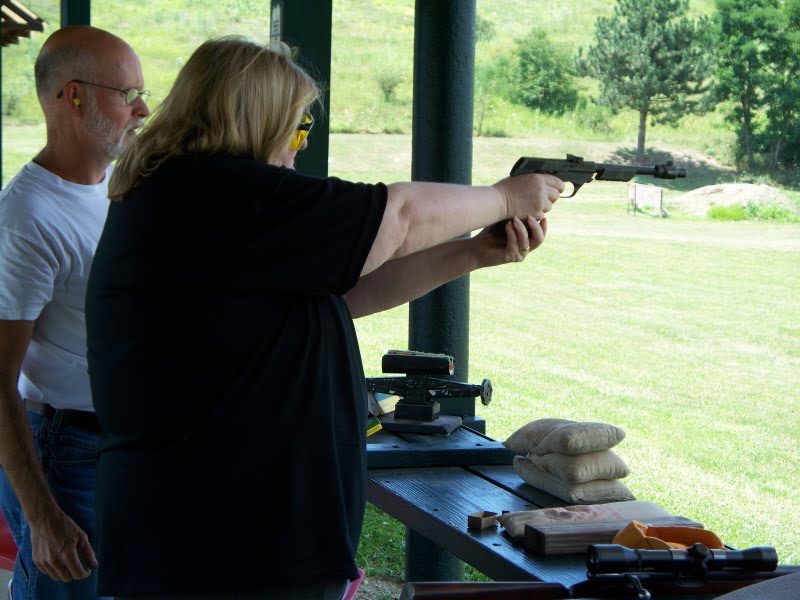
And here’s Sherry firing a .22 target piston under the instruction of that guy who shall remain nameless.
Martha looks like an expert with that target pistol.
Not to brag…and there aren’t any photos of me to prove or disprove it…but I impressed the heck out of my hubby with that pistol. Heh.
Then there was the .38 revolver.
Innocent-looking little thing. My favorite part of the day was the look on Martha’s face when she shot it. Appearances are deceiving. This little bugger packs a wallop.
But the real star of the day was Tamara. She covered all the territory, not to mention time periods. It wasn’t part of the plan, but a fellow using the range at the same time we were offered to let Tamara shoot his 50 caliber sniper rifle. And she took him up on it. After all, how many opportunities do Working Stiffs get to do that kind of thing?
This beast has been known to hit a target at a mile and a half. Impressive to say the very least.
The guy’s friend also let her shoot his AR-15.
And just so all the bases were covered, she even tried out the atlatl, a prehistoric spear throwing weapon
And thus concludes our Working Stiffs field trip to the wonderful world of weapons.
On Monday and Tuesday, Gina and Martha wrote about their experience at the Firearms 101 Workshop we put on. I figured I’d stick with the theme and share the photographic evidence of our trip to the firing range.
But first, a disclaimer. You may already know that my dear Hubby hates when I blog about him. He generally refuses to let me post photos of him. So don’t anyone tell him that he made it onto Working Stiffs.
The day began with Max and Ray (AKA Hubby) of the McDonald Sportsmen’s Association sharing their expertise with us. From the very basics of showing and explaining the difference between pistols and revolvers, rifles and shotgun, to the more advanced discussions of ballistics, they patiently answered our beginners-level questions and let us examine and study a wide variety of their weapons collections. Myths were busted. We even got a history lesson or two.
Here we have Max answering some of Martha’s questions.
But the real fun came after lunch when we headed outdoors to the firing range.
Here’s Nancy Howarth shooting a .22 rifle for the first time. No, it didn’t kick.
And here’s Sherry firing a .22 target piston under the instruction of that guy who shall remain nameless.
Martha looks like an expert with that target pistol.
Not to brag…and there aren’t any photos of me to prove or disprove it…but I impressed the heck out of my hubby with that pistol. Heh.
Then there was the .38 revolver.
Innocent-looking little thing. My favorite part of the day was the look on Martha’s face when she shot it. Appearances are deceiving. This little bugger packs a wallop.
But the real star of the day was Tamara. She covered all the territory, not to mention time periods. It wasn’t part of the plan, but a fellow using the range at the same time we were offered to let Tamara shoot his 50 caliber sniper rifle. And she took him up on it. After all, how many opportunities do Working Stiffs get to do that kind of thing?
This beast has been known to hit a target at a mile and a half. Impressive to say the very least.
The guy’s friend also let her shoot his AR-15.
And just so all the bases were covered, she even tried out the atlatl, a prehistoric spear throwing weapon
(FYI, the proper name for the “arrows” is “darts”).
I’m glad everyone enjoyed their venture out to the countryside. I do think we provided the guys with a considerable amount of entertainment value, too.
Thursday, November 20, 2008
Never Underestimate the Danger
by Joyce
Annette's post yesterday and the news about the FBI agent shot and killed here in Pittsburgh yesterday got me thinking about how dangerous law enforcement can be. Most civilians take that fact for granted. We were lucky in the department where I was a secretary for ten years that we never had a fatality. The guys I worked with never took dumb chances and they could always count on each other for back up--even the ones who didn't get along.
Yesterday morning, FBI Special Agent Sam Hicks and members of a multijurisdictional drug task force stopped at a home in Indiana Township to serve a warrant on Robert Korbe. Agent Hicks was shot and killed by Christina Korbe, Robert's wife. Hicks was the first FBI agent killed in the line of duty while serving in Pittsburgh. (Several agents from Pittsburgh have been killed elsewhere, including Martha Dixon, for whom the Pittburgh FBI building is named.)
According to statistics released by the FBI, of the 57 officers feloniously killed in 2007, 55 of them were killed with firearms. (Note: according to the National Law Enforcement Memorial Fund website, this number is 68.) On the the website Policeone.com it states that of these 55, "38 were killed with handguns, nine with shotguns, and eight with rifles."
The only thing deadlier than guns for police officers is traffic fatalities. In 2007, 83 officers died in motor vehicle accidents.
We had the following posted on the bulletin board in the squad room where I used to work:
THE TEN FATAL ERRORS THAT HAVE KILLED EXPERIENCED LAWMEN
(The above was published by the National Association of Chiefs of Police.)
Annette's post yesterday and the news about the FBI agent shot and killed here in Pittsburgh yesterday got me thinking about how dangerous law enforcement can be. Most civilians take that fact for granted. We were lucky in the department where I was a secretary for ten years that we never had a fatality. The guys I worked with never took dumb chances and they could always count on each other for back up--even the ones who didn't get along.
Yesterday morning, FBI Special Agent Sam Hicks and members of a multijurisdictional drug task force stopped at a home in Indiana Township to serve a warrant on Robert Korbe. Agent Hicks was shot and killed by Christina Korbe, Robert's wife. Hicks was the first FBI agent killed in the line of duty while serving in Pittsburgh. (Several agents from Pittsburgh have been killed elsewhere, including Martha Dixon, for whom the Pittburgh FBI building is named.)
According to statistics released by the FBI, of the 57 officers feloniously killed in 2007, 55 of them were killed with firearms. (Note: according to the National Law Enforcement Memorial Fund website, this number is 68.) On the the website Policeone.com it states that of these 55, "38 were killed with handguns, nine with shotguns, and eight with rifles."
The only thing deadlier than guns for police officers is traffic fatalities. In 2007, 83 officers died in motor vehicle accidents.
We had the following posted on the bulletin board in the squad room where I used to work:
THE TEN FATAL ERRORS THAT HAVE KILLED EXPERIENCED LAWMEN
1. Your Attitude - If you fail to keep your mind on the job while on patrol, or if you carry problems with you into the field, you will start to make errors. It can cost you or other fellow officers their lives.
2. Tombstone Courage - No one doubts that you are brave, but in any situation where time allows, wait for backup. You should not try to make a dangerous apprehension alone and unaided.
3. Not Enough Rest - To do your job, you must be alert. Being sleepy or asleep on the job is not only against regulations, but you endanger yourself, the community and all of your fellow officers.
4. Taking a Bad Position - Never let anyone you are questioning or about to stop get in a better position than you and your vehicle. There is no such thing as a routine call or stop.
5. Danger Signs - You will come to recognize "danger signs"--movements, strange cars, warnings that should alert you to watch your step and approach with caution. Know your beat, your community, and watch for anything that is out of place.
6. Failure To Watch The Hands Of a Suspect - Is he or she reaching for a weapon or getting ready to strike you? How else can a potential killer strike but with his or her hands?
7. Relaxing Too Soon - The "rut" of false alarms. Observe the activity, never take any call as routine or just another false alarm. It's your life on the line.
8. Improper Use or No Handcuffs - Once you have made an arrest, handcuff the prisoner properly.
9. No Search or Poor Search - There are so many places a suspect can hide weapons that your failure to search is a crime against fellow officers. Many criminals carry several weapons and are able and prepared to use them against you.
10. Dirty or Inoperative Weapon - Is your firearm clean? Will it fire? How about ammunition? When did you fire your weapon last so that you know if you can hit a target in combat conditions? What't the sense of carrying any firearm that may not work?
(The above was published by the National Association of Chiefs of Police.)
Subscribe to:
Comments (Atom)