by She Who Shall Not Be Named AKA She With More Names Than She Can Keep Straight
Lately, I’ve gotten sucked into some discussion on how – or whether – self-publishing is better than traditional (AKA ‘legacy’) publishing. With that in mind, I thought we’d have a little discourse on the various options available to authors today, and some of the benefits and drawbacks of each.
I started out in traditional publishing, with a Big Six publisher, so we’ll start there. The Big Six, by the way, are Hatchette, HarperCollins, McMillan, Penguin, Random House, and Simon and Schuster. Just so you know.
A contract with a Big Six publisher is many an author’s dream. There’s a lot of prestige in being able to say, “My new book with Penguin is coming out next month.” (Believe me, I know; I’ve said it.) The Big Six have a lot of clout, a lot of money, a lot of connections. The advances are almost always better than with a smaller publisher (although royalties tend to be standard across the board). The distribution tends to be better. The name opens a lot of doors that are closed to smaller publishers or the self-published. There’s the assumption that if you’re published with a Big Six publisher, your book must be worthwhile. You can expect to get professional cover art, professional editing, and professional support. You might even get co-op, which is money your publisher pays to bookstores to secure special placement for your book when it’s released, in the front of the store. It doesn’t happen for every book, but it does for some, and it’s costly, so mostly only the really big publishers can afford it.
On the flipside, the author is a very small part of the giant machine of a big publisher. Most of us are tiny cogs and screws, easily replaced if we show signs of wear and tear. Some of us are a little more important – the New York Times bestsellers, say – but the machine will continue on without us, even so. The world has enough of those too, to carry on, and new ones are made all the time. There’s very little personalized attention to be gotten, since even your editor is working with a bunch of other authors, and you might feel lost in the shuffle.
Beyond the Big Six, there are a lot of smaller, independent publishers. Some are big and fairly well known in the industry, some are tiny and most people have never heard of them. Some have been around for ages, and are very well regarded. Some haven’t had time to prove themselves yet. Some are e-presses only, and since I have no personal experience with those, I’m going to leave them alone. If you’ve got info regarding the ins and outs of e-presses, please leave your helpful hints in the comments. The one immediate drawback that even I can see, however, is that if you decide to go with an e-press, there’ll be no hardcopy books available anywhere.
Moving right along: I placed two books with a small indie publisher a couple of years ago. Small publishers are different from big publishers. There’s still the fact that you’re traditionally published instead of publishing yourself, but beyond that, small publishing has more in common with indie than it does with Big Six, I think.
Assuming the editor is competent, you’ll get professional editing. Sometimes it can be hit and miss, since not all editors are competent. In my case, I was lucky, and the editor was very good at her job. They’re not always that way. (The same goes for independent editors, by the way, if you’ve ever considered hiring one for your WIP.)
Same goes for the cover artist. Some covers from small publishers are awesome; some not so great. The advance is often minimal, or non-existent. Distribution can be difficult, since a small publisher doesn’t have the same clout as the Big Six, and they almost never have the money for co-op, so even if your book makes it into the store, it’ll be on a shelf in the back, with less chances of being discovered by someone browsing for something new to read.
On the other hand, you get lots of personal attention. Small publishers work much closer to the bone than big ones, and they usually only take on books they really love. Where a Big Six publisher might feel fine about using you as a tax write-off if things don’t work out, a small publisher almost desperately wants you to succeed, and what they can’t provide financially, they do their best to make up for in other ways, like attention and effort.
Finally, there’s DIY. Self publishing. Indie publishing. Or (thank you, Jennifer Crusie!) author originated digital publishing.
Traditional publishing, whether Big Six or indie, is a private club. You might get in, but a lot of people don’t. A lot of those people are the ones who are now self-publishing and feeling that tradipubs (don’t look at me, I didn’t coin the phrase) have done them wrong. They’re very vocal in their admonishments to publishers to wake up and smell the decaf. E-books are here to stay and traditional publishing is as dead as the dodo; it just hasn’t realized it yet. (I don’t think so, but that’s a blog for another day. This one is already long enough.)
There are a lot of benefits to DIY, if you’re wired that way. I’ve self-published three books, and I have to say I enjoy the fact that it’s all up to me. I’m control-freaky enough to get off on being in total control of every word, every period, every semi-colon. I don’t have to listen to an editor tell me that such and such isn’t appropriate for the genre and has to go. Nobody messes with my prose but me.
On the flipside, nobody messes with my prose but me, and most of us can benefit greatly from an unbiased eye on our work. Some of us are lucky enough to have critique partners/groups and beta readers who catch our flaws, but if you’re not one of those, you’ll probably want to hire an independent editor to look over the book before your hit the publish button. The biggest reason self-publishing has gotten a bad rep, is because the quality is often inferior. Not always, but enough that the stigma has attached itself. Hiring an editor is something you’ll have to pay for out of pocket, that a traditional publisher, big or small, will do for you free of charge.
Same thing with formatting and cover. I formatted my own books – the trick is to start with a clean manuscript – but if you’re not technically inclined, and you’re not sleeping with a techie, you’ll probably want to hire that out, as well. It’ll run you a couple hundred bucks, which also comes out of your pocket. Then there’s the cover. Your traditional publisher takes care of that for you. When you self-pub, you have to do it yourself. Again, if you’re inclined that way, you can make your own. If you’re not, you’re better off hiring a cover artist. It’ll cost you, but it’s worth it. An amateurish cover will mark you as a DIY’er right off the bat.
And after you’ve uploaded the book, it’s still all up to you. Nobody is there to give you a hand with publicity. There’s no co-op, and no book signings. No catalogue, no one telling the book buyers at Barnes and Noble or Amazon that they need to stock your book. It’s ALL. UP. TO. YOU.
So there you have it. The pros and cons of traditional vs. indie publishing.
There’s a whole lot more I could say about all the options, and the nitty-gritty of making them work for you – or not, as the case may be – but we’re at over 1300 words already, and at this rate I’ll probably get a prize or something for the longest Working Stiffs blog this year.
So whatcha think, fellow Stiffs and readers? Is there a ‘better’ option? Or does it just come down to ‘better for you’?
Since I'm in Florida this week, you'll have to debate amongst yourselves, I'm afraid. If I have time between the sun, the sand, the dolphins, and the hot guys, I'll try to stop by, but don't count on it.
Oh yes: Contract Pending is now available as an ebook on Amazon, BN and Smashwords. Anyone looking for a freebie review copy - I'd love a review in return, please! - email me and I'll give you the coupon code.
Friday, July 08, 2011


Thursday, July 07, 2011
Angel Clouds and Rainbows
by Paula Matter
My annual tribute is early this year because a guest will be blogging in two weeks. The following was originally posted two years ago.
There are times I remember precisely where I was when a legendary event happened. The following are most prevalent and come to my mind readily:
Martin Luther King, Jr.'s assassination
Robert Kennedy's assassination
Dwight D. Eisenhower's death
Neil Armstrong's landing on the moon
John Lennon's assassination
Challenger explosion
September 11, 2001
Huge emotional events that effected America, the nation, the world.
I never experienced a profound tragedy firsthand.
Until July 17, 1996.
If you live in my small, quiet borough, you'll know that date. It's forever etched in our minds, our hearts. Thirteen years ago tomorrow, we lost 16 high school students and five adult chaperones in the TWA Flight 800 crash.
For days, weeks, months after this tragedy, our tiny town mourned. As a community we stuck together as we attended funeral after funeral after funeral.
And we endured.
The angel visited us in the evening of July 21, 1996. She appeared as a cloud over the high school, and lingered long enough for many to see her.
Twenty-one smaller white clouds appeared at the angel's feet, at first in a circle, then formed two straight rows.
The first of many rainbows also appeared that evening. Two beautiful rainbows arched over us until the sun set.
It wasn't unusual to hear reports of more rainbows suddenly appearing. They were spotted at soccer games, track meets, swim meets.
One month after the crash, on August 17, 1996, we held a community memorial. Thousands of people gathered in the high school football field. Minutes before the service started, a gorgeous rainbow appeared. Those of us who live here weren't surprised, and we were happy to share it with so many others. The rainbow disappeared five minutes or so after the service ended.
Closure and comfort came in other ways too. Finally, after six very long weeks, the last body from our town was recovered and brought home. I remember that day well. A customer told me, "They found her." And we cried together.
On July 17, 1999, the Memorial Park opened on the grounds of the high school. I went there a few days ago to take new photos to share with you.

The names of our town's twenty-one victims.

This ceramic angel sits on the base.

Our angel.

Engraving on one side.


Surrounded by twenty-one maple trees,
our angel stands.
Forever in our hearts.
Wednesday, July 06, 2011
Mystery Novelist's Question about Casey Anthony Trial
by C.L. Phillips
Admit it - you followed this trial. Maybe you didn't watch the video or listen to Nancy Grace, but you know about it. For those of you under the Cone of Silence for the last three years, here's the condensed version : two year old child goes disappears for thirty days or so before mother reports her missing. Body is found five months later within several hundred feet of the family home. Trial begins with outlandish opening statements designed to provide alternative suspects and place the defendant, the child's mother in the role of long suffering victim. Until the lawyer wised up and told the jury during closing arguments, "My client is a liar and a sl*t, but you can't convict her for that." And finally the judge gives the jury instructions that define reasonable doubt as more than some doubt.
I don't have a dog in this hunt. I don't care if the mother is found guilty or not. What I'm more interested in discussing is this question : "WHAT happened in the JURY room?"
Really. What were they thinking? Do you suppose the twelve members of the jury went into the room and said, "Alright, we've been sequestered for forty-five days. Who wants to go home tomorrow?" Imagine how that could frame the deliberations. Or maybe eleven said guilty, one said "No way, I'm never voting guilty." And then everyone caved to go home?
You know I always thought O.J. Simpson got off because of the "If the glove doesn't fit, you must acquit" line from Johnny Cochran. But this trial had none of that. All the fireworks happened in the opening statements, none of it poetic.
So what do you think happened in the JURY ROOM? And if you were writing this murder mystery from the point of view of the defense lawyer - what was his last meeting with his client like? Did he gaze into the eyes of a murderer and say, "You know, you might want to get your tubes tied?"
Give me your favorite denouement for this mystery.
Tuesday, July 05, 2011
Summer Time and the Living is Easy
By Martha Reed
As you may know, I’ve taken the month of July off from
active writing. Yes, I am participating in Nancy Martin’s manuscript editing
boot camp, which is keeping my hand in but I’m not working on creating anything
new, just polishing up what I already have before I send it out to find a
buyer.
It’s been insightful to me how many hundreds of hours open
up when I’m not actively working on a manuscript – evidently enough to paint my
kitchen and to finally get the backyard in order again but I have to admit that
I’ve still got my creative eye on the horizon. Once boot camp is over and the
kitchen is done I’m jumping back in!
The other insight is that I’m in tune with the seasons
again. Last July I was in the middle of constructing my mss. I don’t remember
noting much about the summer – other than to make sure the air conditioning
unit was installed in my office window. This year has been different – I’ve
been getting up early to finish the outside chores before the heat settles in. Working
this way reminded me that I love hot weather. I come by it honestly; I lived in
Texas for a decade and you don’t do that unless you like it hot. Working in the heat also reminded me of some southern memories and humor and I had to look up an old favorite, Jerry Reed. No relation.
I’m only hoping that my boot camp
partners and I have as much fun working together as these two knuckleheads do! Happy
Independence Day! Enjoy the summer.
Monday, July 04, 2011
CONTROLLED BY DREAMS?
by Gina Sestak
Happy Independence Day to you all!
Although I spent the last part of June attending the annual conference of the International Association for the Study of Dreams at Rolduc, a medieval monastery in Kerkrade, Netherlands, this will not be a "how I spent my summer vacation" kind of post. It will focus instead on a hot topic of conversation at the conference, the role dreams sometimes play in criminal activity.
Ten years ago, the dream community was appalled to learn that dreams played a role in the 9-11 attacks. This year, British Social Anthropologist Iain Edgar presented on his new book:

Dreams have been implicated in individual acts of violence as well as organized terrorism. Jared Loughner, the man who shot 19 people in his attempt to assassinate Congresswoman Giffords in Arizona, is a lucid dreamer. A "lucid dream" is one in which the dreamer becomes consciously aware that it is a dream while the dream is still in progress.
Some speculate that Loughner's lucidity practice may have blurred the boundaries between dream and waking reality (although his waking-life planning for the assassination attempt seems to contradict this).
So, what do you think? Does this sound believable to you? Have you ever used dreams to motivate characters?
Happy Independence Day to you all!
Although I spent the last part of June attending the annual conference of the International Association for the Study of Dreams at Rolduc, a medieval monastery in Kerkrade, Netherlands, this will not be a "how I spent my summer vacation" kind of post. It will focus instead on a hot topic of conversation at the conference, the role dreams sometimes play in criminal activity.
Ten years ago, the dream community was appalled to learn that dreams played a role in the 9-11 attacks. This year, British Social Anthropologist Iain Edgar presented on his new book:
Here's a summary, from Amazon.com's Product Description:
The war in the Middle East is marked by a lack of cultural knowledge on the part of the western forces, and this book deals with another, widely ignored element of Islam-the role of dreams in everyday life. The practice of using night dreams to make important life decisions can be traced to Middle Eastern dream traditions and practices that preceded the emergence of Islam. In this study, the author explores some key aspects of Islamic dream theory and interpretation as well as the role and significance of night dreams for contemporary Muslims. In his analysis of the Islamic debates surrounding the role of "true" dreams in historical and contemporary Islamic prophecy, the author specifically addresses the significance of Al-Qaeda and Taliban dream practices and ideology. Dreams of "heaven," for example, are often instrumental in determining Jihadist suicidal action, and "heavenly" dreams are also evidenced within other contemporary human conflicts such as Israel-Palestine and Kosovo-Serbia. By exploring patterns of dreams within this context, a cross-cultural, psychological, and experiential understanding of the role and significance of such contemporary critical political and personal imagery can be achieved.
Dreams have been implicated in individual acts of violence as well as organized terrorism. Jared Loughner, the man who shot 19 people in his attempt to assassinate Congresswoman Giffords in Arizona, is a lucid dreamer. A "lucid dream" is one in which the dreamer becomes consciously aware that it is a dream while the dream is still in progress.
Some speculate that Loughner's lucidity practice may have blurred the boundaries between dream and waking reality (although his waking-life planning for the assassination attempt seems to contradict this).
So, what do you think? Does this sound believable to you? Have you ever used dreams to motivate characters?
Friday, July 01, 2011
Haunted Heart
We somehow missed scheduling someone for the first Friday of July, and I ended up on the second Friday instead. I thought I'd have to do both, since my legions of fans would naturally be flocking to the blog to see whatever brilliant inspiration I came up with, and I certainly didn't want them to go away disappointed... anyway, a friend has a new book out today, and since we didn't have anyone else scheduled - and since I didn't feel like writing two blogs myself - I told her she could promote her book. Romantic suspense, y'all.
Take it away, Carolyn Rosewood!
![]() Rowena Sommers thought moving back home to restore her beloved Aunt’s home was the key to starting over. Van Whitney thought taking the job would keep his business afloat. When a ghost hunter tries to convince Rowena the home is haunted, can these two escape the past and find a future together?
Since Rowena’s immediate goal is the restoration of her Aunt Lunette’s home, I wanted to give her something more to worry about than whether or not she’d sleep with Van, the man she hires to restore it. I thought it would be fun if someone were trying to convince her the home is haunted.
But that still wasn’t enough. I like to make my hero and heroine suffer. There had to be a reason why Trace wanted inside the walls of that home, so Aunt Lunette’s long-dead husband became the key to that answer. He hid something inside the walls that Trace wants. And when Van discovers one of his own crew is involved as well, the stakes become high for him too.
Haunted Heart has plenty of hot sex between Van and Rowena as they rekindle a love that started in high school. The book also features stolen money and stocks hidden behind plaster walls, a circuit interrupter and transmitter, planted to make Rowena think she’s hearing ghostly sounds and witnessing spirits play with the lights in her house, blueprints for a bank robbed in 1928, and a smoking device that gets out of hand one night, while Rowena is alone in the house, asleep.
I hope you’ll check out Haunted Heart!
Carolyn Rosewood is the author of Haunted Heart and The Last Soul, the novella Hunted (a sequel to The Last Soul) and the short story Ghost of a Chance, part of the Midnight Collection anthology coming from Evernight Publishing in October. You can find out more about her and read excerpts of her work on her website, www.CarolynRosewood.com
Take it away, Carolyn Rosewood!
 Rowena Sommers thought moving back home to restore her beloved Aunt’s home was the key to starting over. Van Whitney thought taking the job would keep his business afloat. When a ghost hunter tries to convince Rowena the home is haunted, can these two escape the past and find a future together?
Haunted Heart is first and foremost a romance, but it’s filled with mystery and intrigue as well. This story grew out of my fascination with old homes, especially Victorian homes, and had originally featured a paranormal investigator as the hero. As I began to write it, the idea to have the paranormal investigator be one of the villains intrigued me.
Since Rowena’s immediate goal is the restoration of her Aunt Lunette’s home, I wanted to give her something more to worry about than whether or not she’d sleep with Van, the man she hires to restore it. I thought it would be fun if someone were trying to convince her the home is haunted.
But that still wasn’t enough. I like to make my hero and heroine suffer. There had to be a reason why Trace wanted inside the walls of that home, so Aunt Lunette’s long-dead husband became the key to that answer. He hid something inside the walls that Trace wants. And when Van discovers one of his own crew is involved as well, the stakes become high for him too.
Haunted Heart has plenty of hot sex between Van and Rowena as they rekindle a love that started in high school. The book also features stolen money and stocks hidden behind plaster walls, a circuit interrupter and transmitter, planted to make Rowena think she’s hearing ghostly sounds and witnessing spirits play with the lights in her house, blueprints for a bank robbed in 1928, and a smoking device that gets out of hand one night, while Rowena is alone in the house, asleep.
I hope you’ll check out Haunted Heart!
# # #
Carolyn Rosewood is the author of Haunted Heart and The Last Soul, the novella Hunted (a sequel to The Last Soul) and the short story Ghost of a Chance, part of the Midnight Collection anthology coming from Evernight Publishing in October. You can find out more about her and read excerpts of her work on her website, www.CarolynRosewood.com
Thursday, June 30, 2011
Crime In Genres
by guest blogger Angela Verdenius
Crime in books is so varied. It can be
savage, shocking, run-of-the-mill, or even…yes, people, it can be funny. You don’t believe me? Try reading a Stephanie Plum book by Janet
Evanovich and tell me that some of the crimes aren’t funny. I’ve literally sat in bed with tears running
down my face, roaring with laughter.
It used to be that if you wanted a story on
crime, you went out and bought a crime novel.
It featured cops and robbers and killers, was a chiller or thriller, and
basically was a crime novel.
Not so much now.
You can have crime and romance (romance
suspense), crime and the supernatural (urban fantasy), crime and futuristic
romance (think J D Robb), crime and horror (slasher), forensic thrillers (Kathy
Reich), light crime (mysteries), and even crime in kids’ books. Come to think of it, crime in kids’ books
has been around a long time - think Famous Five by Enid Blyton. All those kidnappings and robbers…
Crime ranges from the light to the murderous,
it all depends what takes your fancy in the reading world. My own taste at the time depends on the mood
I’m in - my reading tastes range across almost everything.
The newest thing to break out in the
crime/romance is the terrorism/FBI/SEALS/Elite Forces/Special Ops etc. Something about a man in uniform fighting
against the odds that just tickles our romantic souls.
But then again, I’m also a sucker for a hot
cop romance . (Okay, let’s not
go into my particular fantasies…not the kind of blog for that!)
Over time, as real crime gets more shocking
and varied, so the story-lines of books follow. It’s interesting to see how the growth of terrorism and computer
hacking is evolving in the crime novels.
Life leading reading matter.
I write futuristic romances, and a little
horror (and just released my first contemporary romance), but I suddenly
realised, while thinking about this blog the other day, that I have a lot of
crime in my futuristic romances.
Thieves, lawmen, outlaws, bounty hunters, space pirates, murder,
kidnapping, traitors, espionage, fights, war, pretty much everything. I never thought about it before, I didn’t
even attempt to write ‘crime’ into my novels, they were a part of the story
linking the storyline and characters, but suddenly I thought…hey, there’s crime
in my books!
So I wonder if the authors writing romance
suspense ever think of it as that they’re actually writing crime and romance? Do they set out with that mind-set? I wonder.
I know I certainly didn’t!
And where do we draw the line between a
straight crime novel, and crime with mostly romance (or horror or other
genre). Okay, I sort of know the answer
to that, LOL, I’m just tossing that question into the ring to stir things up a
bit! (I’m trying to sound intelligent
here, people, work with me!)
But what attracts us to the crime? Is it the thinking, trying to figure out the
criminal, or we’re lusting after the hero (if it’s a romance)? Or we like the technology, or the
supernatural slant? The meshing of
relationships in the characters involved?
Or are we all just a little gory-liking deep down? For me, it adds that unknown affect in the
book, the impact on characters and relationships, how it affects their outlook
on life, on the crime, the impact on their life and where it leaves them in the
end.
And because I can close the book and know
that it’s all in the writer’s imagination and I’m safe. Really.
Because it’s just a book, right?
 I think I’ll just go and check that the
door is locked….
Angela Verdenius lives in Australia where she is ruled by her cats, adores reading, and thinks a perfect day is writing and drinking Diet Coke. Her latest book is Doctor's Delight, a contemporary romance featuring a plus-size heroine.
Wednesday, June 29, 2011
Multiple Personalities

By guest blogger Sheila Connolly
When I first started writing, I never considered writing a series. I started with one book, and then discovered that I couldn't let the characters go, so I kept writing. And writing. After four and a half books, when none had sold, I laid them quietly on the shelf. And kept writing, except about other people.
Now I find myself in the enviable and overwhelming position of writing more than one series at a time. Of course, it didn't happen all at once—it just kinda grew. The book that eventually led to the Orchard Mystery series was supposed to be a standalone, but Berkley Prime Crime liked it, and I've now written six of them (which bear little resemblance to that original standalone concept). Actually the setting came first—an old house in a small New England town—and the people kept showing up, one or two at a time. It's kind of like settlers moving into a village. The place is based on a real town and a real house. I've never lived there, but generations of my ancestors did, and I feel weirdly at home there.
 My second series is nothing like the first—intentionally. I sometimes wonder if many writers harbor split personalities. I think I do, because both series reflect sides of me, but they're not exactly related. I've never been a farmer, but the Museum Mystery series is set in the cultural community of Philadelphia, where I worked for several years. It's urban—definitely not a small town, unless you count the population of museum professionals as their own tribe. Meg in the Orchard series struggles to manage an orchard; Nell in the Museum series struggles to raise money for the historic institution she runs. And both keep tripping over bodies. Makes you wonder if anywhere is safe these days!
 The Orchard series seems to tap into a vein of American nostalgia—wherever you were raised, you probably still have this image in the back of your mind of a small town with a central green dominated by a tall-steepled church, with blazing red, orange and yellow trees on the hills behind. It's all new to Meg, but she's finding that she likes it. On the other hand, a city—any city—has its own kind of energy. Things happen just because there's so much energy there, and so many people. Nell may retreat to her home in the suburbs to recharge her batteries, but she loves working in the midst of so much history.
And if that's not confusing enough, earlier this year I contracted to write yet another series (don't ask me if they'll all run at the same time!), this time set in Ireland. For once my protagonist is not an educated professional woman; instead, she's a young blue-collar woman raised by an Irish grandmother. She's definitely not into nostalgia for the Ould Country, because she's seen too many down-and-out Irish immigrants pass through her life. But it shouldn't be a surprise that she changes her mind when she gets to Ireland: it's not what she expected.
And that's another piece of me—my father's parents were both Irish-born, although I never knew them. I didn't travel to Ireland until I was in my forties, but as soon as I arrived it felt like home. In writing about it, I want to get past the tacky leprechauns and paper shamrocks and find out what a different country is really like under the surface.
Now the challenge will be to keep all these people straight in my head: the reluctant farmer, the committed professional, and the skeptical barmaid. And don't forget, I have to throw in a body or two.

After exploring careers ranging from art historian to investment banker to professional genealogist, Sheila Connolly began writing mysteries in 2001, and is now a full-time writer. She writes the Orchard Mystery series, the most recent of which is Bitter Harvest (August 2011), and the Museum Mystery series, based in Philadelphia; the second book, Let's Play Dead, will be published next week. Her first e-story, Called Home, is now available on Amazon and Barnes & Noble this week.
Tuesday, June 28, 2011
Don't Mind The Corpse

Main
character – check
Love
interest – check
Antagonist
– check
Supporting
cast members – check, check and check
Tally up
the point of view (POV) characters – 5
This goes
against the 4 POV limit, but we’ll live.
Or most of us will live. By the
time I write the fourth chapter, I already know how one character eats it in
the end. So, technically, I’m dealing
with four characters and a walking corpse.
Keep writing.
Discover
that the walking corpse actually resembles a walking corpse on the page. He’s as dead as a red-shirted Star Trek
character. There’s no life to him, no
color and no reason for us to care about his death.
Edit.
Try to
force personality into the corpse, but find that the doomed character refuses
to cooperate. By heaven, he’ll be heard on his terms and not mine!
Take a
week off.
Get back
to work, pushing forward with the rough draft, and try to ignore the scent of
decay coming from the corpse in the corner.
(I might try spraying some Febreeze on him, but at this point he’s taken
to plucking his toes off like some gruesome rendition of; “She loves me, she
loves me not.” Which I find highly
disturbing, so I just try to pretend he’s not there.)
Nearing
the end of the draft, Point of View character number 3 gets hit by a flying
ax. Instantly dead, this character’s
abrupt transition into the Netherworld is tragically beautiful. The lack of his voice on the page is so
startling that I can’t write for the rest of the night.
The corpse
in the corner increases in stench exponentially. I find him playing dice with his rotten toes, smirking at me as
though to say; “So why did that character matter so much more than me?”
I toss and
turn in fitful sleep that night, my corpulent character looming at the foot of
the bed. He’s getting impatient now and
I can sense it. I’ve finally reached
his death scene, but find that the whole thing reeks of a setup.
Stop.
Beat my
head on my desk a few times. Complain
to my cat, who purrs and assumes that I want to drag a ball of yarn around for
him. I don’t, but I do anyway, all the
while glaring at the computer screen from across the living room.
Complain
to friend, who has come to the point in our relationship where she just smiles
and nods, hoping I won’t ask a question at the end of my crazy rant because
there’s no way she understands it. And
she’s lucky, because I already know the problem with my much-adored work in
progress. The truth is, I’ve known it
since chapter four, when I spied the death of this character.
I didn’t
care about the walking corpse because I knew the end of his story. I never explored his personality, his
tastes. I never saw the way he lingered
in the library, staring at the books with a longing that’s all too familiar to
me. He was dead before he got to live
on the page.
Monday, June 27, 2011
Virtual Dinner Party : Who will you bring?
by C.L. Phillips
Let's do something different today. I'd love to learn about one of your writing projects. Doesn't have to be complete. Maybe it's your work-in-progress, or the pile of pages you are editing for the fourth time, or the novel you have out for query.
What I want to do is meet one of your main characters. Give me a cute introduction, something that tickles my fancy and makes me want to get to know your hero.
I'll start by way of example. Then you chime in with your comment. Think of it as a virtual dinner party, but instead of introducing ourselves, we are introducing one of our characters. Pick anyone you like, even your villain. But no fair telling us whether the character is the hero or villain. Make us guess.
And to make it even more of a challenge, try to make your introduction tweetable (that's a 140 characters for you non-twitter types). Don't worry if you can't, I just thought it would be an interesting twist. And here at Working Stiffs, we are all about the twists, right?
Jimmy Ray Hawkens. Austin lawyer. Trapped between duty and love. Divorced three times. Never fails to save a client. Only drinks when he must.
Now it's your turn! :)
Friday, June 24, 2011
Foreign Culture

Writing from Italy for an American audience creates many challenges. I want my work to present stories that couldn’t happen anywhere else. And I aim at showcasing Italian culture that visitors on vacation for a few days or even weeks might not see.
To establish the setting, the first thing I do is drop in Italian words or phrases. When I first began writing from this vantage point, I translated or paraphrased, following a tip from the first “how to” book I read. For example, a character might tell the waiter, “Pasta e fagioli, per favore.” Later, the waiter would deliver his pasta and beans. When I read these passages now, I cringe because their leadenness slows the pace. Fortunately, I didn’t submit much before I abandoned this approach. Now I drop in phrases familiar to Americans or which have spelling or pronunciation similar to the English counterpart.
My American protagonist has an Italian mother who left Italy for America forty years ago. Caroline learned Italian from her mother, but it’s a bit out of date. In my story “Feeding Frenzy” from Fish Tales, The Guppy Anthology, she overhears something that she understands on the surface, but not the idiom it represents. That phrase becomes the key to solving the murder. When she finally learns the idiomatic meaning, she can identify the murderer. I hope that having Caroline occasionally misunderstand creates a bond with the reader.
I also try to draw a picture of Italian daily life and habits. The bar is integral to the Italian way of life. It’s rather like the post office in my home town where everybody stops to talk with their neighbors when they go to pick up the post. In Italy people gravitate to the bar for a cup of espresso or cappuccino in the morning, maybe a glass of fruit juice in the afternoon. Here you’ll hear arguments or last night’s soccer match or gossip about the latest political scandal. And it’s a family affair. Grandparents take their grandchildren to the bar for ice cream.
Other things have no counterpart. For example, Italians frequently identify a woman with the article La followed by her surname. Meryl Streep is often called La Streep by the newspapers. In my WIP, two brothers meet for coffee. One, a police commissioner, refers to the murder victim as La Davidoni. His brother is attracted to Caroline the protag. Later, the police commissioner warns his brother to steer clear of La Whitlock. I want to show that this cultural habit is not disrespectful. It’s quite the opposite.
The biggest challenge is trying to find a balance that showcases the culture for a foreign audience without sounding simplistic to the conoscenti. An Italian friend who grew up in the U.S. and knows both cultures thinks I achieve that with my blog (http://ItalianIntrigues.blogspot.com). I hope I’m doing that with the novel.
Patricia Winton has lived in Italy for about 12 years, the last nine in Rome. A former food writer, she has combined her passion for Italy, mysteries, and food to create a cast of characters and plot lines that derive from the Italian setting. Her first published work using these elements is “Feeding Frenzy” in Fish Tales, The Guppy Anthology (Wildside Press, 2011). She has two novels in the works.
Website: http://PatriciaWinton.com
Blog: http://ItalianIntrigues.blogspot.com
Thursday, June 23, 2011
Prevailing Themes

by guest blogger Bill Cameron
Not long ago, I had a revelation. It was
the sort of thing you'd think I would have figured out already, but an
excess of brainpower is not something I'm blessed with. Takes me a long
time to noodle through things. In this case, it took me four books and
who knows how many short stories to recognize there's a prevailing theme
in my writing.
Wait. What?
The first surprise is that there IS a prevailing theme. I honestly had no idea. Oh, I've had, "This story is about …" moments. Lost Dog was about (gasp) loss. Chasing Smoke was about confronting mortality. Day One dealt with the need for security. And County Line is about how a single choice can resonate throughout a lifetime.
Fancy, high-falutin' stuff. But only peripherally interesting. No one reads a story because you say, "It's about loss."
For
me, the recognition of each book's individual themes served as a
touchstone during revision—does this scene/character/line of dialog fit
what I'm trying to do here? Once I've sorted through those kinds of
questions, broad observations about "theme" don't have much
significance.
But this prevailing theme notion? Maybe that's something worth a second look.
So
what's my thing? Turns out all my books and the majority of my short
stories are about how parental neglect and abuse shape children into the
adults they become. Each story is a different take on this issue.
Sometimes I focus on how damaged children become damaged adults,
sometimes my interest is in how they survive to become whole. But if one
thing shows up again and again in my work, it's really crappy parents.
That's
fairly specific. It's not "loss" or "mortality" or some other cruising
altitude observation which can apply to a multitude of tales. Rather,
it's a window into what preys on my mind. It's a problem I struggle to
understand, perhaps even to solve.
Of course, the issue is likely beyond resolution. But that's another matter altogether.
You
might ask how a guy gets to be nearly 48 years old before he figures
out what's important to him. It's not that I haven't long understood
childhood abuse is important to me. In other contexts, this problem has
been a priority for me for most of my life.
It's
one thing to have a priority in one area of your life and another thing
to see how it influences another. Like I said, I can be slow on the
uptake, and my approach to writing is so focused on the moment that I
don't often see the bigger picture until later.
Those
general themes—loss, confronting mortality, etc.—are rarely clear to me
when I'm drafting a story. I didn't know the theme of Lost Dog
until the third draft, and I had to complete at least one draft of the
other three books before I had a handle on what I was attempting. When I
consider that, it makes sense that I needed a body of work under my
belt before I could see what I'm up to in my writing.
Now that I know this, what next?
Well,
if nothing else, I hope the realization helps make me a better writer.
Will I continue to explore these themes? And in so doing, with I be more
mindful of the approaches I use in the future? The quick answer to both
those question is yes. I'm working on a young adult mystery which I
think will take a look at the domestic abuse issue in a way which is new
for me. That's pretty exciting.
But
the other thing I find I'm likely to do is consciously choose to tackle
other issues in future projects. Not that I believe I've said all I
have to say about domestic abuse, but I'm looking for opportunities to
explore new issues. If there is a lesson is in this, it's simple enough:
one way to avoid a rut is to see it before you get stuck. Rut or not,
understanding of where I've been helps me better choose where to go
next.

Bill Cameron is the author of dark, gritty mysteries featuring Skin Kadash: County Line, Day One, Chasing Smoke, and Lost Dog. Bill’s short stories have appeared in Spinetingler, as well as Portland Noir, First Thrills,
and the forthcoming West Coast Crime Wave and Deadly
Treats anthologies. His work been nominated for multiple awards,
including the Spotted Owl Award for Best Northwest Mystery, the Left
Coast Crime Rocky Award, and the 2011 CWA Short Story Dagger Award. He
lives in Portland, Oregon, where he is currently trying to decide what
his next great issue will be.
Wednesday, June 22, 2011
Interview with Mindy Klasky, traditional author serializes book online
by C.L. Phillips
Today we've got a tasty treat - an interview with Mindy Klasky. Believe it or not, I discovered Mindy on Twitter. I went to her website and read FRIGHT COURT. She's using a novel concept (pun intended) to sell her words, and I thought you might enjoy meeting her. Here's our interview:
1) Fright Court - lawyers, vampires and cupcakes - What a concept. Tell us about the story, without giving away the ending. We love mysteries.
FRIGHT
COURT combines a lot of my interests. I started out my professional
life as a lawyer, and I spent *way* too many hours in courthouses around
the country. There's something a little creepy about all those chilly
marble hallways, all those quiet-as-a-tomb corridors. I started to
think about what might happen if an ordinary human woman found herself
involved in some pretty extraordinary legal events. From there, it was a
short hop to developing the Eastern Empire, my collection of
supernatural creatures who have their own legal system.
2) You are doing something very innovative - you are serializing Fright Court, asking for Paypal donations and offering sweet rewards for your readers. What encouraged you to try this idea?
I
have published twelve novels through traditional channels. Originally,
I thought that FRIGHT COURT would follow the same path. Along the way,
though, I realized that traditional publishing offers pretty narrow
channels -- vampires can be dark and secret and scary or vampires can be
frothy and light and all about shoes and shopping. My vampires are
somewhere in between -- there are definitely dark elements to their
tale, but I can't tell Manolo Blahniks from Christian Laboutins.
4) How has the reader response been different from your initial expectations?
I
had originally expected to get a lot of reader reaction, including
donations, when I posted the first chapter, and then nothing for weeks
and weeks, as I continued to reveal the story. I've been surprised --
and gratified! -- to receive a lot of ongoing support, with new
donations coming in ever week.
5) What do you know now that you wished you knew before you started the Fright Court serialized novel?
Organizing
the serialization took more effort than I expected. Due to the
structure of the web pages, I can't just prepare all the posts and
program them for appearance on their individual dates; I need to add
links to existing pages each time a new chapter goes live. Those links
create a better reading experience, so I'm pleased to add them, but they
do make for some challenging Thursday evenings!
Thank
you so much for the chance to visit here at Working Stiffs! I hope
that you will check out FRIGHT COURT, and let me know what you think of
the novel!
Mindy will be hanging out with us today responding to comments, so don't be shy. Ask her anything about her books, e-publishing, or even cupcakes. And Mindy, we at Working Stiffs thank YOU for sharing your experience and wish you the BEST.
Today we've got a tasty treat - an interview with Mindy Klasky. Believe it or not, I discovered Mindy on Twitter. I went to her website and read FRIGHT COURT. She's using a novel concept (pun intended) to sell her words, and I thought you might enjoy meeting her. Here's our interview:
1) Fright Court - lawyers, vampires and cupcakes - What a concept. Tell us about the story, without giving away the ending. We love mysteries.
Of
course, "murder" (of a human) wouldn't be a capital crime for a
vampire. But other things might be -- letting the human world know
about the existence of supernaturals, for example. Or creating a
"blood-herd" of unwilling humans, to feed from at will (possibly drawing
unwelcome attention from mundane authorities.) Or... well, let's just
say that there's a lot of trouble vampires can cause.
Before
long, my human heroine found her way into a maze of supernatural legal
proceedings. As for the cupcakes? Well every girl needs sustenance
along the way! :-)
2) You are doing something very innovative - you are serializing Fright Court, asking for Paypal donations and offering sweet rewards for your readers. What encouraged you to try this idea?
Therefore,
I decided that I needed to provide FRIGHT COURT with a different type
of home -- an online launch as an electronically published novel. As
for the serialization? There's a very long tradition of serialized
publishing -- Dickens, Melville, Highlights Magazine for Children...
I've always liked the idea of building suspense over chapters -- and so
far, it looks as if my readers are enjoying it too!
3) What has been the response from your readers?
Most
modern readers aren't used to serialization. A handful of people have
complained about the delay in waiting for chapters; a number of readers
have asked if I'll be publishing the entire novel as an ebook when I'm
done. (The answer is ... probably. I'm taking one project at a time,
for now.)
Most readers, though, have really
enjoyed the new format. A number have made donations to support the
project, in part because they get a weekly email, reminding them that a
new chapter has been posted.
4) How has the reader response been different from your initial expectations?
5) What do you know now that you wished you knew before you started the Fright Court serialized novel?
6) What else can we look forward to reading from you?
My
next novel will be traditionally published -- a fun, light category
romance called THE MOGUL'S MAYBE MARRIAGE (available August 11 from
Harlequin.) I am also working on a middle-grade traditional fantasy
novel, and I have dozens of other irons in the fire.Mindy will be hanging out with us today responding to comments, so don't be shy. Ask her anything about her books, e-publishing, or even cupcakes. And Mindy, we at Working Stiffs thank YOU for sharing your experience and wish you the BEST.
Tuesday, June 21, 2011
Social Media and the Herd Mentality
By Martha Reed
Last night I watched the movie Social Media, about the
advent of Facebook and the business chaos it inspired, and as I sat there
watching it I kept thinking: This has a lot of application to what it happening
in the publishing business today, too. I’ve repeatedly heard at conferences and
workshops that what’s happening to authors today is very similar to what
happened to musicians with Napster five years ago.
We’re experiencing the concept of direct content (via
eBooks), we’re questioning the old business model structure and pay breakout,
ie., author/agent/editor/Publishing house. I’ve seen concerns over copyright. And
these are all good discussions to have, in any situation.
The question, as I gaze into my murky crystal ball, is what
is an author to do?
For example: I have a completed manuscript in the pipeline.
I’m following the traditional publication route, querying agents, etc. but I’m
also reading everything I can get my hands on about the publishing marketplace. I get discouraged to see that agents, desperate now because of the inflow
of out of work former editors who are morphing into agents seem to be following a
herd mentality by only looking for YA supernatural because they think that’s
where the money is post-Twilight. Maybe it is. But Sisters in Crime paid for a survey that indicated a majority of readers were women between
50-70 years old who lived in the southern states. I’m sure some of them are
reading Charlaine Harris’ Sookie Stackhouse, but there must be room in there
for other trend lines that are not YA paranormal.
What are your thoughts on the current marketplace? What
publishing strategies are you choosing to follow? Inquiring Mind wants to know.
Monday, June 20, 2011
MAGIC WORDS
by Gina Sestak
"Open sesame." "Presto Chango." "Abracadabra."
We're all familiar with the power of magic words.
It seems to me, though, that every word is magical. A squiggle on the page, a tickle on the eardrum, can convey a complex meaning. Every word is freighted with connotations and somewhere, deep in the recesses of our subconscious mind, we've all been programmed by words. The language we speak colors the way we see the world.
I've always been fascinated by languages. Before I realized that I have absolutely no talent for learning them, I used to fantasize about becoming a translator. And so I studied Latin and French in high school, more French, Spanish and Russian in college. I tried to learn. I really did, but it seems as if my brain has two compartments: "English" and "Other Stuff." So when I'd forget the Spanish word for "rain" I'd just plug in the Russian one . . .
I've tried to learn Greek and Danish before trips to Greece and Denmark. No luck. So why, I wonder, have I now embarked upon trying to learn an even more difficult language?
For the past several months, I've been using the Pimsleur method to study Hindi. Pimsleur is one of those programs that promises you'll learn a language in a week. It's been months. Instead of covering a half-hour lesson every day, I've had to repeat every lesson for at least a week before it started to sink in. I'm only up to No. 14 of 30, and I can't pronounce anything correctly. NOTHING.
Hindi sounds are different from English sounds. Worse, I have trouble hearing exactly what each sound is. Listening to the same speaker on the same CD, it sometimes sounds as if she's saying t and sometimes d, and so I figure that it must be something in between. Same goes for another sound that seems to be a cross between k and g. Then there's the one that seems to be triangulated in the center of t, d, and th. My tongue doesn't work that way!
I'm really not aiming to learn to speak Hindi, though. I'm trying to learn to understand enough that I can watch Bollywood films without having to be so dependent upon subtitles. So far, I've been able to pick up some words. I can comprehend fragments of the dialogue: but, and, or, tonight, eat, and things like that, but it would be a boring movie if the characters spoke like the Pimsleur lessons:
"Hello."
"Hello."
"How are you?"
"I am very well."
"Do you want to drink something?"
"Yes. I want to drink some tea. Do you want to drink something?"
"I want to drink some coffee in the restaurant."
Understanding spoken Hindi is challenging enough. I haven't even tried to learn to read - it's written in an entirely different alphabet, the Devanagari. It looks pretty on the page, but it may as well be Greek to me.* Here's an example - the word Om:
 Yikes.
*Actually, when I was in Greece I found that I knew enough about the Greek alphabet to sound out words and sometimes guess their meanings.
At this point, you're probably wondering: What kind of flaming idiot tries to learn an entire language just to watch movies in it?
The answer is: me.
"Open sesame." "Presto Chango." "Abracadabra."
We're all familiar with the power of magic words.
It seems to me, though, that every word is magical. A squiggle on the page, a tickle on the eardrum, can convey a complex meaning. Every word is freighted with connotations and somewhere, deep in the recesses of our subconscious mind, we've all been programmed by words. The language we speak colors the way we see the world.
I've always been fascinated by languages. Before I realized that I have absolutely no talent for learning them, I used to fantasize about becoming a translator. And so I studied Latin and French in high school, more French, Spanish and Russian in college. I tried to learn. I really did, but it seems as if my brain has two compartments: "English" and "Other Stuff." So when I'd forget the Spanish word for "rain" I'd just plug in the Russian one . . .
I've tried to learn Greek and Danish before trips to Greece and Denmark. No luck. So why, I wonder, have I now embarked upon trying to learn an even more difficult language?
For the past several months, I've been using the Pimsleur method to study Hindi. Pimsleur is one of those programs that promises you'll learn a language in a week. It's been months. Instead of covering a half-hour lesson every day, I've had to repeat every lesson for at least a week before it started to sink in. I'm only up to No. 14 of 30, and I can't pronounce anything correctly. NOTHING.
Hindi sounds are different from English sounds. Worse, I have trouble hearing exactly what each sound is. Listening to the same speaker on the same CD, it sometimes sounds as if she's saying t and sometimes d, and so I figure that it must be something in between. Same goes for another sound that seems to be a cross between k and g. Then there's the one that seems to be triangulated in the center of t, d, and th. My tongue doesn't work that way!
I'm really not aiming to learn to speak Hindi, though. I'm trying to learn to understand enough that I can watch Bollywood films without having to be so dependent upon subtitles. So far, I've been able to pick up some words. I can comprehend fragments of the dialogue: but, and, or, tonight, eat, and things like that, but it would be a boring movie if the characters spoke like the Pimsleur lessons:
"Hello."
"Hello."
"How are you?"
"I am very well."
"Do you want to drink something?"
"Yes. I want to drink some tea. Do you want to drink something?"
"I want to drink some coffee in the restaurant."
Understanding spoken Hindi is challenging enough. I haven't even tried to learn to read - it's written in an entirely different alphabet, the Devanagari. It looks pretty on the page, but it may as well be Greek to me.* Here's an example - the word Om:
*Actually, when I was in Greece I found that I knew enough about the Greek alphabet to sound out words and sometimes guess their meanings.
At this point, you're probably wondering: What kind of flaming idiot tries to learn an entire language just to watch movies in it?
The answer is: me.
Friday, June 17, 2011
Mystery Series from Acorn Media
by Pat Gulley
Not so long ago I wrote a blog about the Murdoch Mysteries; a Canadian TV series that takes place in the late 1890s inToronto USA
Not so long ago I wrote a blog about the Murdoch Mysteries; a Canadian TV series that takes place in the late 1890s in
What
alerted me to the 3rd season of Murdoch was an ad on a Midsomer
Murder episode I was watching on Netflix that had a whole list of TV
productions done by Acorn Media. I suddenly realized just how many mystery
series (and many other things) Acorn has done that I absolutely love! As-a-matter-of-fact,
when I finally found a complete list, I wondered if they did 90% of British TV.
I’m sure they don’t, but they sure have done a lot of stuff I’ve watched, and loved,
over the years, many not mysteries. I also found myself going to Netflix to
search some of these shows out, only to find more and more suggestions until I
had to quit, worrying that I’d spend days pulling up show and doing nothing but
watching old shows forever. (Author opinion: Ain’t that the way of research???)
I digress.
So, here’s a list of “I’m thankful” for, and to tell you that if you are a
purchaser of mystery series, then Acorn Media’s website is a treasure.
Otherwise, Netflix does have most of them. One, however, was not. The Agatha
Christie Hour, featuring classic tales of her lesser know sleuths, was missing
and though I’m sure Tommy & Tuppence was on it, I wonder if Mr. Parker Pine
was? No way to know without buying, but I’m not a buyer of movies or series.
Here’s my
nostalgic list of “wow, I love that show”. Midsomer Murders (18 discs—seems
there are more), Murdoch Mysteries (3 seasons) Miss Marple with Geraldine
McEwan, Blue Murder (with Caroline Quentin—remember her in Jonathan Creek
One I found
but don’t remember is Oliver’s Travels. There were five episodes. Netflix does
have it. Oh gosh, and another one: George Gently, better go order.
Are you a
fan of British Mysteries? What did I miss?
Thursday, June 16, 2011
Paging Elmer Fudd
By Paula Matter
I had a nice, upbeat post all prepared for today. You would've loved reading all about the progress I've made in my garden. You would've been happy for me. It was that kind of post.
Then I went outside to take a couple more photos. . .
Rabbits:9 12 Paula: 0
I'm not going to let them win. No, I'm not a killer (she wrote on a public forum), but I must stop them from destroying my plants.

Y'know what? I'm not gonna give the little bastards the satisfaction. Bitching about them gives them power. I'm gonna show you what progress I have made despite their evil ways. I'm at about the midway point.


April 2010 June 2011


I had a nice, upbeat post all prepared for today. You would've loved reading all about the progress I've made in my garden. You would've been happy for me. It was that kind of post.
Rabbits:
I no longer call the little bastards bunnies.
I'm not going to let them win. No, I'm not a killer (she wrote on a public forum), but I must stop them from destroying my plants.
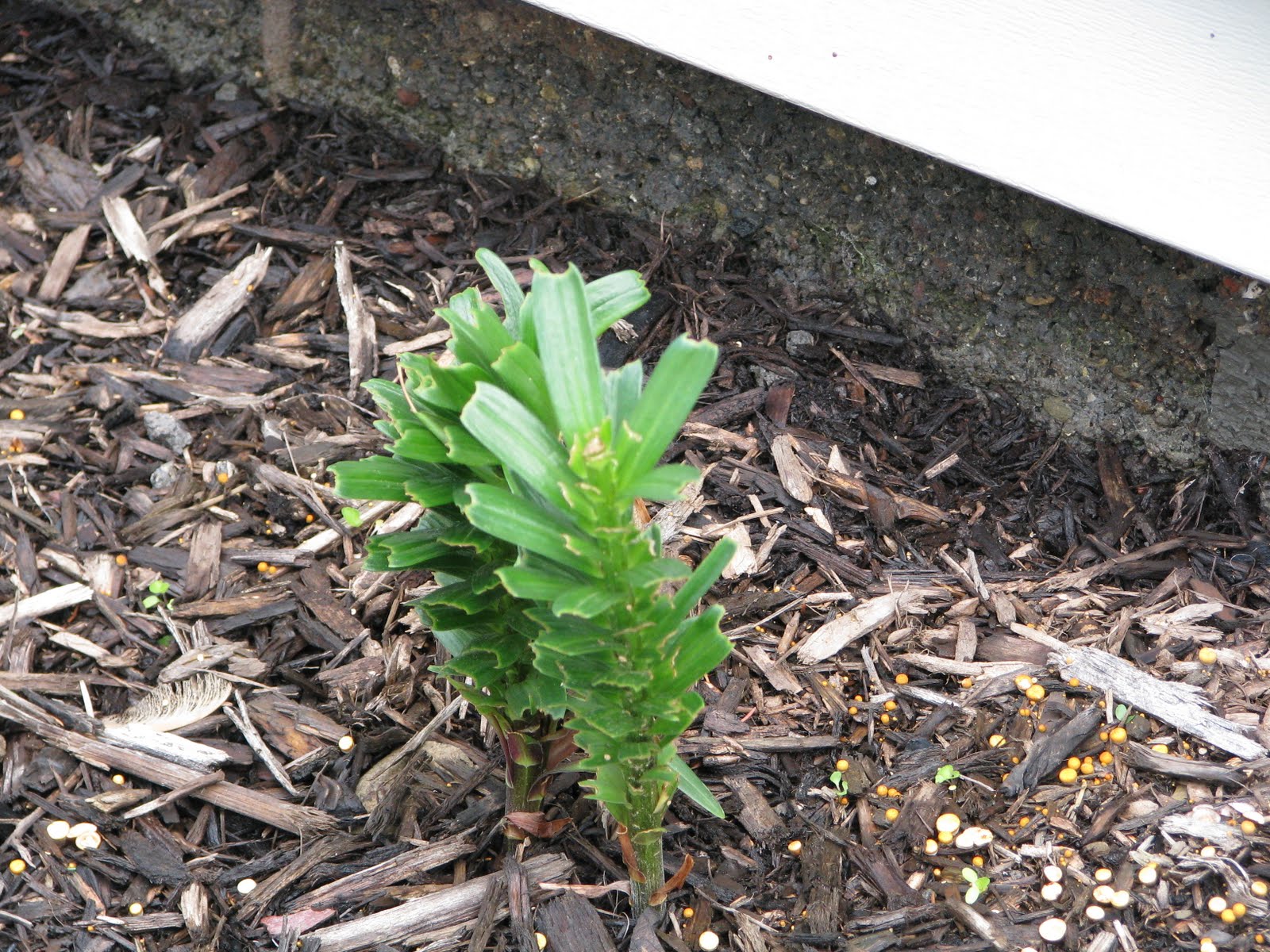
A half eaten lily
Y'know what? I'm not gonna give the little bastards the satisfaction. Bitching about them gives them power. I'm gonna show you what progress I have made despite their evil ways. I'm at about the midway point.

April 2010

June 2010

June 2011 minus the mulch
Putting this photo up here before it's finished is kinda like querying an agent before the book's done.


April 2010 June 2011
Okay, so maybe it wasn't that kind of post since I uploaded only photos. But you do see progress, right? I'll be back in three weeks with the final results. In the meantime . . . http://tinyurl.com/4xp9e55
Subscribe to:
Posts (Atom)